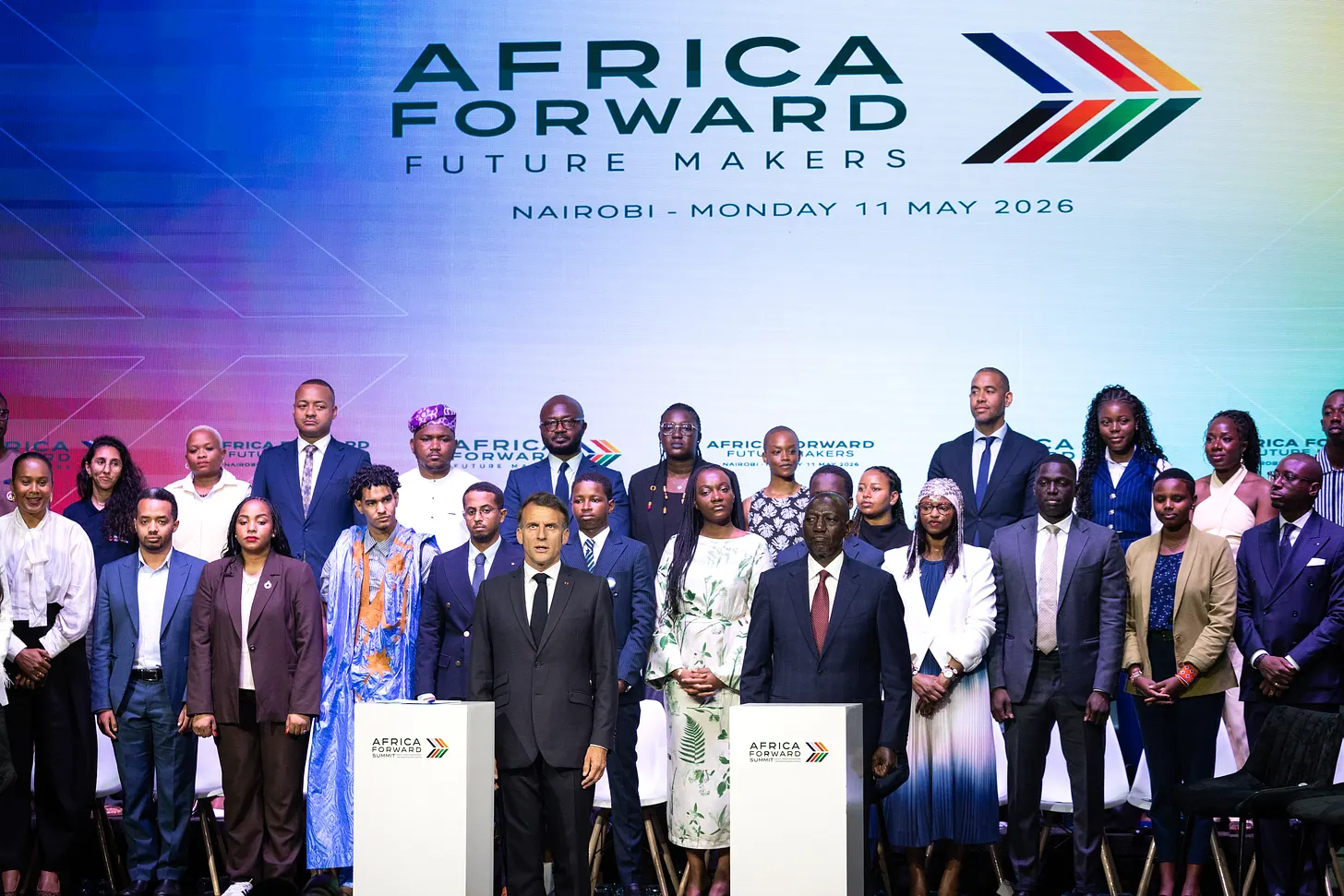
The Africa Forward Summit has ambitions to rewrite the terms of one of the world’s most freighted partnerships, but history will be watching
When Kenyan President William Ruto and French President Emmanuel Macron opened the Africa Forward Summit at the Kenyatta International Convention Centre in Nairobi, they did something that no French head of state has done before: hosting the flagship Africa-France summit on Anglophone soil. Since the format was inaugurated in 1973, every such gathering has taken place either in France or in a Francophone African country.
The decision to hold this edition in Kenya — which has no post-colonial entanglement with Paris, only a history of commercial dealings with French companies like Airbus and Peugeot, is itself a statement about the relationship that France is trying to build, and the one that it is trying to leave behind.
That context matters enormously. The Africa Forward Summit arrives at a moment when the architecture of global partnerships is shifting faster than at any point since the end of the Cold War. US$3.4 trillion, that is the approximate combined GDP of the African continent today.
It is projected to grow at over 4 percent annually in both 2026 and 2027, according to the International Monetary Fund’s April 2026 World Economic Outlook, making Africa one of the few bright spots in a global economy clouded by Middle East instability and post-pandemic fiscal hangovers.
The continent is home to 17 percent of the world’s population, a figure set to rise to nearly 2.5 billion by mid-century, with 830 million of those people aged between 15 and 35. In an era of demographic contraction across Europe, East Asia, and much of the developed world, that is not a liability, it is a strategic asset of extraordinary magnitude.
The summit’s theme: ‘Africa–France Partnerships for Innovation and Growth’, is built around five thematic pillars: energy transition and green industrialisation; reform of the international financial architecture; the blue economy; sustainable agriculture; and artificial intelligence and digital technologies. Over two days, more than 30 heads of state and government gathered alongside over 4,000 delegates and upwards of 2,000 private sector leaders and companies.
The first day, at the University of Nairobi, was structured around a business forum designed to curate investable partnerships between African and French enterprises. The second will convene heads of state at KICC to address the structural and political reforms necessary to underpin those partnerships. Certain conclusions from Nairobi are expected to feed directly into France’s G7 presidency agenda when leaders gather in Evian in June.
The business case for the summit is straightforward. Africa is currently home to 60 percent of the world’s uncultivated arable land, holds vast reserves of the critical minerals required for the global energy transition, and is sitting at the threshold of the fourth industrial revolution with a digitally native youth population that other continents can only envy. Yet it imports approximately US$100 billion per year in agricultural products that it has the capacity to produce and process itself.
It imports 70 percent of its medicines and 99 percent of its vaccines, a dependency that the COVID-19 pandemic exposed with devastating clarity. Africa accounts for just 1 percent of global data centre capacity, and roughly half of that sits in a single country, South Africa. Meanwhile, more than 600 million Africans still lack access to electricity, the basic precondition for participation in any industrial economy, let alone a digital one.
These are not merely development statistics. They represent an investment thesis. The summit’s agriculture roundtable, for instance, will interrogate specific value chains — cereals, oilseeds, dairy, horticulture, coffee, cocoa, and speciality crops — where the gap between raw export and processed value addition represents hundreds of billions of dollars in forgone revenue. Ghana, Kenya, Ethiopia, Senegal, and Morocco have been identified as lead countries in horticulture and high-value crop discussions.
The French Development Agency has confirmed financing commitments to support technology transfer in pharmaceutical manufacturing, and the World Bank Group is expected to announce a major programme targeting the production of 60 percent of Africa’s health commodity needs on the continent by 2040.
In HIV treatment alone, Unitaid is set to announce a landmark technology transfer agreement with an American pharmaceutical company to initiate production of a long-acting injectable HIV prevention medicine in Kenya, South Africa, and Nigeria — a deal that would, if executed, mark one of the most concrete steps toward pharmaceutical sovereignty Africa has seen.
On the financial architecture track, the summit’s ambitions are equally significant and arguably more structural. African countries continue to pay a punishing premium to access international capital markets. Credit rating agencies apply risk methodologies calibrated for advanced economies to a continent of 1.5 billion people, effectively treating Ghana and Germany as comparable sovereign risks.
A number of African nations remain in or near debt distress, their fiscal space compressed by the very capital conditions that were supposed to enable their development. The Common Framework for sovereign debt restructuring, established by the G20 in 2020, has moved too slowly and too narrowly to provide meaningful relief.
The conversation in Nairobi — to be held in the presence of the UN Secretary-General, the African Union Chair, and the leadership of major multilateral development banks — is expected to produce African heads of state recommendations that will carry weight in Evian.
Then there is the question of artificial intelligence. Africa accounts for 1 percent of global data centres. It has less connectivity than any other region. And it is about to be reshaped by a technology whose infrastructure, training data, and governance frameworks are being set almost entirely elsewhere. The summit’s digital track is built around a concept of sovereign AI — the idea that Africa cannot simply consume AI systems designed for and governed by others, but must design, train, host, and regulate them on its own terms.
Three pillars are identified: infrastructure investment, talent development, and governance frameworks aligned with global values but anchored in African institutions. A multilateral commitment on child online safety is also expected from the summit, involving co-signatories beyond the Africa-France bilateral frame.
None of this, however, has silenced critics. France’s retreat from the Sahel, forced out of Mali, Burkina Faso, and Niger by military governments hostile to Paris, has raised legitimate questions about whether a summit rebranded for Anglophone Africa represents substantive reform or strategic repositioning.
For decades, France’s Africa policy was built around military presence, the CFA franc monetary architecture, and political relationships that, in the view of many Africans, served French interests more reliably than African ones.
Progressive movements in Kenya and across the continent have organised a counter-summit under the banner of the Pan-Africanism Summit Against Imperialism, arguing that the ‘Africa Forward’ branding obscures what they see as the continuation of an unequal relationship under a new name.
These concerns deserve serious engagement, not dismissal. The history of Africa-Europe summitry is littered with ambitious communiqués that produced little durable change. Commitments have been made, financing pledged, and partnerships announced, only for follow-through to dissolve in the gap between summit declarations and implementation.
European engagement with Africa has too often been reactive — calibrated more by anxiety about Chinese, Russian, or Turkish influence than by genuine partnership instincts. African governments and civil society are well aware of this pattern, and they are watching Nairobi accordingly.
The Kenyan government’s position, however, is that the frame of engagement has genuinely shifted. Africa, it argues, is no longer negotiating from weakness. It is negotiating as a continent that knows its own demographic weight, its resource endowment, and the terms on which it is prepared to engage.
The summit’s insistence on value addition rather than raw commodity export, on technology transfer rather than import dependency, on financial architecture reform rather than concessional aid — these are not rhetorical flourishes. They are, if backed by binding commitments, the architecture of a different kind of relationship.
The true measure of Africa Forward 2026 will not be what is said in Nairobi. It will be what is still standing in two years: how many of the announced deals have been operationalised, how many of the financial architecture proposals have found their way into G7 conclusions, and whether Africa’s voice at the table of global decision-making has meaningfully grown.
The continent’s negotiating position is stronger than it has been in a generation. Whether this summit converts that strength into durable outcomes is the question that will determine its place in history.
The Africa Forward Summit took place at KICC and the University of Nairobi on 11–12 May 2026.
Post Views: 23
Discover more from The Business & Financial Times
Subscribe to get the latest posts sent to your email.