
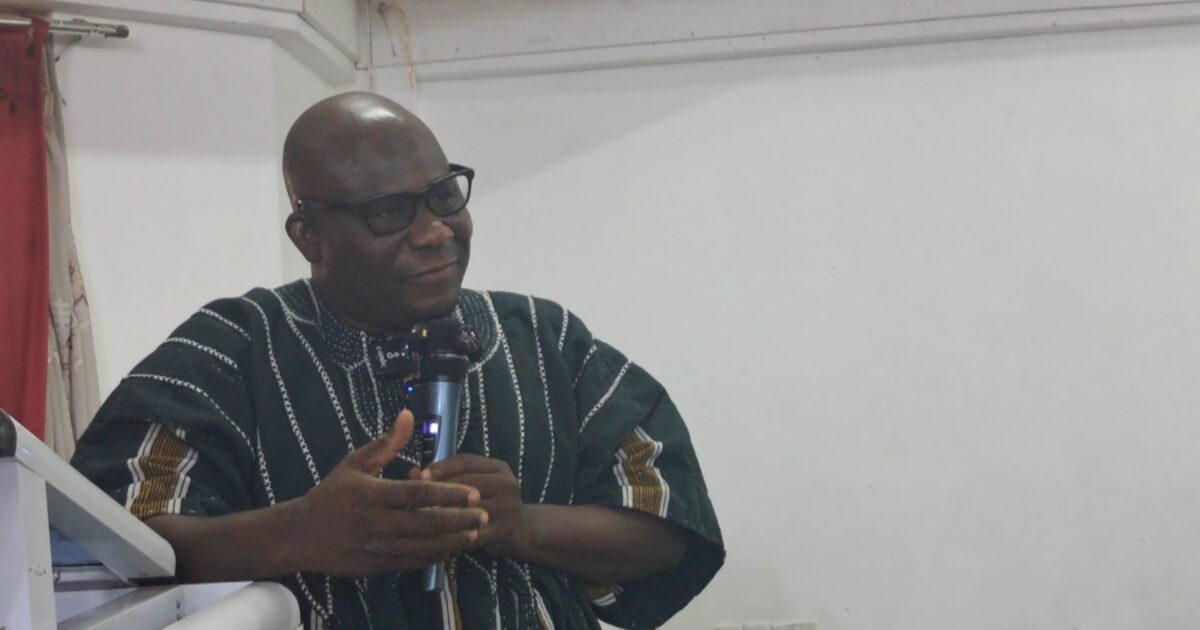

An aspirant for the National Democratic Congress (NDC) Upper West Regional Chairmanship, Alhassan Adams Randy, has unveiled a 10-pillar transformation agenda aimed at rebuilding the party in the region.
The agenda, dubbed “A Renewed Vision,” was presented to journalists in Wa by his Campaign Coordinator, Carlos Ibrahim Chireh, with Mr Randy providing further details on its implementation.
The 10 pillars are consultative leadership, women and youth empowerment, fair rewards and recognition, development advocacy, grassroots strengthening, a caring and self-reliant party, electoral readiness, party infrastructure, communication and information management, and peace-building and conflict management.
Speaking about his competence for the position, Mr Randy said his background and professional credentials placed him ahead of his competitors.
“Competence, competence. I have a lot of competence and an intimidating background. Whoever looks at my background and credentials on paper will see that, among those contesting, none is more qualified than me,” he said.
“I have a lot of confidence and competence in me, and we know exactly what we want as a region,” he added.
Mr Randy, a businessman and consultant in procurement and project management, said he had never undertaken a contract in the Upper West Region because of the high number of contractors competing for limited projects.
“I have never done any contract in the Upper West Region because the contractors are more than the projects. That is my reason,” he said.
He promised to ensure fairness and equitable distribution of party resources if elected, arguing that the benefits of the party’s activities should reach all constituencies rather than a select few.
“We are bringing forward fairness. We are bringing equitable distribution of party resources. When we win, the benefits of the party should reach all the people in the region, not just a few people,” he said.
He added that resources would be shared fairly among all constituencies.
Mr Randy also said his proposed policies would benefit residents irrespective of their political affiliations.
“Most of our policies will cover everyone, whether you are NPP or NDC. We want to make it very interesting. We want to make it lovely,” he said.
On development advocacy, he said the region needed a strategic agenda to guide its demands for government appointments and development projects.
He said the party must identify its priorities and make deliberate efforts to pursue them, particularly when the NDC is in government.
Mr Randy proposed the formation of a task force to engage government on the region’s development needs, instead of relying on individuals to lobby the President.
He also identified the need to empower constituency executives, describing them as the first point of contact for people interested in joining the party.
He said constituency executives should be better equipped and supported to make their positions attractive to prospective members.
On women and youth empowerment, Mr Randy said profiling had begun at the constituency level to identify the specific needs of women and children and develop appropriate interventions.
He expressed confidence in his chances of winning the regional chairmanship election, citing what he described as encouraging results from the constituency-level elections.
Mr Randy said his decision to present his agenda to journalists was intended to promote accountability and allow the media to assess his commitments if elected.
He said the presentation would provide journalists with a basis to question him on the promises made during his campaign.
Grassroots, welfare and electoral readiness
Mr Chireh said the NDC in the region must move beyond operating primarily as an election-winning machine and invest in training its executives.
He said the campaign intended to strengthen the grassroots by providing structured training for party executives after their election.
He also announced plans to establish a welfare scheme to support vulnerable party members, including former appointees and individuals who had served the party but no longer held positions.
Mr Chireh identified water supply challenges, particularly broken-down boreholes, as one of the issues affecting the party’s electoral fortunes in the region.
He said the campaign proposed training party members in every constituency to form borehole repair brigades to address such challenges.
The brigades would also be trained to repair streetlights, he added.
On electoral readiness, Mr Chireh said the party had lost some polling stations in previous elections because of inadequate or inappropriate deployment of polling agents.
He said the campaign would prioritise the consistent recruitment and training of polling agents and ensure that every polling station was made accountable for the votes recorded.
DISCLAIMER: The Views, Comments, Opinions, Contributions and Statements made by Readers and Contributors on this platform do not necessarily represent the views or policy of Multimedia Group Limited.
DISCLAIMER: The Views, Comments, Opinions, Contributions and Statements made by Readers and Contributors on this platform do not necessarily represent the views or policy of Multimedia Group Limited.
Source link