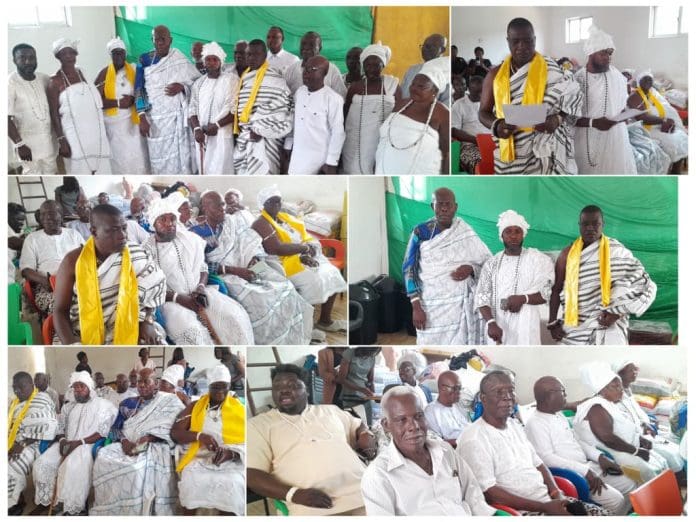

The Osu Traditional Council on Monday inducted two new members in a ceremony aimed at strengthening customary governance and easing pressure on Ghana’s courts, particularly in chieftaincy and land disputes.
The induction, held Dec. 22, 2025, in Accra, saw Nii Nortey Otututse II, Osu Ashinte Dzaasetse, and Nuumo Noi Osikan III, Osu Klottey Wolomo, sworn into office after taking the Oaths of Membership, Judicial and Secrecy. Her Ladyship Justice Bertha Aniagye administered the oaths and formally inducted the two chiefs as members of the council.
In brief remarks, Justice Aniagye urged traditional authorities to deepen collaboration with security agencies, especially the Ghana Police Service, to clearly distinguish cases that fall within the jurisdiction of traditional councils from those best handled by the police. Such cooperation, she said, would help reduce unnecessary referrals and delays while promoting orderly dispute resolution.
The ceremony drew traditional leaders, priests and priestesses, including Nii Kwabena Bone V, Osu Alata Mantse and acting president of the Osu Traditional Council, and Naa Badu Adiagba I, Abelenkpe Manye.
Speaking in an interview after the event, Nii Kwabena Bone V said the inductions were necessary following the loss of several council members in recent years. “As a traditional council, we need to refill our membership,” he said. “By the grace of God, we have added two new people today, and in due course we will add more.”
He emphasized that adequate membership is critical for the council’s judicial work, noting that cases must be heard by odd-numbered panels of at least three members. “With additional members, we can sit on pending cases and clear them,” he said, adding that effective traditional adjudication would help decongest the courts.
Nii Kwabena Bone V echoed Justice Aniagye’s call for public education on the mandate of traditional councils. Many chieftaincy disputes, he said, spend years in higher courts only to be referred back to traditional authorities. “People waste time and money,” he said. “We must educate the public on what the traditional council can do.”
He also sought to clarify Osu’s traditional jurisdiction, which he said extends far beyond the commonly known area near the Accra Sports Stadium. According to him, Osu lands historically stretch to areas including Adenklebi, Kpomkpon, Boi, Hebron and Papao, now known as West Legon. Several communities, he said, are overseen by caretakers and await the installation of chiefs in consultation with the Osu Stool.
“If about 17 villages report to Osu, we will solve a lot of issues,” he said, describing the council as strategically located in a prime part of Greater Accra and in need of public support to resolve disputes amicably.
Addressing concerns that traditional authority is waning, Nii Kwabena Bone V attributed the decline to competing claims to chieftaincy and persistent land litigation. He criticized double sales of land and called on chiefs to act responsibly for the sake of future generations. He also appealed for stronger civic education on land ownership and the Chieftaincy Act of 2008 to curb conflicts and guide prospective land buyers.
Offering advice to the newly inducted members, he urged them to study the Chieftaincy Act thoroughly. “It should be like the Bible or the Quran,” he said. “If you know your limits and your powers, no one can push you around.” He encouraged a “win-win” approach to adjudication that fosters reconciliation and public confidence.
“We will ensure they learn,” he added. “When the traditional council is strong, the whole system benefits.”
By Kingsley Asiedu