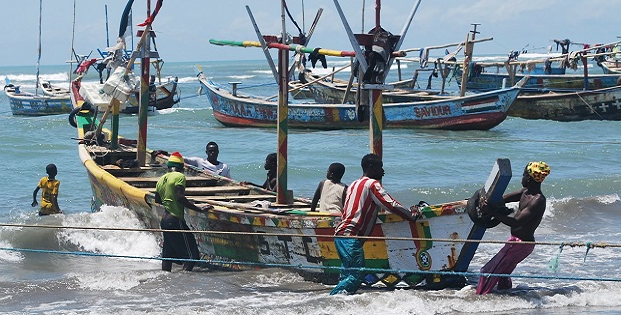

By Wisdom JONNY-NUEKPE
An environmental impact assessment of government-imposed fishing closed season regime, has received an overwhelming approval from fishers and fisheries sector stakeholders in key fishing communities across the country.
The three-year assessment, conducted by the UK-Headquartered global CSO, Environmental Justice Foundation (EJF) since 2023, in eight coastal towns including; Axim, Sekondi, Shama, Elmina, Apam, Bortianor, Tema and Keta, revealed that more than 80 percent of fishers from these enclaves understood the scientific benefits behind the closed season regime.
Per the assessment, EJF interviewed 120 fishers across the eight coastal communities about biological monitoring during the closed season period. The participants reported that once they became involved in the biological monitoring of the closed season, they felt huge pride in contributing to the country’s fish population recovery.
As a result of the inclusion project, almost half of the 120 fishers trained as citizen scientists by EJF reported greater trust in regulators. An additional 92 percent showed strong scientific understanding, and 85 percent expressed a wish to participate in future training.
EJF’s Science and Research Manager in Ghana, Dr. Edna Quansah explained that participant fishers, played varied roles in the assessment and monitoring exercise, each engaging in at least one of the following: assisting in the sourcing of fish for analysis, measuring and gutting of fish, data entry, and educating fishers about the closed season.
The majority of the fishers were involved in measuring and gutting fish, which helped them to observe firsthand the biological indicators.
“Our research and assessment show clearly that the closed season is scientifically necessary and strongly supported by fishing communities themselves. The opportunity now is to deepen that support by ensuring communities are fully involved in shaping, implementing and monitoring these policies, and that enforcement is fair and consistent.” Dr. Quansah noted.
During EJF’s engagements with fishing communities, fishers repeated a number of recommendations for improving the implementation of the closed season to make it more effective, inclusive, and sustainable. Among the recommendations, the fishers asked government to ensure closed season announcements are made early and clearly, intensification and expansion of educational initiatives, reaching more from the impacted communities through local media and community meetings.
The fishers also appealed to government to consider providing soft loans (provided on lenient terms, often with a zero percent interest rate) to alleviate financial hardship for fishers during closed season. Also, the fishers noted that it is imperative for government to strengthen enforcement against illegal fishing, to ensure that the ecological benefits of closed season are truly felt.
Existing threats in the fisheries sector
Ghana’s marine fisheries resources are a source of livelihoods for around 10 percent of the country’s population. They provide 80 percent of the country’s gross fish production and are a direct source of food and income for over 200 coastal communities.
However, around the world many marine fisheries have collapsed or are on the verge of collapse as a result of overfishing – and Ghana is no exception. The mainstay of Ghana’s fishing communities is the small pelagic fishery including chub mackerel and sardinella, known as the ‘people’s fish’.
By 2020, almost 100 percent of sardinella landed by the industrial trawl fleet was below the legally accepted minimum size. This fishery is vital for local food security and livelihoods in Ghana, but it is on the brink of collapse.
Ghana’s closed season regime
Closed seasons were first introduced in Ghana for the industrial marine fishery (trawl) sector in 2016. In 2019, the measure was extended to all fishing fleets, including the artisanal sector. In 2025 and 2026, the Ministry of Fisheries and Aquaculture announced a closed season exemption for marine canoe artisanal fishers, asking that they comply with other traditional and statutory management measures, such as observing designated fishing holidays.
Post Views: 17
Discover more from The Business & Financial Times
Subscribe to get the latest posts sent to your email.