

…as Green City project offers hope to workers
By Elizabeth PUNSU, Kumasi
President John Dramani Mahama has announced a GH₵3billion revolving housing fund to make home ownership more accessible to public sector workers.
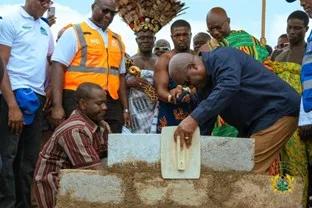
He made this known at the sod-cutting ceremony for the Green City Housing project at Dedesua in the Ashanti Region.
Speaking at the ceremony, President Mahama described the initiative as a major step in the country’s “long and evolving housing journey” and part of government’s broader effort to tackle the housing deficit, estimated at more than 1.5 million units.
The President acknowledged that rising land values, high construction costs and limited access to long-term financing had placed home ownership beyond the reach of many Ghanaians, contributing to the growth of informal settlements and poor living conditions in urban areas.
He warned that rapid urbanisation could worsen the situation, pointing out that more than half of the population already lives in urban centres and that by 2050 nearly 70 percent could be concentrated in cities such as Accra, Kumasi and Sekondi-Takoradi.
“If we do not act urgently and at scale, tomorrow’s housing challenges will far exceed what we are experiencing today,” he cautioned.
President Mahama explained that government was pursuing a comprehensive housing strategy focused on increasing supply, improving affordability, strengthening tenant protection and reforming housing finance systems to reflect Ghanaian income levels.
He disclosed that the revolving fund would be established in partnership with organised labour, the private sector, the Social Security and National Insurance Trust (SSNIT) and Republic Bank.

Under the arrangement, housing agencies such as the State Housing Company (SHC) and the Tema Development Corporation (TDC) would access credit facilities from the fund to build houses, while banks would provide long-term mortgages for workers to repay over 15 to 20 years.
The President stressed that the houses would be priced in cedis rather than dollars to shield homeowners from currency depreciation and rising mortgage costs.
“Let me announce that these houses are going to be indexed in cedis, not dollars,” he emphasised.
He added that government was also rolling out low-cost housing schemes for nurses, teachers, doctors and other civil servants in collaboration with organised labour and financial institutions.
On the Green City Housing project, President Mahama described it as a timely intervention that would provide not only housing but also jobs and economic opportunities within the Bosomtwe District.
The project, located on more than 200 acres of land provided by Otumfuo Osei Tutu II, is expected to deliver over 1,000 housing units in a gated and environmentally sustainable community.
“This is not just about shelter; it is about building a complete, liveable community that is safe, affordable and dignified,” he said.
Managing Director of the State Housing Company, John S. Bawah, described the Green City project as a practical and fully financed response to the prevailing housing crisis.
He said the development was designed to reflect the lush vegetation and environmental character of Kumasi, popularly known as the “Garden City.”
According to him, the project will comprise a mix of two, three and four-bedroom detached houses, two-bedroom semi-detached homes and one, two and three-bedroom apartments.
The estate will also include recreational facilities, commercial spaces and open areas for public events.
Mr. Bawah disclosed that a total of 1,067 residential units would be delivered over a five-year period, with phase one expected to produce 214 units by the fourth quarter of 2027.
He noted that the project already had a financing framework, construction timeline and partnership structure in place. He, however, appealed for government support under the “Big Push” infrastructure initiative to reduce costs and keep homes affordable.
Specifically, he requested support for roads, drainage and sewage systems within the estate, which he said could help reduce property prices by between 25 and 40 percent below prevailing market rates.
This request was immediately accepted by President Mahama.
The Minister for Works, Housing and Water Resources, Kenneth Gilbert Adjei, for his part, underscored the importance of sustainable housing in addressing climate change.
He described the Green City project as a model for environmentally responsible urban development. He said it reflected government’s commitment to integrating green building principles into national housing delivery.
“We, therefore, invite investors and development partners to join us. Through innovative financing models such as public-private partnerships and rent-to-own schemes, we can accelerate delivery and expand access,” he added.
Post Views: 1
Discover more from The Business & Financial Times
Subscribe to get the latest posts sent to your email.