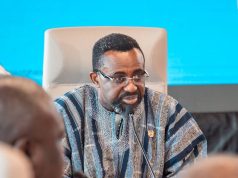


The Special Prosecutor, Kissi Agyebeng, has called for a decisive shift in Ghana’s educational framework, urging policymakers to re-anchor learning in the country’s heritage as a pathway to innovation, effective leadership, and sustainable development.
Delivering the keynote address as guest speaker at the 95th Anniversary and Speech and Prize-Giving Day of his alma mater, Accra Academy, Mr Agyebeng argued that education remains the most reliable instrument for shaping a resilient and self-aware society.
Speaking on the theme “Education as the Catalyst for Preserving Heritage, Driving Innovation, and Empowering Future Leadership,” he cautioned that Ghana’s continued reliance on inherited colonial models risks deepening the disconnect between knowledge acquisition and national identity.
Tracing the historical roots of formal education in Ghana, he noted that the system was originally structured to serve colonial administrative needs rather than indigenous development, a situation he said was further worsened by the advent of Christianity and Islam. The enduring effect, he observed, has been the marginalisation of local languages, the distortion of indigenous names, and a gradual erosion of cultural confidence.
“Our languages became unspeakable taboos; our culture and traditions were labelled barbarous,” he said.
He added that this historical distortion continues to manifest in everyday life, including the persistence of altered indigenous names and identities, such as Ashanti Region instead of Asante; Kumasi instead of Kumase; Kibi instead of Kyebi; and Cape Coast instead of the original Oguaa, among others. This, he warned, has left the country in what he described as an “in-between” state—neither firmly grounded in its own identity nor fully assimilated into the external models it seeks to emulate.
According to him, this identity crisis has direct implications for innovation and leadership, as a society disconnected from its roots struggles to think independently and act purposefully. He therefore proposed a deliberate reconfiguration of education to prioritise three interdependent pillars: the preservation of heritage, the promotion of innovation, and the cultivation of leadership.
“Therefore, in my estimation, our educational system must securely preserve our heritage for any meaningful desirable impact on our condition… My thesis is that the preservation of heritage drives innovation, which in turn empowers future leadership,” he said.
Beyond academic attainment, Mr Agyebeng stressed the need for an education system that shapes the “heart, head, and hand,” nurturing values, sharpening intellect, and equipping individuals with practical skills for productivity. He cautioned against an excessive focus on examinations and certifications, noting that true education must prepare individuals to navigate complex realities and contribute meaningfully to society.
While acknowledging the value of global knowledge exchange, he emphasised that Ghana must engage with external ideas from a position of identity and confidence. The objective, he said, should not be imitation, but thoughtful adaptation that strengthens national character while embracing innovation.
“At all costs, we should enhance our circumstances with enlightened innovation and knowledge wherever it may emanate. However, we should not lose ourselves and our very identities in the process,” he said.
Mr Agyebeng’s address ultimately served as a call for national introspection, urging leaders, educators, and stakeholders to confront the limitations of the current system and pursue reforms that align education with Ghana’s historical context and future aspirations. In his view, the task ahead is not merely to educate, but to cultivate a generation capable of defining its own path, innovating with purpose, and leading with clarity.