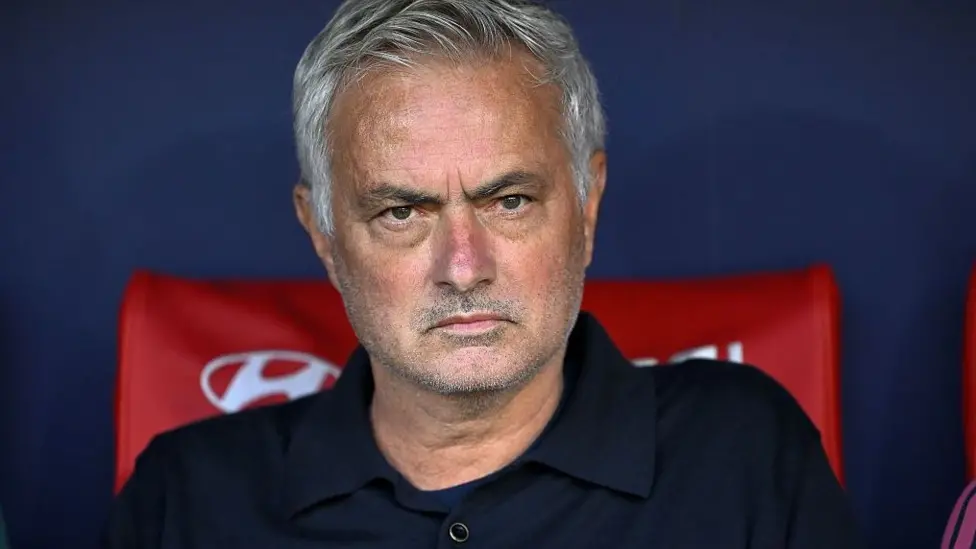
Jose Mourinho won three trophies during his first spell at Real Madrid – La Liga, the Copa del Rey and the Spanish Super Cup
When Jose Mourinho walked back through the doors at Real Madrid this summer, 13 years had passed since he last left the club.
He returned with a familiar reputation and enormous expectations, but facing a very different challenge.
Mourinho was handed a three-year contract, with the club hoping he could restore stability and success after two trophyless seasons.
Now, seven league matches into his second spell, some of the familiar tensions of last season have already resurfaced.
Defeat by rivals Atletico Madrid has left supporters questioning Real Madrid’s consistency and Mourinho’s approach.
The Portuguese coach now has plenty of time to consider his options during an unusually long three-week international break. Madrid do not play again until they host Villarreal on Saturday, 10 October – and travel to Barcelona two weeks later.
Mourinho has concerns about the break, but it is an early opportunity to take stock and prepare for a run of fixtures that could tell us much more about the direction of his second spell at the Bernabeu.
How have Real Madrid started?
For Mourinho, the derby defeat at Atletico Madrid was a sobering reminder of the scale of the challenge he has taken on.
Despite blaming much of the loss on two first-half decisions he felt went against his side – Cristian Romero escaping a red card for his studs-up challenge on Jude Bellingham and Lee Kang-in going unpunished for a similar challenge on Federico Valverde – the reality is that their performance was simply not good enough.
It means Real Madrid sit fourth in La Liga, with defending champions Barcelona already six points ahead. They have won all seven of their league games, scoring 31 goals, with Raphinha already scoring 12 times.
Atletico sit second and Real Betis third, both five points behind Hansi Flick’s side.
The only time Real Madrid have overturned a six-point deficit to Barcelona at the top of La Liga was in Fabio Capello’s 2006-07 title triumph.
What do Real Madrid need to improve?
A clear issue from the defeat at Atletico was Madrid’s lack of control in midfield.
Mourinho started Aurelien Tchouameni alongside Valverde, with Bellingham playing further forward. The pairing gave Madrid energy and defensive security, but they struggled to control the tempo or create enough from deeper areas. Bernardo Silva was introduced for the final eight minutes, but by then Madrid were already chasing the game.
That presents Mourinho with an interesting selection decision. Against opponents who defend in a compact shape, Madrid may need more creativity and control from midfield.
Silva’s ability to dictate the rhythm of a game makes him an obvious option, while Arda Guler offers another creative presence further forward.
Mourinho doesn’t necessarily need to abandon the double pivot, but he does need to find a way for Real to have more control of matches.
Get more from Mbappe and Vinicius Jr
There is no shortage of individual attacking quality at Real Madrid. The problem is making it work consistently as a unit.
Against Atletico, Madrid struggled to create clear chances. Kylian Mbappe was largely ineffective and hardly touched the ball, while Vinicius Jr was substituted shortly after Dean Huijsen’s red card early in the second half.
Mourinho has three players, in Vinicius, Mbappe and Bellingham, capable of deciding matches on their own.
Bellingham’s ability to carry the ball forward, arrive late in the box and link midfield with attack is another important part of Madrid’s attacking threat, but Mourinho needs to ensure the trio complement rather than crowd each other.
Vinicius needs to rediscover the explosiveness and directness that makes him so difficult to defend, while Mbappe needs a greater supply of chances rather than being asked to create opportunities for himself.
There is another attacking option Mourinho could turn to more often.
Carlos Espi has already made an impression since joining the club, scoring the 90th-minute winner against Espanyol on his league debut before doing it again in stoppage time against Elche.
The 21-year-old has therefore shown he can make an impact when given game time.
With Madrid still working out how best to balance Vinicius, Mbappe and Bellingham, Espi offers Mourinho another option – particularly when Madrid need a focal point in the final stages of matches.
His early impact suggests he deserves more opportunities to show what he can do.
Defend transitions better
The other major concern is what happens when Madrid lose the ball.
Atletico repeatedly found space around Madrid’s midfield and were able to attack quickly, while Huijsen’s red card made the situation even more difficult. If Mourinho wants his side to press aggressively and commit numbers forward, Tchouameni and Valverde must provide enough protection when possession is lost.
Against Atletico, Denzel Dumfries, Ibrahima Konate, Huijsen and Marc Cucurella lined up in front of Thibaut Courtois. There is quality in that back four, but Mourinho will want greater cohesion – particularly when Madrid’s full-backs push forward.
Courtois’ performance showed how important he remains, with the goalkeeper making several important saves to keep Madrid in the game. The aim for Mourinho will be to reduce those situations and make Madrid harder to expose when attacks break down.
The veteran Portuguese needs to come up with some new answers to his team’s problems quickly, or there may not be much of a title race.
DISCLAIMER: The Views, Comments, Opinions, Contributions and Statements made by Readers and Contributors on this platform do not necessarily represent the views or policy of Multimedia Group Limited.
DISCLAIMER: The Views, Comments, Opinions, Contributions and Statements made by Readers and Contributors on this platform do not necessarily represent the views or policy of Multimedia Group Limited.
Source link