
By Samuel Ayammah
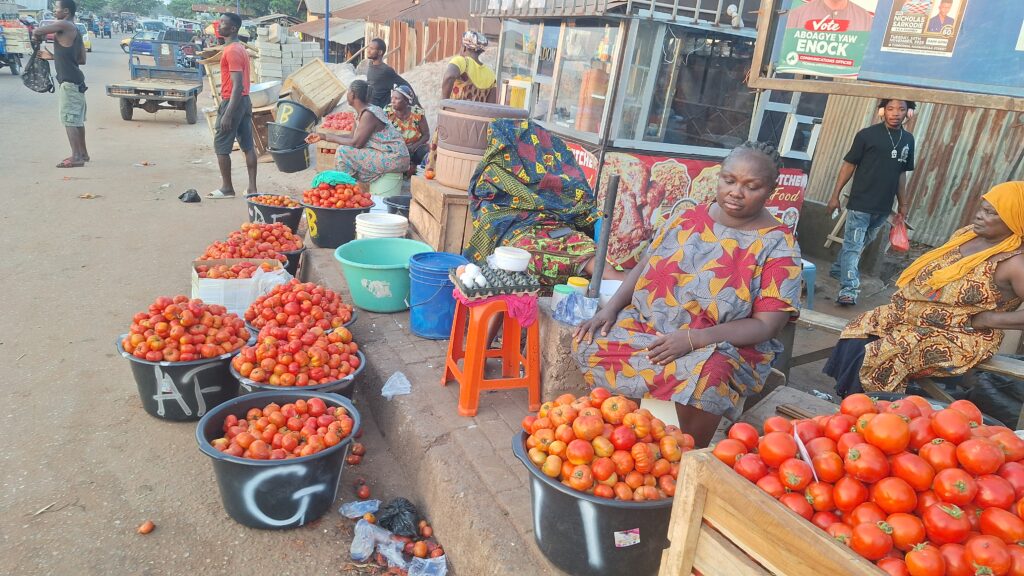
It is that time again in Tuobodom, a farming community in the Techiman North District of the Bono East Region, when the reward for months of hard work turns into worry.
After defying erratic rainfall, the high cost of inputs, pests and diseases, and the rising cost of labour to cultivate tomatoes, farmers are now struggling for a ready market for their produce.
The fields are heavy with fruit, a sight that should bring joy and prosperity to every household, yet for many families in Tuobodom, harvest has become a season of anxiety and frustration.
Trucks that used to arrive regularly from far and near to buy in bulk no longer come as they used to, and where buyers come, traders dictate prices even after agreeing on a price per box before harvesting, leaving farmers with little bargaining power and forced to accept whatever is offered or risk losing the entire harvest.
A box of the improved variety now sells for between GH¢1,500 and GH¢1,700, while a box of the local variety sells for between GH¢300 and GH¢500.

The gap explains why farmers are desperate to move away from the local variety, even though most are still trapped in producing it.
The local tomato, popularly called power, is what many plant because they can afford it. It is watery, has a heavy sour taste and does not stay fresh for long after harvest.
The improved variety, popularly called peto, lasts longer, is not watery and is not sour, it travels better over long distances and stays firm in the market, so traders and consumers prefer it. The local variety is difficult to transport and store, which makes traders reluctant to buy it in large quantities.
But one tin of the improved seed costs GH¢1,300, which is beyond the reach of most farmers already struggling to buy fertilizer and chemicals and to pay for labour, forcing them to plant the local variety even though it gives them less income.

For George Ayiti, the biggest pain is not the farming itself, but what happens at harvest time.
He says traders agree on a price per box before harvesting, only to change it when they arrive on the farm.
“We agree on a price before we harvest, but when the buyers come, they change the price,” he said.
“We have no choice because if we refuse, the tomatoes will rot on the farm. So we accept whatever they give us.”
He said farmers invest everything in the crop and deserve to be respected at the point of sale.
“We suffer to grow it, we suffer to harvest it, and at the end, we are the ones who lose. That is not fair.”

Emmanuel Ankomah says the weather has become too unpredictable for farmers to continue depending on rainfall.
He said erratic rainfall this season affected planting, growth and harvesting, and left many farmers counting losses.
“We cannot continue to look up to the sky for farming. The rain does not come when we need it, and when it comes, it is too much,” he said.
“If we had irrigation, we could farm all year round. We would not be rushing to sell at the same time and losing money.”
He said irrigation would give farmers steady income and reduce the pressure of the glut season.
“With water, we can plan. Without water, we are always gambling.”

Kofi Baffoe says he put everything he had into this season’s tomato farm, and now he is struggling to recover his investment.
He said the cost of fertilizer, chemicals and labour kept rising while the price buyers offer keeps falling.
“I invested everything I had in this farm. I borrowed some money too, hoping to pay back after harvest,” he said.
“Now the buyers are offering a price that cannot even cover my cost. How do I pay back?”
He said farmers are not asking for charity, only a fair and agreed price.
“We are not asking for too much. Just give us a fair price for our work, so we can survive and farm again next season.”

Philip Dorwin believes a tomato processing factory close to Tuobodom would change everything for the community.
He said a factory would provide a permanent market, stop the yearly glut and rotting of tomatoes, and create jobs for the youth.
“If there is a factory here, our tomatoes will not rot. The factory will buy them and process them,” he said.
“Every year, we watch our tomatoes go waste because there is no buyer. A factory will end that.”
He said the youth would also benefit, because the factory would create jobs and stop them from leaving the community in search of work.
“Our children will get jobs here. They will not have to travel far to look for work.”

Nana Agyei Kyeremeh says Tuobodom has the land, the farmers and the will to become a leading tomato producing centre, but farmers need the right support.
He said subsidised improved seeds and chemicals would allow farmers to produce quality tomatoes that fetch better prices and feed idle factories.
“Our farmers know how to farm. What they lack is support. Give them good seeds and chemicals at affordable prices, and they will produce quality tomatoes,” he said.
He said government must also help secure a ready market to protect farmers from exploitation.
“If farmers are sure of a market and a fair price, Tuobodom will feed Ghana. We can supply markets across the country.”
He added: “Tuobodom can thrive. We only need irrigation, good seeds, a factory and a fair market.”
Techiman North is a predominantly tomato farming area, and almost every household depends directly or indirectly on the crop.
Farmers say when the challenges are addressed, the impact will go far beyond the farm gate.
With irrigation for all-year-round farming, farmers will earn steady income instead of one uncertain seasonal harvest. That steady income will allow families to pay school fees, improve their housing, access healthcare and reinvest in their farms without borrowing at high cost.
With subsidised improved seeds and chemicals, farmers will produce the peto variety that traders prefer, earn between GH¢1,500 and GH¢1,700 per box instead of GH¢300 to GH¢500, and reduce post-harvest losses.
With a processing factory in or near Tuobodom, tomatoes that would have rotted will be bought and processed, creating permanent jobs for the youth, market women, transporters, crate makers and food vendors. Money that currently leaves the district will stay in the local economy.
With a guaranteed ready market and fair, agreed prices, farmers will have bargaining power, traders will plan better, and the district will attract more buyers and investors.

Together, the farmers say, these interventions will boost the local economy, reduce youth migration and unemployment, strengthen food security, and improve the lives of the people of Techiman North, turning Tuobodom into a leading tomato producing centre supplying markets across the country.
The farmers in Tuobodom are therefore appealing to government for irrigation facilities to allow all year round farming and steady income, subsidised improved seeds and chemicals to produce quality tomatoes that fetch better prices and feed idle factories, a tomato processing factory to provide a permanent market, add value and create jobs, and a ready market to protect them from exploitation and give them fair and agreed prices, so that Tuobodom can become a leading tomato producing centre supplying markets across the country and strengthening the local economy.