
By Samuel SAM
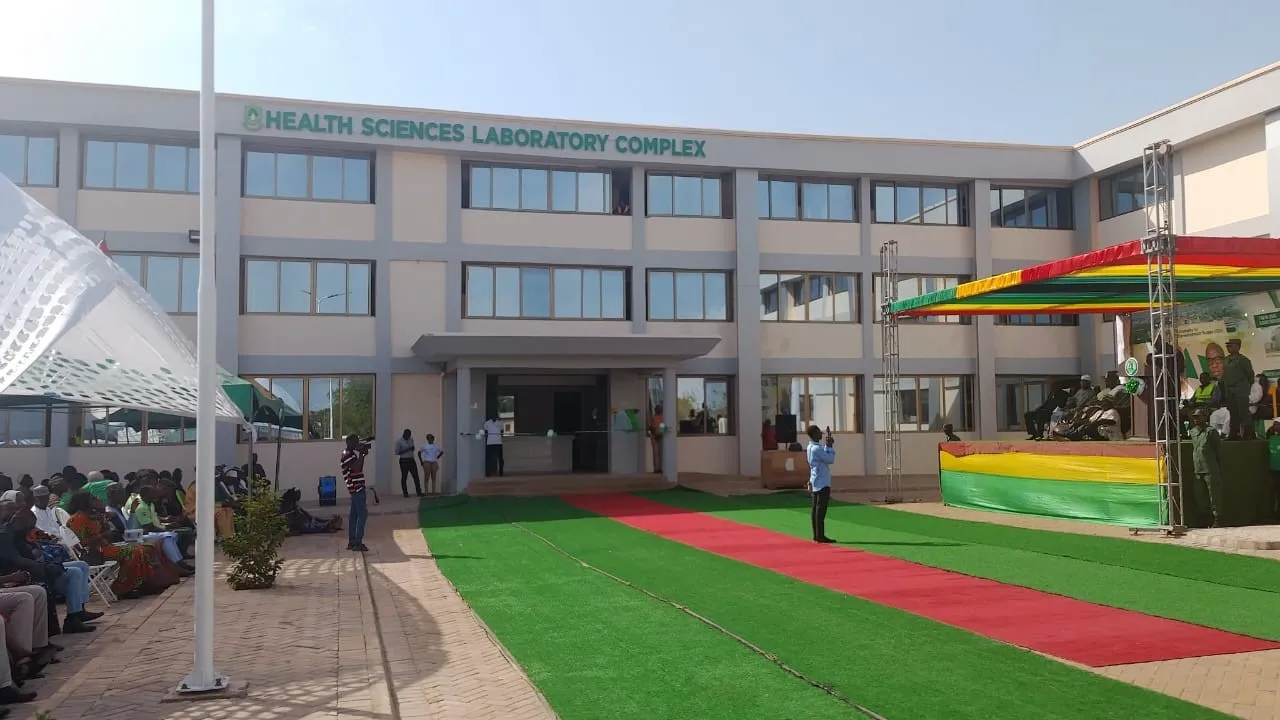
University for Development Studies (UDS) has inaugurated five major infrastructure projects at its Tamale Campus aimed at boosting teaching, learning, research, innovation and the quality of training in Health Sciences programmes.

The facilities include School of Nursing and Midwifery Complex, also known Modern Nursing and Midwifery Complex to accommodates about 3,300 students, which involves multiple lecture halls, skills and industry laboratories, offices and an 800-seater auditorium for large lectures, seminars and academic events; and state-of-the-art Health Sciences Laboratory Complex for specialised labs in histopathology, haematology, dentistry, anatomy and pharmacology, which has lecture halls and about 30 office spaces.
The Twin-Oval multipurpose auditorium complex has two halls, each with 300 seats to serve as lectures, conferences, examinations and other academic gatherings to ease pressure on existing facilities and a fully equipped dental clinic. However, it will become fully operational in May 2026 to strengthen hands-on clinical and practical training for students while providing oral healthcare services to the public.

The Information and Communication Technology (ICT) Complex is to enhance digital innovation, teaching, learning and administrative efficiency through improved Information and Communication Technology infrastructure.
The projects, funded through internally generated funds (IGF) and with support from partners like Access Bank Ghana, are to address infrastructure constraints, improve the quality of training for highly skilled health professionals in nursing, midwifery, medicine and allied health.
They were designed to promote practical training, research and innovation in health-related programmes is to compliment the university’s focused of nurturing professionals to meet national healthcare needs, particularly in underserved areas of northern Ghana.

Speaking at the ceremony, Sagnar-Naa Ambassador Yakubu Abdulai, Paramount Chief of the Sagnarigu Traditional Area, commended UDS leadership for transforming the campus for into a vibrant and modern academic hub for the training of quality graduates for the job industry and national development.
“What we are witnessing today is not merely the commissioning of physical structures but the realisation of a vision through deliberate investment in education and human capital,” he stated.
He emphasised that the new facilities would benefit not only the university community but also the wider Sagnarigu and Northern Region populace.
He urged students to make full use of the upgraded infrastructure to pursue academic excellence and personal growth.
He called on UDS management to prioritise proper maintenance of the facilities to ensure their longevity and sustained impact, preventing any deterioration that could undermine the investments made.
The Vice-Chancellor of UDS, Prof. Seidu Al-Hassan, said the projects form part of the university’s commitment to building a university that responds meaningfully to the development needs of society while upholding the highest standards in academic delivery.
“These facilities are a testament to our resolve to build a university that responds to the development needs of society while maintaining high standards in academic delivery”, he stated.
“For far too long, limited infrastructure has constrained our ability to admit more students into high-demand medical programmes despite overwhelming interest. With this new facility, we are now better positioned to engage government to increase student intake into our medical programmes, thereby contributing more effectively to addressing the critical shortage of healthcare professionals in our country”, he added.
He, therefore, expressed profound appreciation to all who contributed to the realisation of the projects.
Registrar of UDS, Mr. Nurudeen Issah Abubakar, said management of the university would continue to adopt measures to address infrastructure needs to compliment government agenda of enhancing quality education in the country.
He called on development partners’ support to augment infrastructure to meet the growing students’ populace and enhancing of teaching and non-teaching staff capacity to the delivering of quality education.
Post Views: 1
Discover more from The Business & Financial Times
Subscribe to get the latest posts sent to your email.