
By Joshua Worlasi AMLANU
The United States sees significant room to expand investment in Ghana as bilateral trade between the two countries approaches US$4 billion, U.S. Chargé d’Affaires ad interim, Rolf Olson has said.
He highlighted the strengthening economic relationship between Washington and Accra amid evolving global trade dynamics and development priorities.
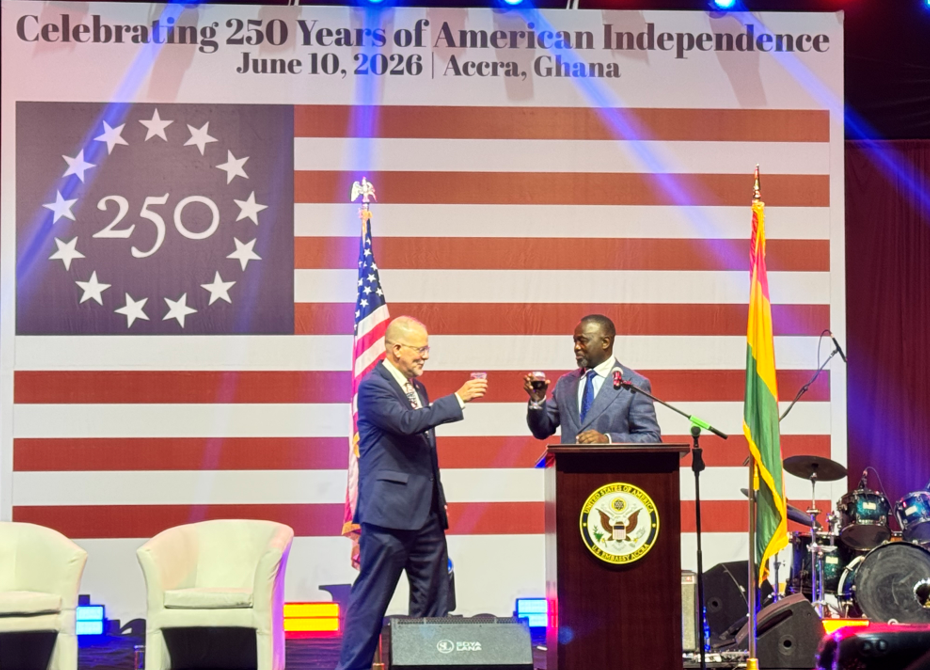
Speaking at celebrations marking the 250th anniversary of American independence in Accra, Mr. Olson said more than 100 American companies are currently operating in Ghana across sectors including energy, technology and agriculture, providing employment, skills development and tax revenues while demonstrating long-term confidence in the Ghanaian economy.
“Last year, we reached about US$4 billion in U.S.-Ghana bilateral trade in goods and services, but we know that number can grow,” Mr. Olson said.
The remarks come as Ghana seeks to attract new foreign direct investment following recent economic reforms and the completion of its International Monetary Fund-supported programme. The government has been positioning itself as a stable investment destination within West Africa, leveraging its democratic credentials, strategic location and participation in the African Continental Free Trade Area (AfCFTA).
According to the Chargé d’Affaires, American businesses operating in Ghana continue to view the country as a market where they can invest, expand and maintain a long-term presence. He noted that American companies employ thousands of Ghanaians and contribute to local economic development through job creation, training and tax payments.
Among the largest U.S. investors is Newmont, which Olson described as Ghana’s largest taxpayer. He referenced the inauguration of the company’s new Ahafo mining line last year, noting that 99 percent of its workforce is Ghanaian.
The U.S. diplomat said the economic relationship extends beyond direct investment to encompass infrastructure, aviation, technology and consumer markets. He cited projects such as the George W. Bush Highway, developed with support from the Millennium Challenge Corporation, as examples of longstanding economic cooperation.
The United States is increasingly looking beyond traditional development assistance toward partnerships driven by trade, investment and innovation, the Chargé d’Affaires said.
“That is what partnership looks like in our current era — not dependence, but resilience; not a one-way flow of assistance, but a two-way exchange of investment, innovation and expertise,” he said.
The focus on commercial engagement comes as both countries identify opportunities in emerging sectors including digital technology, artificial intelligence, advanced agriculture and energy innovation.
Mr. Olson said Ghana’s growing population of young innovators is well positioned to benefit from expanding collaboration with U.S. firms and investors. He pointed to ongoing U.S. support for advanced wireless technology deployment across hundreds of base stations in Ghana aimed at expanding rural connectivity and reducing the digital divide.
The Attorney General and Minister for Justice, Dr. Dominic Ayine, said the government is committed to strengthening the economic relationship and attracting additional U.S. investment.
He noted that bilateral economic cooperation has expanded through initiatives such as the African Growth and Opportunity Act (AGOA), which provides duty-free access to the U.S. market for thousands of eligible products from participating African countries.
“The relationship between Ghana and the United States has evolved and flourished for the mutual benefit of our people,” Dr. Ayine said.
He added that Ghana’s recent macroeconomic gains should provide a stronger foundation for increased trade and investment flows.
According to Dr. Ayine, the government’s efforts to restore fiscal stability and investor confidence have begun yielding results. He cited the successful completion of Ghana’s IMF Extended Credit Facility programme and the conclusion of a Policy Coordination Instrument arrangement as measures intended to strengthen policy credibility and support economic growth.
Political stability, democratic governance and an independent judiciary continue to make Ghana an attractive destination for international investors, he said.
Dr. Ayine also highlighted Ghana’s strategic position within West Africa and its access to the broader continental market through AfCFTA, factors that could support future investment from U.S. businesses seeking regional expansion opportunities.
Beyond economics, both officials highlighted cooperation in health, education, security and justice. Mr. Olson said the United States has invested approximately US$25 billion in Ghana’s health sector over the past two decades, supporting HIV treatment, malaria prevention and COVID-19 vaccination programmes.
He also pointed to the role of technology-driven healthcare solutions such as Zipline’s drone delivery network, which has completed more than 800,000 medical deliveries in Ghana since 2019.
Officials from both countries signalled optimism about the future trajectory of bilateral relations. With trade nearing US$4 billion and growing interest in technology, infrastructure and industrial development, both governments see opportunities to deepen commercial engagement while expanding cooperation in areas ranging from security to innovation.
Post Views: 1
Discover more from The Business & Financial Times
Subscribe to get the latest posts sent to your email.