By Nana Karikari, Senior Global Affairs Correspondent
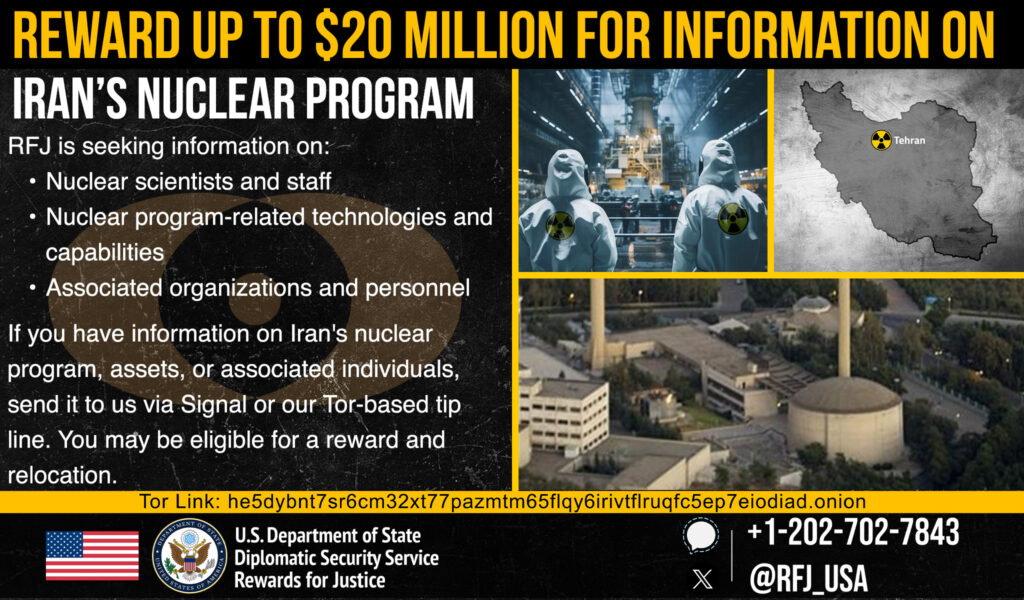
The U.S. State Department has announced a reward of up to $20 million (approximately 234 million Ghanaian Cedi) for information leading to the disruption of Iran’s nuclear programme.
The offer is managed through the State Department’s Rewards for Justice programme. Officials confirmed the U.S. government is willing to relocate individuals who provide actionable details. According to an official announcement published on X, the State Department is seeking specific intelligence on “nuclear scientists and staff, nuclear program-related technologies, and capabilities, associated organizations and personnel.” The post added: “If you have information on Iran’s nuclear program, assets, or associated individuals, send it to us via Signal or our Tor-based tip line. You may be eligible for a reward and relocation.”
The U.S. government emphasized its policy objectives in the statement, noting: “The U.S. government remains committed to countering any attempt by Iran to develop a nuclear weapons program.”
Washington cited severe compliance failures by Tehran as the key driver for the bounty. The State Department noted that Iran’s “lack of compliance with the IAEA on safeguards obligations has led to the agency’s loss of ‘continuity of knowledge’ regarding Iran’s production and inventory of key components like centrifuges.”
Centrifuges are industrial devices required to enrich uranium. Enriched uranium serves as fuel for commercial nuclear power plants, but high enrichment levels—around 90 percent purity or above—allow the material to be weaponized for nuclear explosive devices.
Military Prepares Command Structure and Options Near Moonless Window
Parallel to financial incentives, the U.S. military is expanding administrative oversight to curb Iranian operations. U.S. Central Command confirmed the establishment of Task Force Iron Gate, based in Tampa, Florida. Composed of approximately 20 civilian and military personnel, the team will focus on Iran’s land borders and the Caspian Sea. The task force will coordinate with multiple federal agencies to restrict Iran’s border movements of weaponry, dual-use items, and illegal financial streams.
Naval operations have already targeted Iranian supply lines. Centcom estimates that its naval blockade of Iran’s ports has prevented the country from exporting more than $25 billion (approximately 292.5 billion Ghanaian Cedi) in crude oil.
Military planners are also finalizing options for potential strikes. Centcom is completing preparations for possible major operations in Iran, though a U.S. official confirmed it has not received a new directive from Washington.
Senior U.S. officials told news outlets that Nov. 9 marks a new moon in the Middle East. The phase provides minimal moonlight, creating favorable tactical conditions for night-time military operations.
President Donald Trump met with his national security team on Thursday to consider renewing military strikes. Speaking to reporters in the Oval Office, Trump remarked that Washington would “make a decision” on resuming the conflict.
“Do we want to go further” with strikes to ensure Iran’s nuclear program is dead and that “it will never happen again?” Trump said. “I would rather not destroy the rest of the country if possible, but maybe I will have to. You’ll know soon enough.”
Trump reiterated on Friday that Iran would never be permitted to obtain a nuclear weapon, referencing prior operations. Last year, the president claimed that Iran’s nuclear facilities had been “completely and totally obliterated” following a bombing campaign by the U.S. and Israel.
Political Fallout Following Midterm Results Shapes White House Strategy
The potential for renewed military action comes immediately after domestic political shifts in the United States. Prior to the midterms, Trump told reporters he was in “no rush” to launch strikes, despite mounting speculation.
In an interview with Fox News on the eve of the elections, Trump pointed to subterranean targets. The president noted the U.S. “might need to go after Pickaxe Mountain,” an underground facility linked to Tehran’s nuclear program. Trump described the action as “not a big deal” that could be completed in “one hour.”
However, the political landscape shifted following election day. Both Trump and Vice President JD Vance acknowledged that public opposition to the war on Iran contributed to heavy losses for the Republican Party in the midterm elections. The electoral setback has prompted speculation that the administration may refrain from further military escalation.
On Friday, Trump maintained that Iran was eager to end the eight-month conflict, pointing to the economic and military strain on Tehran. “We’re dealing with them now. They want to make a deal very badly,” he said.
Mediation Efforts Continue Amid Fragile Maritime Security
Tehran maintains that its nuclear activities are designed strictly for peaceful energy production and denies any intention to manufacture nuclear weapons.
Diplomatic channels remain active through regional intermediaries. A spokesman for Qatar’s foreign ministry confirmed on Tuesday that both sides were “reviewing the ideas and proposals we have presented,” adding that Qatar remains hopeful an agreement can be reached.
Iranian negotiators discussed a proposal with mediators to reopen the strategic Strait of Hormuz within two days, provided the U.S. satisfies seven specified conditions.
Washington and Tehran reached a preliminary agreement to end the war and restore maritime transit through the strait in June. That deal collapsed within weeks when attacks on commercial shipping resumed, leading the U.S. to reinstate its naval blockade.
As diplomatic review continues in Qatar alongside preparations in Tampa, the trajectory of the standoff remains tied to whether Washington chooses renewed military action or structured negotiation.