By Frederick E. Aggrey
Ghana has announced a series of measures aimed at improving access to education, employment and social support for more than two million persons with disabilities (PWDs).
The proposals include free tertiary education, a minimum 5% employment quota in public and private institutions, and the establishment of disability desks in all 261 Metropolitan, Municipal and District Assemblies (MMDAs).
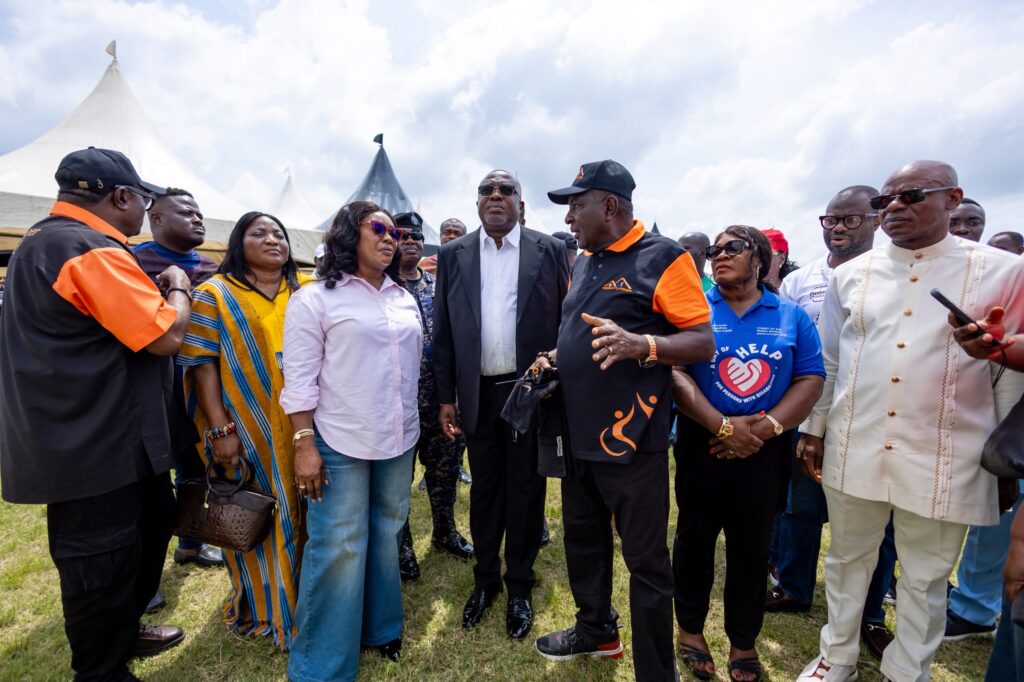
The measures were outlined by Dr Samuel Ofosu Ampofo, Policy Advisor to the Vice President, Professor Naana Jane Opoku-Agyemang, during the Day of Help for Persons with Disabilities in Koforidua on Friday, October 30, 2026.
Representing the Vice President, Dr Ofosu Ampofo said disability inclusion should be treated as a human rights issue rather than an act of charity.
“A nation is not judged solely by the strength of its economy or beauty of its infrastructure. It is judged by how it treats its most vulnerable citizens,” he said, conveying the Vice President’s greetings to Rev. Dr Steve Mensah and the Charismatic Evangelistic Ministry (CEM).
He cited the 2021 Population and Housing Census, which puts the number of persons with disabilities in Ghana at 2.4 million, representing about 8% of the population.
He also referred to World Bank data indicating that more than 70% of persons with disabilities remain excluded from formal employment and education.
Dr Ofosu Ampofo said the government was pursuing policy reforms to address these challenges.
Under the education proposal, persons with disabilities would receive free tertiary education, including tuition and residential support. The initiative would be backed by an amendment to the Ghana Education Trust Fund (GETFund) Act to provide statutory funding.
He said the proposal builds on the Inclusive Education Policy introduced in 2015, when Professor Opoku-Agyemang was Minister of Education.
On economic empowerment, Dr Ofosu Ampofo said the allocation of the District Assemblies Common Fund (DACF) for persons with disabilities had increased from 3% to 5% in 2026.
He added that disability desks would be established in all 261 MMDAs to improve access to support and services.
The government is also pursuing legal and employment reforms. Dr Ofosu Ampofo said Cabinet had approved amendments to the Persons with Disabilities Act, 2006 (Act 715), to align it with the United Nations Convention on the Rights of Persons with Disabilities.
He said President John Dramani Mahama had also announced a minimum 5% employment quota for persons with disabilities in public and private institutions, with tax incentives for private employers that comply.
The Ministry of Gender, Children and Social Protection is processing 272 graduates with disabilities for employment through the Ghana Education Service, he added.
“The greatest obstacles are not physical conditions but society’s barriers — buildings without ramps, schools without learning aids, attitudes that mistake disability for inability,” he said.
Meanwhile, Head of CEM Ability Village, Fred Nuer, said the church’s charity arm currently supports more than 7,000 persons with disabilities in Koforidua and surrounding communities in the Eastern Region.

The support includes free medical care, assistive devices, surgeries, food and vocational training.
Mr Nuer announced plans to establish the CEM Ability Village, a sustainable community that will provide technical and vocational training, specialised healthcare and rehabilitation, software development, hardware repair, counselling, assisted living and affordable housing.
He said the initiative aimed to be replicated across all 16 regions of Ghana.
Both leaders called on corporate organisations, development partners and churches to move beyond one-off support and commit to long-term partnerships that promote inclusion.
They also stressed the importance of involving persons with disabilities in decisions that affect them, saying: “Nothing about persons with disabilities should be decided without their meaningful participation.”