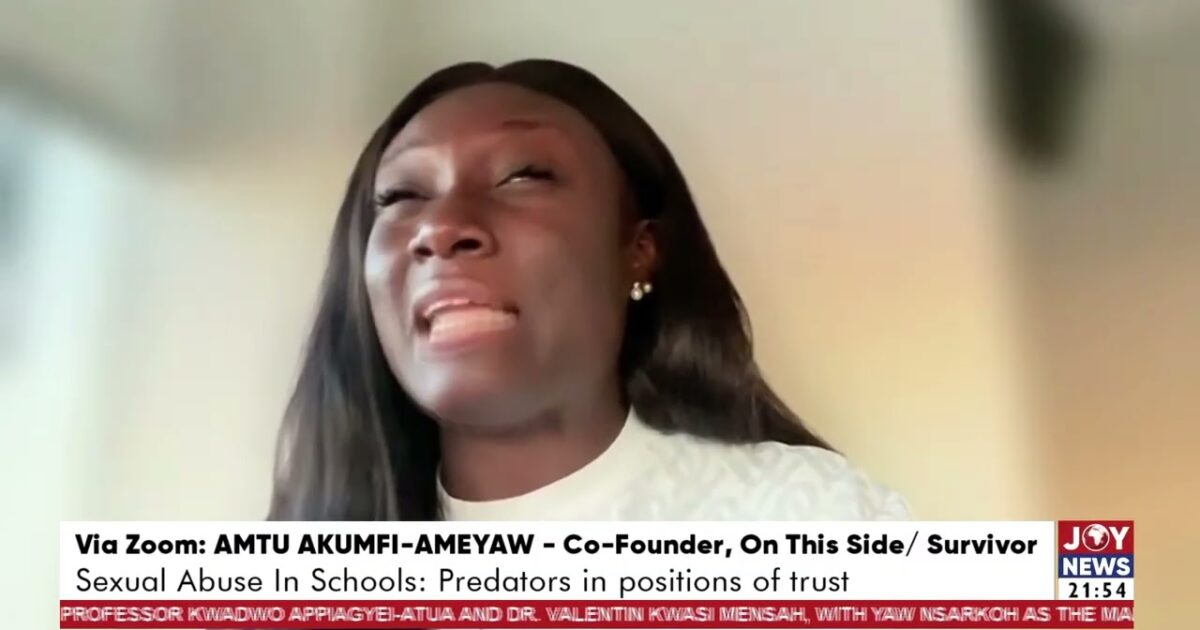

A survivor of sexual abuse has accused society of turning a blind eye to perpetrators, saying people often protect those they know or respect while questioning the experiences of victims.
Amtu Akumfi-Ameyaw, co-founder of On This Side, said the tendency to defend alleged abusers, dismiss complaints and treat sexual abuse as a joke discouraged survivors from speaking out and reinforced the guilt and emotional distress they already experienced.
Reacting to developments in the alleged sexual abuse of female students at Obuasi Senior High Technical School (SHTS), she said the response to such cases reflected a wider social problem in which people were quick to demand that girls protect themselves but paid less attention to teaching boys to respect others.
The allegations are the subject of Manasseh Azure Awuni’s documentary, Inside the Dreaded Headmaster’s Bungalow. It examines alleged sexual abuse involving female students at Obuasi Senior High Technical School.
Click here to Watch the documentary.
Speaking on Joy News’ PM Express on Monday, October 19, she said people often pretended not to know sexual abusers, even when they were within their families, friendship circles or communities.
“I kid you not; each and every one of us knows an abuser. Each and every one of us,” she said.
“Sometimes we cover it because we care too much about other people, because they are loved ones, they are people we respect, and things like that.”
Silence and misplaced loyalty
Ms Akumfi-Ameyaw said the instinct to protect people who were loved or respected could lead families and communities to minimise allegations of abuse rather than confront them.
She likened the practice to selective opposition to corruption, arguing that people tended to condemn wrongdoing until someone close to them was implicated.
“If it hasn’t happened to you or somebody you love, it looks like a joke,” she said. “And then also, if somebody you love or you care about is the abuser, you tend to take an entrenched position of defending them, of making it look like it’s okay.”
She said such attitudes made it easier for communities to sweep allegations under the carpet, leaving survivors to contend with the consequences while those accused received protection.
Her comments followed public discussion surrounding a video related to the Obuasi SHTS allegations, in which a remark about an alleged incident being “a kiss on the cheek” had drawn attention.
Ms Akumfi-Ameyaw said the reaction illustrated how sexual abuse could be trivialised, particularly when people were unwilling to acknowledge wrongdoing by someone they knew.
Why survivors sometimes remain silent
The advocate said survivors often struggled with intense emotions, including disappointment and guilt, after their boundaries had been violated.
They could also blame themselves for failing to prevent the abuse, she said, and those feelings could deepen when trusted adults failed to provide the support they expected.
She cited housemistresses, senior housemistresses and teachers as examples of people students might turn to for help, but whose failure to respond appropriately could reinforce a survivor’s sense of helplessness.
When victims then heard people laughing about or dismissing their experiences, she said, they could conclude that what had happened to them did not matter.
That, she explained, could help account for why some survivors initially disclosed their experiences but later withdrew their accounts.
“They are dealing with their own battles,” she said, adding that survivors had to contend with significant emotional burdens even before deciding whether to speak publicly.
Ms Akumfi-Ameyaw also addressed the increase in the number of students reported to have come forward in connection with the Obuasi SHTS case.
She suggested that some students might have felt more able to speak when they realised that others had experienced similar situations and that support might be available.
“Because now they feel that they belong. They feel that they identify. They feel that maybe some level of help could get to them,” she said.
She urged the public not to interpret delayed disclosures as a reason to dismiss survivors’ accounts, saying the decision to speak could be shaped by fear, shame, isolation and uncertainty about whether anyone would help.
Teach boys to respect others
Ms Akumfi-Ameyaw said public discussions of sexual abuse often placed the responsibility for prevention on girls, with warnings about where they went, whom they interacted with and what they wore.
She argued that equal attention must be given to educating boys and men about respect, boundaries and responsible behaviour.
“We continue to ask and dictate how girls should keep themselves. Oh, don’t do this. Don’t go here. Don’t engage with this person. Don’t wear these clothes,” she said.
“And we forget that we also have to socialise our men and our boys to be better and responsible human beings of society.”
She acknowledged that boys and men could also experience abuse, although she said women were disproportionately affected according to data from around the world.
For her, the continued focus on telling potential victims how to avoid abuse raised questions about whether enough was being done to address the behaviour of perpetrators.
“We have to take it seriously,” she said. “We can’t be having families desire to have male kids to become heirs, but we don’t care about teaching them basic things of respect.”
DISCLAIMER: The Views, Comments, Opinions, Contributions and Statements made by Readers and Contributors on this platform do not necessarily represent the views or policy of Multimedia Group Limited.
DISCLAIMER: The Views, Comments, Opinions, Contributions and Statements made by Readers and Contributors on this platform do not necessarily represent the views or policy of Multimedia Group Limited.
Source link