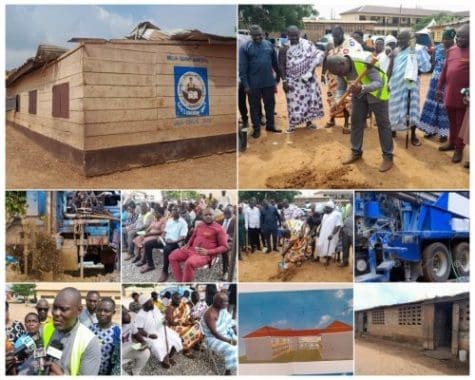


The Weija-Gbawe Municipal Assembly on Monday, Jan. 12, took a decisive step toward transforming education and access to potable water in the municipality, as it held a sod-cutting ceremony to mark the commencement of multiple infrastructure projects across the area.
Led by Municipal Chief Executive Felix Odartey Lamptey, the ceremony signaled the start of construction of 20 mechanized boreholes, a two-storey 11-unit classroom block, a two-unit kindergarten classroom block, and ancillary works including school fencing and sanitation facilities.
The projects, funded largely through allocations from the District Assemblies Common Fund and supplemented by internally generated funds, are expected to address long-standing challenges confronting schools and communities in the municipality.
Speaking in an exclusive interview on the sidelines of the event, Lamptey said the initiative was driven by an urgent need to improve both the quality of education and the living conditions of residents within Weija-Gbawe.
“The significance is to improve education within the Weija-Gbawe Municipality,” Lamptey said. “When you look at the kind of educational infrastructure we have, apart from not being able to contain the number of pupils, some of the facilities are also deteriorated and in need of serious attention.”
According to the municipal chief executive, the projects go beyond cosmetic upgrades. He emphasized that the new classroom blocks and rehabilitated facilities are intended to create a safe, conducive learning environment that supports effective teaching and learning. “This is not just about giving the schools a facelift,” Lamptey said. “It is about providing an environment under which pupils can learn and learn well, because these children are the future of this nation.”
Addressing dire conditions in schools
Lamptey recounted visits to several schools within the municipality that revealed the severity of the problem. At the New Gbawe Cluster of Schools, he said, parts of a kindergarten block had lost their roofing, leaving pupils exposed to harsh weather conditions.
“When it rains, the children cannot stay in the classroom,” he said. “When the sun is hot, they have to come out. This affects teaching and learning in a very serious way.”
Similar conditions were observed at Gbawe Methodist School, where old and dilapidated structures have long posed safety concerns. Roofs in poor condition, crumbling walls and overcrowded classrooms have made learning difficult for pupils and teaching frustrating for staff. “These are not conditions under which we can expect excellence in education,” Lamptey said. “If education is the key to development, then the foundation must be strong.”
The projects, he explained, are part of a deliberate effort by central government to ensure that a portion of the Common Fund is dedicated to education. Through this arrangement, the assembly is constructing new classroom blocks, rehabilitating existing structures and fencing school compounds to enhance security.
Work has already begun on fencing the Weija Methodist School and Oblogo School, while Gbawe Methodist School is set to receive an 11-unit classroom block. A two-unit kindergarten block will also be constructed at the New Gbawe Cluster of Schools.
Education as a catalyst for development
Lamptey linked the investment in education directly to long-term social and economic development within the municipality and the country as a whole.
“It is through education that we will get our nurses, our doctors, our teachers and other professionals in all facets of the economy,” he said. “If pupils are given the right foundation and are able to progress through the educational ladder, then we can be assured of good human development.”
He expressed appreciation to President John Dramani Mahama for what he described as a clear policy direction to prioritize education in the allocation of national resources. “We say a very big thank you to His Excellency the President for ensuring that the Common Fund is structured in such a way that education gets its portion,” Lamptey said. “This is helping municipalities and districts across the country to improve their educational infrastructure.”
Expanding access to clean water
In addition to education, access to potable water featured prominently in the day’s activities. The sod-cutting ceremony also marked the start of drilling works for 20 mechanized boreholes across the municipality.
Lamptey said the boreholes form part of the assembly’s allocation for sanitation, environmental health and water under the Common Fund. While Weija-Gbawe is home to the Weija Dam, he noted that geography has made water access uneven in many communities.
“We have a lot of hills and valleys here,” he said. “So even though people hear ‘Weija’ and think of the dam, there are many communities that do not have reliable access to water.”
Communities such as Bulemi, Sonitra, Top Base, Oblogo, Mt. Camel and others have struggled with water shortages, forcing residents to rely on distant or unsafe sources. The boreholes are intended to supplement services provided by Ghana Water Co. Ltd.
“Water is life. Water is everything,” Lamptey said. “We cannot downplay the importance of water, and that is why we are working to achieve the president’s vision of ensuring that every citizen has access to water.”
The drilling program is being rolled out in phases. Five boreholes are being initiated first, covering communities including Gbawe West, Oblogo, New Weija West, Jaman and Gbawe Gonse.
“These are the initial five,” Lamptey said. “By the end of everything, we will be doing about 20 boreholes. By the middle of this year, we expect to have covered all 14 electoral areas, especially places that do not have water.”
He added that the assembly is exploring the use of internally generated funds to go beyond the initial target, with the aim of extending water access to even more communities.
Lamptey also commended Ghana Water for ongoing expansion projects, including a six-kilometer pipeline extension from Jamam Junction toward Gonse. “Very soon, they will get to Gonse,” he said. “As we do the boreholes and Ghana Water does its extension, residents will benefit from improved water supply.”
Plans for a 24-hour market
Beyond education and water, the municipal chief executive revealed plans for the construction of a 24-hour market to boost local commerce and economic activity. According to Lamptey, engineers from Architectural and Engineering Services Limited have already been on site to take measurements, and designs for the market are complete.
“Very soon, they will be calling us to see when to start work,” he said, signaling that the project is nearing implementation.
Gratitude from beneficiary schools
At Gbawe Methodist 3 School, one of the beneficiary institutions, Head Teacher Ebenezer Hammond expressed profound gratitude to the municipal assembly and its leadership.
He thanked Lamptey and his team, as well as the Gbawe Mantse, Nii Boi Kojo II, and members of the traditional council who attended the ceremony in support. He also acknowledged the Municipal Director of Education, Charles Odoom, and other stakeholders who contributed to making the project a reality.
“This intervention means a lot to us,” Hammond said. “It will greatly improve teaching and learning and create a better environment for our pupils.”
He pledged that the school would put in place strict maintenance measures to ensure that the new facilities, once completed, are preserved for future generations.
Traditional authority welcomes development
Nii Boi Kojo II, the Gbawe Mantse, described the sod-cutting exercise as both a blessing and the fulfillment of a long-held dream. “I have mixed feelings of being happy and sad at the same time,” the chief said in his remarks. He explained that since his enstoolment, the poor state of classroom infrastructure has been one of the most persistent issues brought before him at the palace.
“Especially during the raining season, the condition of these buildings and the difficulty students face while learning have been a major concern,” he said.
While acknowledging that his office had attempted to initiate renovations in the past, he noted that limited resources had made it difficult to complete the work.
“With the support and inclusion of the Weija-Gbawe Municipal Assembly, I am optimistic that schools in deplorable conditions will see major improvement with modern facilities,” he said.
The traditional leader urged residents and stakeholders to contribute their quota toward initiatives that support the youth, whom he described as future leaders of both the community and the nation.
Contractors outline scope of work
Freedom Kwame Amuzu, managing director of Fafali Adom Enterprise, one of the firms contracted to construct fence walls for beneficiary schools, said his company was confident in partnering with the municipal assembly.
“This project is supposed to be six months in duration, but we are expected to complete it within four months,” Amuzu said.
He explained that the contract involves the construction of 425 meters of fence wall and three security gates, at a total cost of 695,155 Ghana cedis.
“Fencing this particular school is a necessary action,” he said. “The school is very open, with surrounding homes and a busy road. This will provide security for the students.”
Amuzu emphasized that the key requirement from school authorities and the assembly was cooperation, adding that his team was ready to deliver.
Modern facilities envisioned
Providing technical details, Municipal Engineer Eng. Felix said the two-storey classroom block would be equipped with modern amenities to support quality education.
The facility will include 11 classrooms fitted with ceiling fans, administrative offices, an ICT center, a library, 17 washrooms, a kitchen and a teachers’ common room, among other features.
“These facilities are designed to meet current educational standards and accommodate both pupils and teachers comfortably,” he said.
Broad community participation
The sod-cutting ceremony drew a cross-section of stakeholders, including community members, teachers, traditional leaders, assembly staff, assembly members from various electoral areas, and other opinion leaders within the municipality.
In a symbolic gesture marking the official start of construction, Nii Boi Kojo II and Lamptey jointly struck the ground with a pickaxe and shovel, drawing applause from the gathered crowd.
For many residents, the moment represented more than the start of construction. It was seen as a sign of renewed commitment to addressing long-standing challenges in education, water access and community development.
As heavy machinery prepares to move onto sites across the municipality, expectations are high that the projects will deliver lasting benefits and help lay a stronger foundation for the future of Weija-Gbawe.
By Kingsley Asiedu