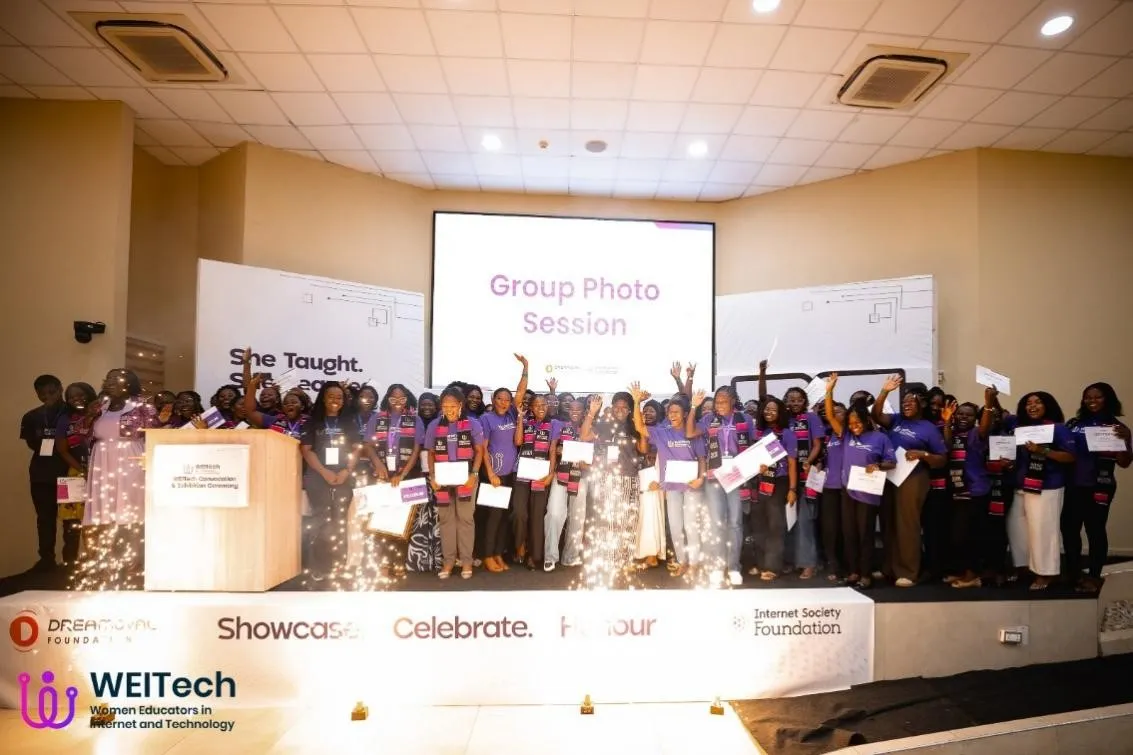
About 100 participants of the Women Educators in Internet and Technology (WEITech) programme have graduated after acquiring advanced digital teaching and learning skills aimed at enhancing their effectiveness and impact in education.

The 2026 WEITech Convocation and Exhibition at the University of Ghana, Accra, marked the graduation of female educators who completed intensive training in digital skills, entrepreneurship and educational technology (EdTech).
Held under the theme “She Taught. She Learned. She Led: Celebrating Women Educators Who Went Beyond the Classroom”, the event recognised participants as certified digital educators equipped to contribute to Ghana’s growing digital education ecosystem. It brought together educators, policy-makers, development partners, EdTech firms and students to celebrate women leveraging technology to transform education.
Executive Director of DreamOval Foundation, Afua Oforiwaa Asiamah-Adjei, described the programme as evidence of the transformative impact of investing in women educators and called for its expansion nationwide.
“Today is proof that when women are given access to the right opportunities, skills and support systems, they become innovators, entrepreneurs, digital leaders and change-makers,” she said.
Ms. Asiamah-Adjei noted that research underpinning the initiative showed many women educators are eager to integrate technology into their teaching but lack access to the required skills and tools. She urged the Ghana Education Service (GES) to accelerate the deployment of digital technologies in public-school classrooms to better prepare learners for a competitive global environment.
Deborah Danquah emerged as the 2026 WEITech Valedictorian and received seed funding for her capstone project, LucidScript, an AI-powered essay practice platform that provides instant curriculum-aligned feedback to students. Twelve other graduates also received seed funding to support the development and scaling of their innovations.

Coordinator of Innovation, Research and Professional Development at Accra College of Education, Mathew Awine Ayamdoo, described the year-long programme as highly impactful and said it should be expanded to reach more educators.
He observed that the adoption of educational technology in many classrooms remains low and often faces resistance. However, he said the WEITech programme had made digital innovation more attractive and accessible to female educators, helping to address that challenge.
Mr. Ayamdoo added that colleges of education are increasingly seeking to integrate technology into teacher-training programmes and called for greater private-sector support for initiatives that advance digital learning.
The Internet Society Foundation, a partner organisation, emphasised the importance of collaboration in creating sustainable digital inclusion opportunities for women. Associate Programmes Officer Celia Gueto Melo said participants had gained not only technical knowledge but also confidence, leadership skills and greater opportunities to drive change in their communities.
“The WEITech programme stands as a powerful example of what is possible when organisations come together with a shared commitment to empowering women through digital skills, education and innovation,” she said.
Since its launch in April 2025, WEITech has trained multiple cohorts of female educators in digital literacy, artificial intelligence, online course design, digital safety, content creation, STEAM education and entrepreneurship.
Through practical projects, presentations and EdTech industry placements, participants have developed innovative approaches to teaching and learning while creating new opportunities for professional growth and income generation.
Post Views: 39
Discover more from The Business & Financial Times
Subscribe to get the latest posts sent to your email.