
AI-generated illustration.
There is a growing industry around women’s empowerment in Ghana. Conferences, brunches, masterclasses, podcasts and hashtags. This is, on the surface, a positive development. More women are creating spaces for other women, and that visibility matters.
But it invites a more difficult question: Who is being empowered, and how?
In recent years, empowerment has, in some spaces, begun to mirror the very exclusions it set out to dismantle. Access often depends on being in the right circle, living in the right area, or having a certain level of social visibility. For many women outside those networks, the language of empowerment remains inspirational, but the material benefit is distant.
This is not an indictment of all women-led initiatives. Much important work is being done, often quietly and without funding. The concern is with a particular model that has become dominant: empowerment as performance.
There is also a second, less comfortable reality that must be named. Some platforms that present as neutral empowerment spaces are, in practice, vehicles for personal advancement. They serve to consolidate a base, increase visibility, and in some instances, build political capital for negotiation. In such models, women are gathered as an audience, as numbers, as content. The optics are of collective upliftment, but the benefits accrue disproportionately in one direction.
That distinction matters, because mentorship and sisterhood require more than a stage.
If mentorship is only accessible when there is a camera, an audience and applause, is it mentorship? If a young woman who looks up to a leader cannot reach her beyond a comment section, unless she can offer visibility or connections in return, is that sisterhood?
These questions are necessary because we are at risk of rebranding old problems in new language. Classism rebranded as curation. Exclusivity rebranded as community. Gatekeeping rebranded as leadership.
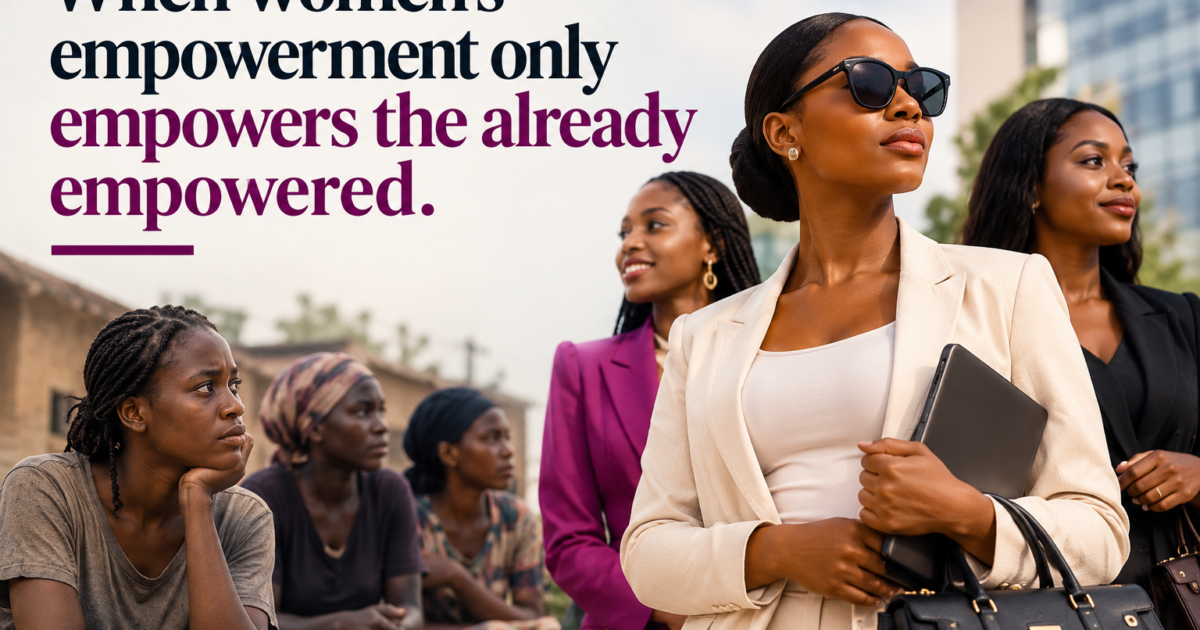
And we must consider who is absent from the room. The woman who cannot afford data to join a live session. The trader who cannot afford transport to an empowerment breakfast. The young woman in a deprived community whose ambition is just as valid but who has no network to amplify it. If empowerment does not reach her, can it still call itself empowerment?
There is also the question of narrative. Too often, stories of female success are framed in ways that inadvertently make other women feel inadequate. Growth should not require another woman’s diminishment. It is possible to celebrate personal achievement without invalidating another woman’s starting point.
What, then, should empowerment look like?
Perhaps it should be quieter. Less about being seen to empower and more about empowering when no one is watching. Opening a door without expecting a thank-you post. Making room for women who may never be in a position to return the favour. Demonstrating integrity in how we treat women when there is nothing to gain from them.
The measure of any empowerment movement cannot be how many women gather in a room, but what happens to those women after they leave the room, and what happens to those who were never invited into it.
If the cameras disappeared, the stages were taken down, and there was no award for empowering women, who would we still show up for, and who would still benefit from our presence?
That is the question that should define the next chapter of women’s empowerment in Ghana.
DISCLAIMER: The Views, Comments, Opinions, Contributions and Statements made by Readers and Contributors on this platform do not necessarily represent the views or policy of Multimedia Group Limited.
DISCLAIMER: The Views, Comments, Opinions, Contributions and Statements made by Readers and Contributors on this platform do not necessarily represent the views or policy of Multimedia Group Limited.
Source link