
A new nationwide survey has revealed growing dissatisfaction over the remuneration of Human Resource (HR) professionals in Ghana, with more than seven out of every 10 practitioners believing they are underpaid despite the increasingly strategic role they play in organisational success.
The findings are contained in the HR Compensation & Salary Satisfaction Survey Report – Ghana 2026, launched by SEDAT Consult Ltd., which describes the situation as an “HR Value Paradox”—where organisations expect HR professionals to drive business performance, talent development and organisational transformation while many practitioners feel their financial recognition has failed to match those expectations.
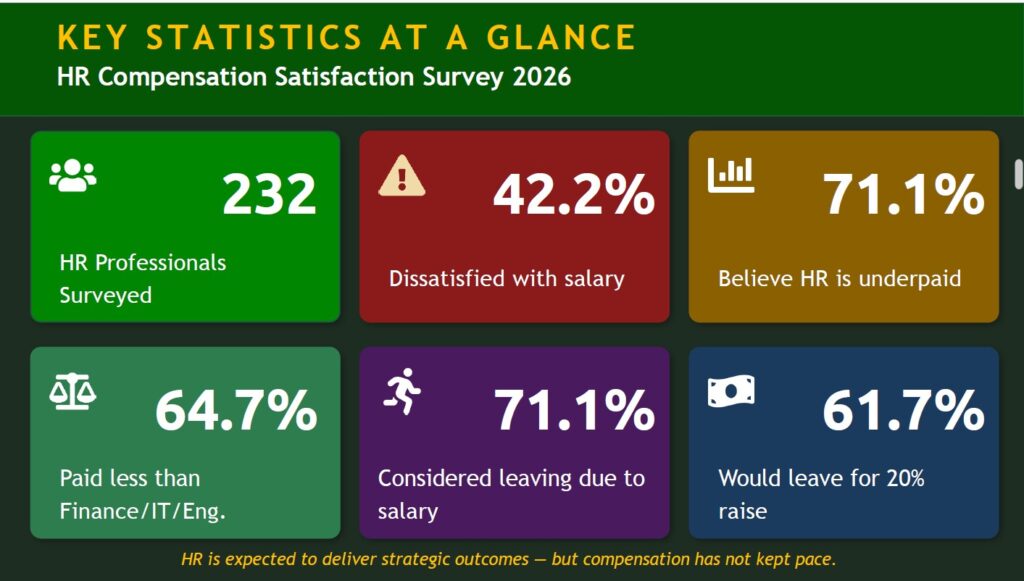
The study, one of the most comprehensive of its kind in Ghana, surveyed 232 HR professionals across multiple sectors of the economy and examined issues relating to compensation, professional recognition and talent retention.
Widespread dissatisfaction
According to the report, 71.1 per cent of respondents believe HR professionals in Ghana are generally underpaid, reflecting what it describes as a widespread perception across the profession rather than isolated personal experiences.
It also found that 42.2 per cent of HR professionals are dissatisfied with their current salaries, compared with only 28.4 per cent who expressed satisfaction.
Additionally, 64.7 per cent believe HR professionals earn less than colleagues in finance, information technology, engineering and operations despite performing equally strategic functions within their organisations.
The report further indicates that 54.7 per cent of respondents do not believe HR professionals receive fair compensation compared with employees in other departments within the same organisations.
According to SEDAT Consult, the findings point to four major concerns—low salary satisfaction, perceptions of widespread underpayment, internal pay inequity and an increasing risk of salary-driven staff turnover.
Retention challenge
The report warns that dissatisfaction with compensation is beginning to threaten organisations’ ability to retain experienced HR professionals.
It revealed that 71.1 per cent of respondents have considered leaving their organisations because of salary concerns, while 61.7 per cent said they would likely accept another job if offered a salary increase of just 20 per cent elsewhere.
SEDAT Consult cautioned that losing experienced HR professionals could undermine organisational performance at a time when businesses increasingly rely on strategic people management to remain competitive.
‘HR Value Paradox’
The report argues that HR has evolved beyond its traditional administrative role into a strategic business function responsible for organisational culture, leadership development, employee engagement, workforce planning, change management and business sustainability.
Despite these expanded responsibilities, many HR practitioners believe their remuneration has failed to reflect the strategic value they create.
The consultancy describes this contradiction as the “HR Value Paradox”, stressing that while expectations of HR professionals continue to increase, financial recognition has not kept pace.
It noted that compensation should not be viewed merely as a salary issue but as one of the strongest indicators of how organisations value their workforce.
Call for evidence-based reforms
Speaking at the virtual launch, which brought together HR professionals, business executives, consultants and other stakeholders, the Founder and Managing Director of SEDAT Consult Ltd., Mrs Patricia Abena Kissi, said the research was designed to move discussions about HR remuneration from anecdotal claims to evidence-based policy dialogue.
“For years, HR professionals have shared concerns about being underpaid and undervalued. We believed it was time to move beyond conversations and generate credible evidence that employers, professional bodies, policymakers, and HR leaders can use to drive meaningful change.”
She explained that the objective of the study was not simply to highlight problems but to stimulate practical reforms capable of strengthening the recognition, reward and future of the HR profession in Ghana.
Mrs Kissi described the findings as a wake-up call for organisations to align their reward systems with the increasingly strategic role HR professionals play in driving business success.
She also challenged HR practitioners to strengthen their commercial understanding, improve analytical capabilities, demonstrate measurable business value and actively participate in national conversations shaping the future of the profession.
Collaboration
The Head of Research and Policy at the Chartered Institute of Human Resource Management, Ghana (CIHRM), Mr Yen Sapark, commended SEDAT Consult for providing empirical data on HR compensation, describing the study as timely and important.
He urged HR professionals, employers, researchers and professional bodies to collaborate in generating reliable compensation data to support policy formulation and advocacy for improved remuneration.
Recommendations
The report recommends that employers regularly benchmark HR salaries, review internal pay structures, strengthen performance-based reward systems and integrate HR leaders into strategic business decision-making.
It also calls on HR professionals to build stronger competencies in HR analytics, workforce planning and business strategy while professional bodies intensify research, advocacy and industry collaboration.
Government and policymakers, the report said, should support labour market research, promote equitable reward systems and incorporate HR expertise into national employment and workforce development policies.
SEDAT Consult announced that the HR Compensation & Salary Satisfaction Survey Report will become an annual publication, serving as a national benchmark for HR compensation trends and supporting evidence-based policy and organisational decision-making.
The consultancy also plans to convene stakeholder roundtable discussions involving government institutions, employers, professional associations and development partners to explore practical measures for strengthening recognition and reward systems for HR professionals across Ghana.
DISCLAIMER: The Views, Comments, Opinions, Contributions and Statements made by Readers and Contributors on this platform do not necessarily represent the views or policy of Multimedia Group Limited.
DISCLAIMER: The Views, Comments, Opinions, Contributions and Statements made by Readers and Contributors on this platform do not necessarily represent the views or policy of Multimedia Group Limited.
Source link