
By Sharon Zoe Williams
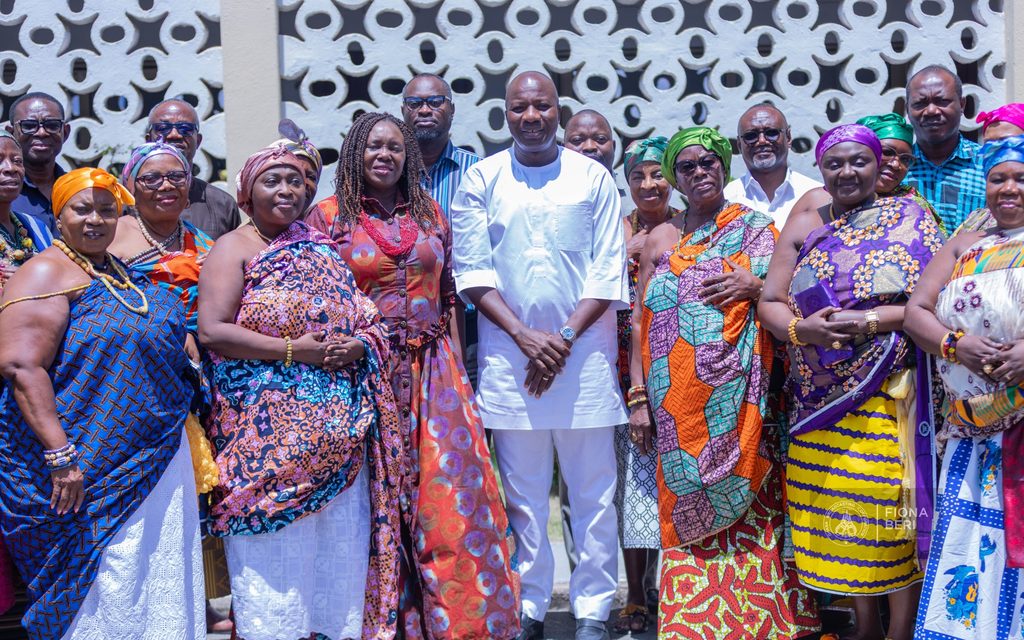
In a historic push for gender-inclusive traditional governance, traditional women leaders from across Ghana paid a courtesy call on the Minister for Local Government, Chieftaincy, and Religious Affairs, Hon. Mahama Ayariga, on Friday, October 16, 2026, to advocate for the official creation of a state-recognized Chamber of the House of Queen Mothers.
The delegation highlighted the indispensable yet historically underrepresented role Queen Mothers play in community stability, peacebuilding, and cultural preservation.
Addressing the Minister, the leadership of the Queen Mothers emphasized that despite being the moral anchor of Ghanaian society, traditional women leaders lack a formal constitutional body equivalent to the National and Regional Houses of Chiefs.
”We nurture the nation, settle disputes in our homes, and preserve our culture. Yet, we have no formal house to call our home,” the delegation declared. “We, therefore, humbly appeal to His Excellency the President of the Republic of Ghana, the Ministry of Local Government, Chieftaincy, and Religious Affairs, and the Parliament of Ghana to consider and approve the establishment of a state-recognized Chamber of House of Queen Mothers.”
Welcoming the delegation, Hon. Mahama Ayariga commended the traditional leaders for traveling from far and near to champion a cause vital to national development. He expressed the Ministry’s strong commitment to supporting their vision of a unified national platform.
”I am very happy to see you here to try and create a national platform of Queen Mothers.” Mr. Ayariga noted.
The Minister acknowledged that women possess unique mediation and leadership traits that remain untapped at the formal policymaking level.
”Our Queen Mothers and Mothers tend to be naturally more suitable for dealing with issues better than most of us men will do,” the Minister emphasized. “There are areas that I personally am convinced about: if we promote our Queen Mothers, resource them, and build their capacity, they would significantly complement the efforts of their chiefs. Furthermore, they would be very strategic partners to government in delivering healthcare, education, and promoting peace.”
The proposed Chamber is expected to serve as an official institutional framework through which Queen Mothers can contribute directly to national policy discussions, social development initiatives, and conflict resolution mechanisms.
The Ministry of Local Government, Chieftaincy, and Religious Affairs is expected to initiate engagements with relevant stakeholders, Parliament, and traditional institutions to review the legal and policy pathways required to bring the Queen Mothers’ request to fruition.