
By Kizito CUDJOE & Juliet ETEFE
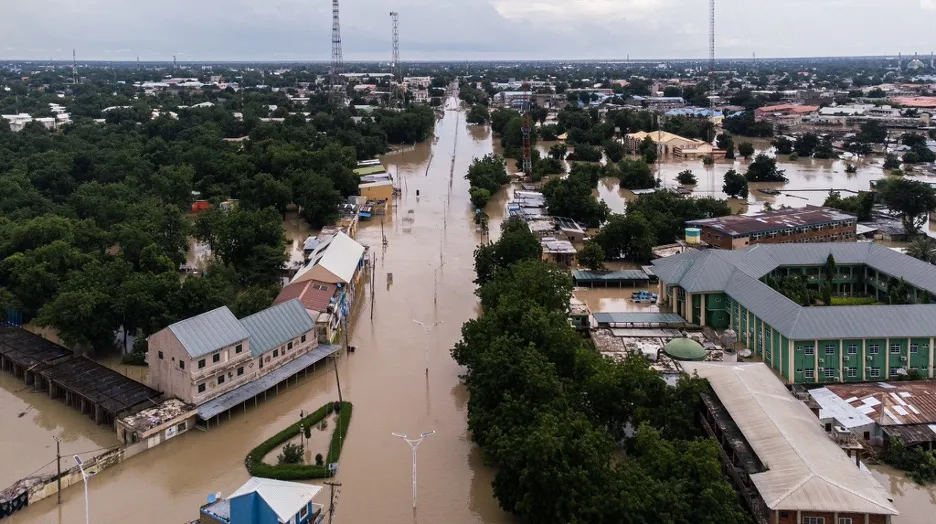
Torrential rainfall on Monday inundated large parts of Accra, paralysing business activity, disrupting transport, forcing some schools to close and leaving several communities without electricity as floodwaters submerged roads and homes across the capital.
Among the worst-hit areas were Dzorwulu, Mallam, Weija, Shiashie, Teshie, Nungua, Kasoa and others, while sections of major roads became impassable under fast-rising waters.
Even the stretch of road in front of Jubilee House – the seat of government – was overtaken by floodwaters, underlining the scale of the flooding that gripped the city after hours of heavy rainfall which began before dawn and continued into the morning.
Videos and photographs circulating on social media, alongside situational reports from radio and television stations, showed vehicles stranded in floodwaters and commuters trapped as overwhelmed drainage systems spilt over, with blocked waterways diverting runoff into streets, homes and commercial areas.
A fire outbreak was also reported to have occurred around Kwame Nkrumah Circle, a major transport hub of the city.
Following the development, authorities urged residents to remain indoors as forecasts pointed to further rainfall later in the day.
“If you have not left home, please stay home. A chunk of the city is flooded and we are not going out,” Interior Minister Mohammed Muntaka Mubarak said in an interview with Joy FM.
He said personnel from the Ghana Navy have been deployed to support rescue efforts and residents in distress were encouraged to contact the National Disaster Management Organisation (NADMO) through emergency lines.

“The Meteorological Department has confirmed to me that the rains are going to continue until afternoon – and they are expecting heavier rains moving in from Togo which have not yet arrived,” he said.
Mr. Muntaka urged employers in both the public and private sectors to exercise flexibility, warning that movement across the city remains dangerous.
“We should have people alive rather than for them to step out and risk their lives, get injured or lose more property,” he said, adding that non-essential movements should be avoided and urgent meetings conducted virtually.
The flooding also disrupted electricity supply in parts of the capital after floodwaters affected critical power infrastructure.
In a joint statement, the Ghana Grid Company (GRIDCo) and Electricity Company of Ghana (ECG) announced a temporary shutdown of the Mallam and Achimota primary substations as a precautionary measure to protect lives, equipment and operational personnel.
The utilities said severe flooding around key installations in the Greater Accra Region had created significant safety risks, necessitating the suspension of power supply until conditions improve.
GRIDCo and ECG warned that additional outages could occur in other flood-affected areas if risks persist, adding that engineers are continuously assessing the transmission and distribution network.
Residents were urged to avoid flooded electrical installations and report fallen poles, exposed cables and other hazards to ECG offices or customer service channels.
In Mallam, where floodwaters entered homes in some communities for the first time, residents described an unprecedented situation.
Sandra Ayebi, a resident, said the extent of flooding has surprised many as areas previously considered safe are now affected.
“You might think it’s the usual situation because sometimes there’s an overspill around the major areas and it extends to West Hills Mall. That place is always flooded. But Mallam hardly gets flooded. This time around, I don’t know what’s going on because even areas that usually don’t get flooded are getting flooded,” she said.
She attributed the situation partly to poor drainage and waste disposal practices as well as the area’s natural slope, which channels run-off from surrounding high grounds into low-lying communities.
“The drains are small and our roads are small and really need an extension,” she said, adding that improper waste disposal is worsening the problem as gutters are often used as dumping points.
“For Mallam, it’s even more dangerous because we have a lot of filling stations around. If there’s an explosion, it will be bad,” she warned, noting concerns over the concentration of fuel stations along narrow road corridors.
She said floodwaters began entering homes around 3 a.m. – marking the first time water had reached bedrooms in her household.
“We’ve never had water come into our bedrooms before, but this time it did. For the very first time we were scooping water out of our bedroom,” she said.
The latest flooding episode is expected to renew concerns over Accra’s drainage capacity, encroachment on waterways and unplanned urban development, long identified as key drivers of the city’s recurrent flood disasters.
It will be recalled that at the recent Environmental Sustainability Summit (ESS) organised by Business and Financial Times (B&FT) in Accra, climate experts warned that flooding events in urban centres like Accra were likely to intensify without urgent investment in drainage infrastructure and stronger land-use enforcement.
Experts pointed to rapid urbanisation, poor spatial planning and the persistent blockage of waterways as key drivers of the city’s growing flood vulnerability – cautioning that extreme rainfall events linked to climate variability are exposing long-standing infrastructural gaps.
They also stressed the need for coordinated metropolitan planning and sustained public education on waste disposal, noting that unregulated construction in wetlands and flood-prone corridors continues to worsen run-off patterns during heavy rains.
Finance expert and General Manager for Green Transition-Jospong Group, Dr. Glenn Kwabena Gyimah, for instance called for the creation of a dedicated national funding facility to address flooding, waste management and related climate risks.
He proposed a National Climate Resilience and Climate Economy Infrastructure Facility by June 2027 to mobilise at least US$500million in blended finance for climate and urban infrastructure projects.
Dr. Gyimah said the facility should be coordinated by key ministries and the National Development Planning Commission (NDPC) and focus on flood control systems, waste management infrastructure, recycling, composting and urban resilience projects.
He noted that despite multiple interventions, Ghana still lacks a dedicated financing mechanism for these interconnected challenges.
“We have various interventions and funding streams, but there is no dedicated source of financing focused solely on flood control, waste management, recycling, composting, urban resilience and waste-to-energy infrastructure,” he said.
Post Views: 1
Discover more from The Business & Financial Times
Subscribe to get the latest posts sent to your email.