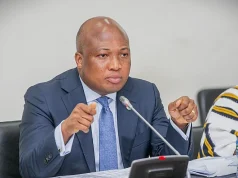

Minority Leader in Parliament, Alexander Afenyo-Markin, has urged the Economic Community of West African States (ECOWAS) to take immediate and concrete steps to address the growing threats facing West African citizens, including deadly militant attacks in the Sahel, xenophobic violence in South Africa, and persistent barriers to free movement within the sub-region.
Speaking under Rule 71 of Parliament’s Standing Orders on matters of urgent public importance, the lawmaker, who also serves in the ECOWAS Parliament, described the situation as “a moment of profound moral reckoning” for West Africa.
Afenyo-Markin highlighted the vulnerability of Ghanaian and other West African traders operating in conflict-prone areas. He cited a February 14, 2026 attack in Titao, northern Burkina Faso, where militants linked to Jama’at Nasr al-Islam wal Muslimin (JNIM) ambushed Ghanaian tomato traders. According to his account, the attackers separated the men from the women, executed the male victims, and set their vehicle on fire. Several West African nationals were killed in the incident, with survivors forced to bury the bodies locally due to insecurity.
The victims were key players in regional food supply chains and were mourned at Techiman Central Market in Ghana. Afenyo-Markin warned that the attack underscores a broader structural risk, as critical food trade routes traverse some of the world’s most volatile conflict zones, particularly the Liptako-Gourma region.
He also referenced a major offensive in Mali on April 25, 2026 — described as the largest since 2012 — which targeted multiple cities and reportedly resulted in the death of the country’s defence minister. In response, Ghana has suspended trader movements along the Mali corridor for security reasons. The Minority Leader called on ECOWAS to establish a dedicated civilian protection framework to safeguard traders and workers in high-risk zones.
Afenyo-Markin further condemned rising xenophobic attacks in South Africa, where African migrants, including Ghanaians, Nigerians, Zimbabweans, and Ethiopians, have faced violence, looting, and displacement. He noted confirmed fatalities, including among Nigerian nationals, and referenced circulating videos showing assaults on foreign nationals. While acknowledging South African President Cyril Ramaphosa’s condemnation of the violence and call for the rule of law, Afenyo-Markin stressed that “words do not arrest perpetrators,” demanding thorough investigations, arrests, and prosecutions.
Turning to challenges within ECOWAS, the lawmaker criticised the bloc’s slow implementation of the 1979 Protocol on Free Movement of Persons. Despite provisions for visa-free travel, citizens continue to encounter harassment, extortion, and illegal checkpoints across borders. “These barriers amount to a de facto tax on poverty,” he said.
He also expressed concern over the delayed ratification of the African Union’s 2018 Free Movement Protocol, describing the situation as incoherent with the goals of the African Continental Free Trade Area (AfCFTA), whose Secretariat is hosted in Ghana. Afenyo-Markin urged Ghana to accelerate ratification of the AU protocol ahead of its 2027 target.
To address these interconnected challenges, Afenyo-Markin proposed a five-point plan including the establishment of a special committee on the safety of ECOWAS citizens abroad, accelerated ratification of the AU Free Movement Protocol, concrete action to dismantle illegal checkpoints within ECOWAS, a formal statement to South African authorities on xenophobic violence, and the development of a regional agricultural resilience strategy. “The safety of our people must never be a matter open to negotiation,” he emphasised.