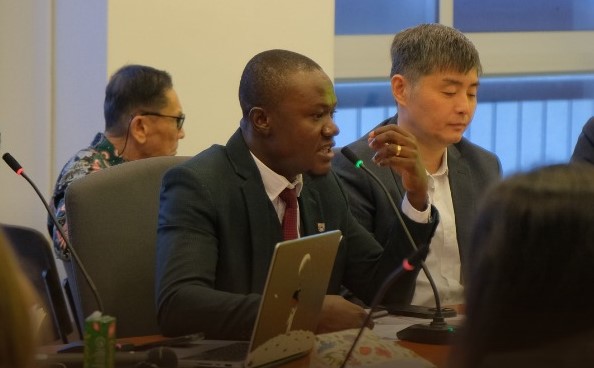
Dr Paul Frimpong, Executive Director and Senior Research Fellow at the Africa-China Centre for Policy and Advisory (ACCPA), has urged African countries to be deliberate in positioning themselves within the global supply chain to achieve economic expansion and self-reliance.
He made the call at a high-level roundtable hosted by the East Asian Institute of the National University of Singapore, where he represented ACCPA and spoke on Africa’s future in a rapidly changing global supply chain landscape.
The roundtable, held under the theme: “Global Supply Chain Shift and Potential New Shipping Routes,” brought together researchers, policy experts and industry stakeholders to examine the impact of geopolitical tensions, evolving trade patterns and China’s changing role in global production systems.
Speaking on supply chain shifts to the Global South, Dr Frimpong said Africa must move beyond mere participation to strategic positioning in the global supply chain order.
Drawing on experiences from emerging manufacturing hubs such as Ethiopia, Kenya and Ghana, he noted that although Africa’s presence in global production networks is increasing, its role remains largely confined to low-value segments.
He said the continent’s participation is still dominated by commodity exports, basic processing and assembly-level manufacturing, with limited involvement in high-value functions such as design, technology development and supply chain coordination.
Dr Frimpong also highlighted China’s evolving role, explaining that as the country upgrades its domestic industrial base, certain manufacturing activities are being relocated to parts of the Global South, including Africa.
However, he cautioned that such relocations were selective, with high-value activities largely retained in China, raising concerns about the depth and sustainability of Africa’s integration into global value chains.
“Africa is present in global supply chains, but not yet positioned to capture value at scale,” he said.
To address the situation, Dr Frimpong outlined key priorities, including deliberate value-chain targeting, closer alignment between foreign direct investment and domestic industrial capacity, and accelerated regional integration under the African Continental Free Trade Area (AfCFTA) to support cross-border production ecosystems.
He stressed that Africa’s competitiveness in the emerging global supply chain order would depend not only on cost advantages, but also on strong policy coordination, infrastructure development and institutional capacity.
In a related development, ACCPA and the Canadian Centre for African Affairs and Policy Research (CCAAPR) have signed a five-year Memorandum of Understanding to collaborate in research, policy dialogue, capacity development and advisory services.
The agreement is expected to strengthen Africa’s participation in global development and governance through evidence-based research, joint publications, researcher exchanges and the organisation of high-level policy forums.
Source: GNA