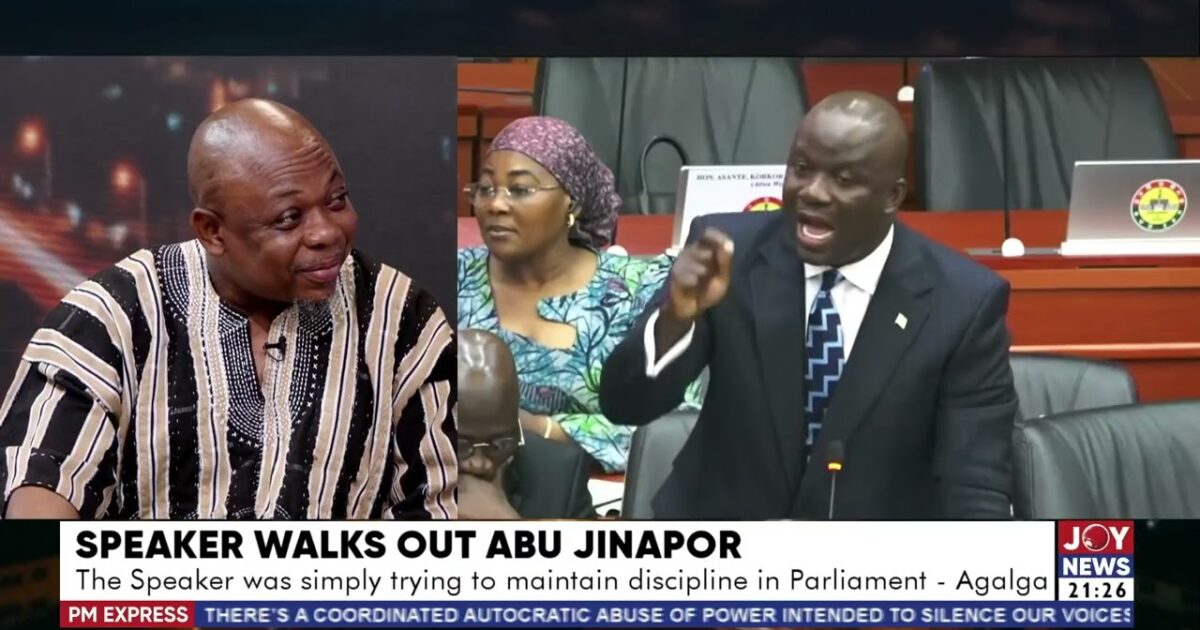

Majority Leader in Parliament, James Agalga, has defended Foreign Affairs Minister Samuel Okudzeto Ablakwa over allegations of irregularities in the issuance of Ghanaian service passports, saying the minister acted appropriately by interdicting an officer implicated in the matter to allow investigations to proceed.
He said the minister could not be held culpable merely because the alleged misconduct occurred within an institution under his supervision, particularly when he had taken steps to address the matter.
Mr Agalga maintained that the appropriate course of action was to investigate the officer concerned, establish the facts and impose sanctions if wrongdoing was proven.
Speaking on Joy News’ PM Express on Wednesday, November 3, he said the allegations he had been briefed on concerned service passports and should not be confused with claims about the sale of diplomatic passports.
“Those allegations, to the best of my knowledge, have nothing to do with diplomatic passports. I am told a certain individual who was even recruited into office in 2004 is complicit in some activities associated with service passports,” he said.
He explained that Mr Ablakwa had ordered the interdiction of the officer as soon as the matter came to his attention, thereby creating room for investigations without the officer remaining in active service.
Mr Agalga said such a response was consistent with the responsibility of a minister supervising an institution where alleged misconduct had been reported.
“The Foreign Affairs Minister, when the matter came to his attention, immediately caused the interdiction of the officer involved to pave the way for some investigations to be carried out. That is a business,” he said.
Prosecution possible if wrongdoing is established
The Majority Leader said the minister’s responsibility did not end with the interdiction but extended to ensuring that the allegations were properly investigated and that anyone found culpable faced the appropriate disciplinary or legal consequences.
He said the outcome of the investigations should determine the next course of action, including possible dismissal or prosecution.
“Ultimate responsibility requires that you deal with situations such as ensuring that proper investigations are conducted. And if the outcome of the investigation implicates the officers involved, then you exact punishment in accordance with the conditions of service, the code of conduct of that particular officer,” he stated.
He added that the sanctions could include dismissal and prosecution, depending on the findings.
Mr Agalga argued that the minister could be accused of wrongdoing if he failed to act after becoming aware of alleged misconduct within the ministry or an agency under his supervision.
However, he questioned why responsibility for the alleged actions of an officer should automatically be placed at the minister’s doorstep when steps had been taken to facilitate investigations.
“Beyond that, the only time you can accuse the minister of wrongdoing is if the minister fails to act,” he said.
Calls for parliamentary investigation
On whether Parliament should independently investigate the passport allegations, Mr Agalga pointed to the oversight responsibilities of the Foreign Affairs Committee.
He said the committee had the authority to summon the minister, the Director of Passports and other officials of the ministry to answer questions and provide information on matters arising within their jurisdiction.
According to him, the committee could initiate its own inquiry whenever members considered an investigation necessary.
“They have all the power at their disposal to summon the minister, including agency heads,” he said.
He added that the committee could invite officials to appear before it to explain the circumstances surrounding the allegations and respond to questions from members.
Mr Agalga, however, challenged the Minority’s approach to the matter, asking whether its representatives on the committee had formally activated the committee’s investigative powers.
He specifically questioned whether the Ranking Member of the Foreign Affairs Committee, Samuel Abu Jinapor, had initiated proceedings through the committee before raising the allegations on the floor of Parliament.
“The fundamental question I want to ask is, did Honourable Abu Jinapor, who is Ranking Member and the Minority on the Foreign Affairs Committee, trigger the investigative role of the committee they belong to?” he asked.
His comments come amid growing political controversy over the issuance of Ghanaian diplomatic and service passports.
The New Patriotic Party (NPP) has raised concerns about six individuals whose service passport applications it claims were approved using official designations that were inaccurate or did not correspond with their actual positions at the National Disaster Management Organisation (NADMO) and the Fisheries Commission.
In a petition dated October 30, 2026, the party asked the United States Embassy in Ghana to review the treatment of the affected passport holders and tighten checks on the documents. The claims remain allegations and have not been established by an investigation or court.
The controversy has also spilled into Parliament, where Mr Abu Jinapor raised separate allegations that diplomatic passports were being sold for between US$10,000 and US$50,000. His claims against Mr Ablakwa triggered a dispute with the Majority Leader and subsequently led to the Speaker ordering his removal from the chamber after he failed to substantiate the allegations.
Mr Agalga’s position is that allegations of misconduct within the Foreign Affairs Ministry must be investigated and that appropriate sanctions should follow where wrongdoing is established.
DISCLAIMER: The Views, Comments, Opinions, Contributions and Statements made by Readers and Contributors on this platform do not necessarily represent the views or policy of Multimedia Group Limited.
DISCLAIMER: The Views, Comments, Opinions, Contributions and Statements made by Readers and Contributors on this platform do not necessarily represent the views or policy of Multimedia Group Limited.
Source link