
By Kizito CUDJOE
The Ghana Chamber of Mines has pushed back against claims the mining sector retains less than half of its export value in-country, describing the widely cited 46.2 percent figure as methodologically flawed and warning that such analysis risks distorting economic policy.
This comes as scrutiny grows over the sector’s foreign exchange retention and its role in exchange rate pressures, with policymakers and analysts increasingly questioning how much value remains within the domestic economy.
Addressing participants at the Mining for Development Forum (MDF) in Goaso, Chief Executive Officer (CEO) Dr. Kenneth Ashigbey said the 46.2 percent retention ratio is based on a “fundamentally inconsistent comparison” that understates the sector’s domestic contribution.
He explained that the figure compares in-country expenditure of US$5.5billion – covering only large-scale mining companies that are members of the Chamber – against total mineral export earnings of US$11.9billion which include output from all producers, particularly small-scale miners.
“This is a classic scope mismatch: a partial measure placed over a total, producing a figure that systematically understates the sector’s domestic contribution,” he said.
He added that the small-scale mining segment, which industry data suggest accounted for about 40 percent of the country’s gold exports in 2024, is excluded from the expenditure side of the calculation while being included in the export denominator.
“Any honest accounting of value retention must treat both the numerator and denominator on a consistent basis,” he noted.
The 46.2 percent estimate has gained traction in recent policy discussions around export earnings and forex retention, but the Chamber insists the appropriate framework for assessing the sector’s contribution is domestic value added rather than ratios built on inconsistent aggregates.
It cautioned that policy prescriptions grounded in flawed analytics risk misdirecting interventions at a time when economic management requires precision.
“Ghana cannot afford that,” Dr. Ashigbey said.
The Chamber’s position comes amid renewed focus on the mining sector’s macroeconomic role, particularly its foreign exchange generation and linkages to the wider economy.
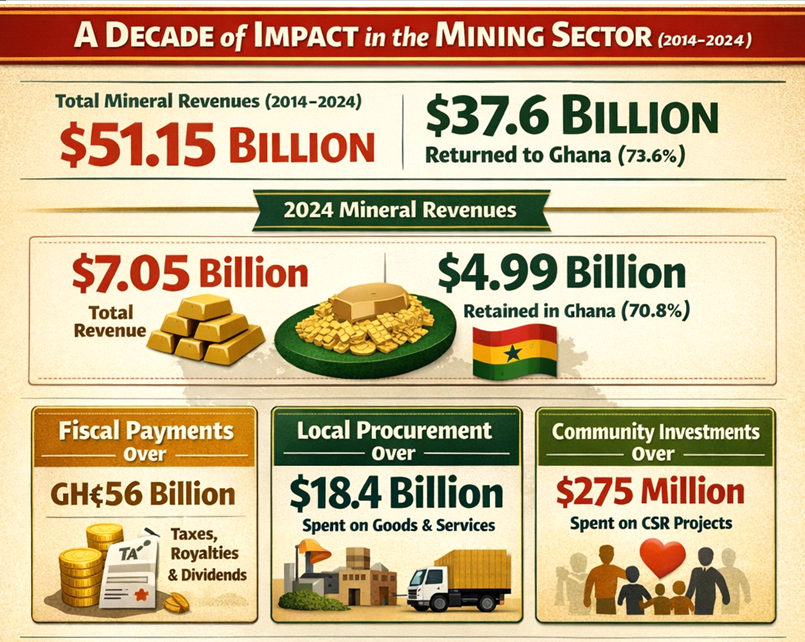
Data presented at the forum showed that between 2014 and 2024 the sector generated more than US$51.15billion in mineral revenues, of which about US$37.6billion representing 73.6 percent was returned to the country.
In 2024 alone, mineral revenues exceeded US$7.05billion with US$4.99billion retained domestically – translating into a retention rate of over 70 percent.
Beyond foreign exchange flows, member companies made fiscal payments exceeding GH₵56billion over the period: including corporate income taxes, mineral royalties, PAYE contributions and dividends.
The Chamber said debate should move beyond headline retention figures to a broader focus on value creation within the domestic economy.
While acknowledging that mineral royalties – over GH₵15.5billion between 2014 and 2024 – remain an important source of funding for mining communities, it argued that reliance on royalties alone is insufficient to drive sustained development.
Instead, it called for a shift toward building local industries around mining operations; thus leveraging procurement opportunities across the value chain.
Member companies spent more than US$18.4billion on goods and services locally over the last decade, with total in-country expenditure exceeding US$25.2billion when energy costs are included.
The CEO pointed to opportunities such as production of activated carbon, a key mining input with an annual budget exceeding US$40million, which could be developed locally using coconut and palm kernel shells.
“Ghana’s mining communities deserve more than a royalty cheque. They deserve a seat at the table of economic transformation,” he said.
Also speaking at the forum, Alex Kofi Annin – General Manager of Ahafo South Mine at Newmont Ghana – said mining continues to play a central role in the country’s economy but must deliver broader local benefits.
“From driving exports and fiscal growth to creating jobs and attracting investment, the industry makes an impact that touches countless lives,” he said, noting that communities expect a more direct stake in this value.
He added that while royalties have supported local development, deeper linkages with local businesses – from transport and catering to fabrication and logistics – are needed to sustain long-term growth.
Post Views: 1
Discover more from The Business & Financial Times
Subscribe to get the latest posts sent to your email.