


By Christabel DANSO ABEAM
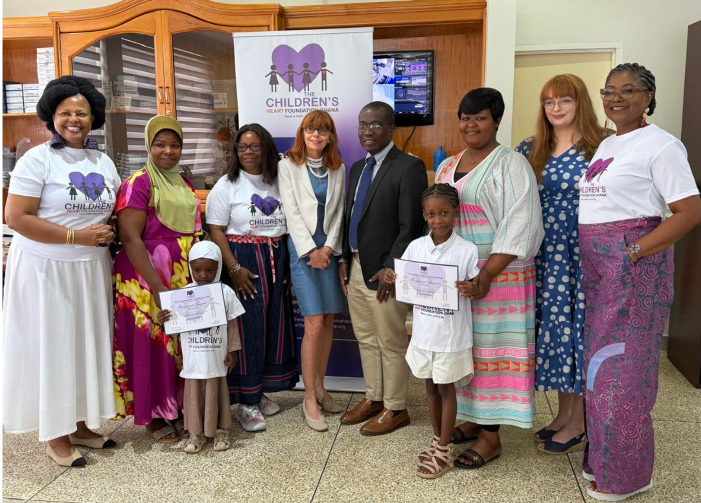
Two children born with congenital heart defects have undergone and are scheduled for lifesaving open-heart surgeries at the National Cardiothoracic Centre at the Korle – Bu Teaching Hospital (KBTH) in Accra, through support from the Children’s Heart Foundation Ghana and its partners.
One of the children has already successfully undergone surgery and is recovering, while the second is expected to have the procedure in the coming weeks.

Speaking on the initiative, the Australian High Commissioner to Ghana, Berenice Owen-Jones, said the intervention was driven by the belief that no child should die because their family cannot afford surgery.
She said congenital heart disease is common and treatable, but for many underprivileged families, the cost often around US$10,000—remains a major barrier.
The funding was mobilised through the Australian High Commission via a Melbourne Cup charity fundraiser. Additional support came from a health walk organised by the Children’s Heart Foundation Ghana, which saw participation from over 100 students and staff of Tema International School, SOS Hermann Gmeiner College and Al-Rayan International School.
Ms Owen-Jones also disclosed that her commitment was personal, noting that her daughter underwent life-saving heart surgery at age five in Australia and is now in her mid-twenties, healthy and thriving.

The Children’s Heart Foundation Ghana has supported over 250 children with cardiac surgeries over the past 15 years since 2011, but more than 50 children are still on the waiting list.
On Congenital heart disease
Congenital heart disease according to Dr. Kow Entsua-Mensah, a Ghanaian consultant cardiothoracic surgeon and the current Director of the National Cardiothoracic Centre (NCTC) at the KBTH refers to a group of conditions present at birth, often developed while the baby is still in the womb.
He also revealed in an interview with B&FT that it is one of the most common birth defects, affecting about one in every 100 children.
“Roughly half of affected children require medical intervention,” he established.
According to Dr. Entsua-Mensah, the conditions vary widely, ranging from simple holes in the heart to complex defects involving blocked, absent, or abnormal blood vessels, or multiple combined abnormalities.

He explained that some cases are mild and may close on their own, while others are severe and require urgent intervention within days, weeks or months after birth.
The less severe cases may be corrected later in childhood, sometimes around school age.
“Treatment options include minimally invasive catheter-based procedures, where a small tube is inserted through a blood vessel to close defects using a device, and open-heart surgery. In more complex cases, surgeons open the chest and connect the patient to a heart-lung machine, which temporarily takes over the function of the heart and lungs while repairs are made,” he explained.
He also indicated that condition can sometimes be detected during pregnancy through fetal scans when severe abnormalities are present. However, milder cases may only be identified after birth when symptoms appear.
On symptoms, he mentioned difficulty feeding—where the baby sucks briefly, becomes tired, rests, and resumes feeding and others may show bluish discoloration of the lips and skin due to low oxygen levels, or experience fatigue and breathlessness with minimal activity.
Risk factors linked to congenital heart disease include genetic conditions such as Down syndrome, a family history of heart defects, and maternal health conditions such as poorly controlled diabetes.
Also, exposure to certain medications during pregnancy and infections such as rubella have also been associated with developmental heart abnormalities.
Dr. Entsua-Mensah said that the backlog highlights the urgent need for sustained funding, improved access to specialised care and urged for effective partnerships between government, development agencies, and private institutions to support children with congenital heart disease.
Concluding, he also called for increased awareness and early detection through antenatal screening, which can help identify severe cases before birth and improve survival outcomes.
Post Views: 3
Discover more from The Business & Financial Times
Subscribe to get the latest posts sent to your email.