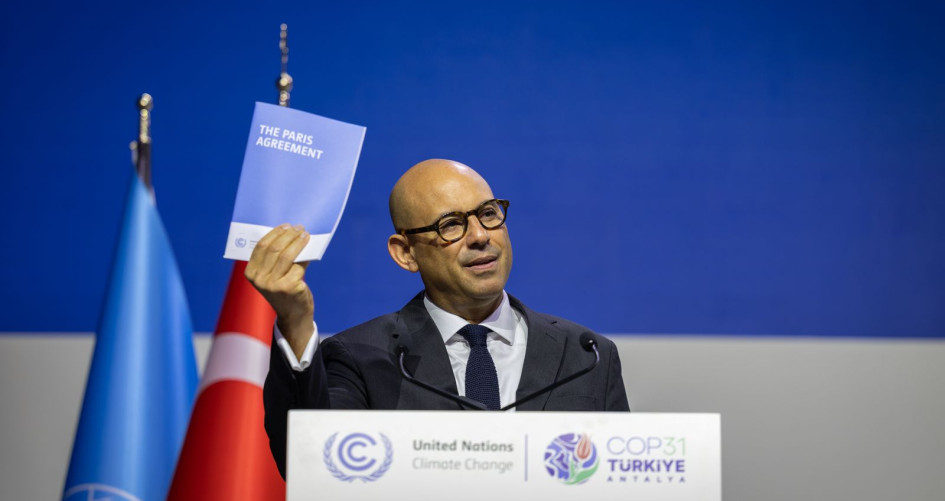

World leaders at the opening of COP31 in Antalya, Türkiye, have called for a stronger focus on implementing existing climate commitments, arguing that global targets and promises must translate into practical action that protects communities and strengthens economies.
UN Climate Change Executive Secretary Simon Stiell, COP31 President Murat Kurum and President of Negotiations Chris Bowen each used their opening statements to stress the need to move beyond setting climate targets towards delivering solutions at scale.
Their remarks placed climate finance, renewable energy, electrification, adaptation and resilience at the centre of the conference, while highlighting the importance of international cooperation and ensuring that developing countries can access the resources and technologies needed to respond to climate change.
The three leaders also acknowledged the widening gap between the climate action countries have promised and what vulnerable communities are experiencing.
For the COP31 Presidency, the central ambition is to make the conference an “Implementation COP” – one that focuses on turning international commitments into results on the ground.
Stiell: COP31 must turn targets into practical solutions
UN Climate Change Executive Secretary Simon Stiell said the international climate process had made important progress in setting global targets and providing direction to governments and markets, but that the pace and fairness of implementation remained inadequate.
He said COP31 must build on previous agreements by breaking down global targets and national plans into practical steps that can accelerate delivery.
“COP31 must supercharge solutions,” he said, arguing that the conference should focus on practical ways to deliver existing commitments.
Among the priorities he identified were addressing difficulties countries face in accessing climate finance, tripling global renewable energy capacity by 2030, strengthening electricity grids and reducing methane emissions, particularly from the oil and gas and waste sectors.
Stiell also highlighted the role of electrification in reducing emissions, saying that action on methane and electrification together could cut half a degree from projected global warming.
He said countries would have more opportunities at COP31 to coordinate the implementation of their climate commitments, with the conference’s Action Agenda providing a platform for collaboration between governments and other stakeholders.
However, he stressed that the Action Agenda should complement, rather than replace, countries’ formal commitments under the international climate process.
“The Action Agenda is not about giving countries a way out of delivering on their commitments. It is about boosting their implementation,” he said.
Stiell also called for developing countries to participate more fully in the Action Agenda, noting that many had not been able to take advantage of opportunities to build resilience and accelerate the transition to clean energy.
He invited countries to voluntarily nominate focal points who could receive information from the UN Climate Change Secretariat about progress and opportunities under the agenda.
Negotiations remain central
Despite the emphasis on practical solutions, Stiell said formal negotiations remained central to the COP process and that strong outcomes on mandated issues were necessary to help countries translate their targets into real-world results.
He identified the Just Transition Mechanism, adaptation, mitigation and climate finance as important areas requiring progress.
On adaptation, he said agreements could help establish a basis for distributing funds to countries and enable indicators to support progress at the national level.
On finance, he said negotiations should provide clarity on how to achieve the existing commitments of US$300 billion and US$1.3 trillion without reopening previous agreements.
He argued that the entire financial system would need to step up to support the delivery of those commitments.
Stiell also warned that the effects of climate change were intensifying, with vulnerable communities bearing the greatest costs.
Referring to recent impacts in the Himalayas and the threat of a strong El Niño, he said climate pressures were already affecting communities and economies.
“A monster El Niño is piling fuel on the climate fire that’s already burning through communities and economies everywhere,” he said.
He further argued that fairness must guide the global transition to clean energy and stronger climate resilience, particularly because countries and communities had unequal capacities to respond to climate impacts.
Stiell also pointed to the economic benefits of renewable energy, saying global renewables had saved around US$500 billion in the previous year and a further US$265 billion in the first half of the current year.
He said adaptation also offered returns on investment, making practical climate solutions important not only for protecting communities but also for strengthening economies.
However, he acknowledged financial pressures facing the UN Climate Change Secretariat, saying its responsibilities were increasing while available funding was declining.
“Mandates are growing. Funds are shrinking,” he said, adding that the organisation could not continue doing more with fewer resources indefinitely.
He cautioned that no single conference could resolve the climate crisis but said COP31 had a responsibility to deliver further progress.
“This is what the era of implementation looks like. So let’s get to work,” he said.
Kurum wants COP31 to bring climate decisions closer to people’s lives
COP31 President Murat Kurum said the conference must respond to a world facing interconnected challenges, including geopolitical tensions, economic uncertainty, food insecurity, unequal access to technology and worsening climate impacts.
He argued that climate change could no longer be treated as an isolated environmental issue because its effects were increasingly connected to food systems, energy, migration, urban development and human health.
“Climate policy today is also development policy. It is food policy. Energy policy. Urban policy. Health policy,” he said.
Kurum said countries might have different circumstances and resources, but they increasingly shared the same climate risks and responsibilities.
He called for dialogue, trust and cooperation to help close the gap between international commitments and the everyday experiences of people affected by climate change.
He said the decisions taken at COP31 would only have real value if they produced tangible benefits beyond the conference halls.
“Our decisions must take shape in a city’s infrastructure, on a farmer’s land and along a factory’s production line. Families must feel their impact in lower energy bills,” he said.
Kurum identified three principles guiding the COP31 Presidency: dialogue, consensus and action.
He said the world already had the knowledge, technology, finance, science and human capacity needed to respond to climate change. The challenge was ensuring that these resources reached the people and places where they were most needed.
He described this as reaching the “last mile” of climate action, whether in farming communities affected by drying soils, small island states facing rising seas or cities experiencing extreme heat.
“Success begins when our decisions reach that last mile,” he said.
35-by-35 electrification pledge and climate finance
Kurum also highlighted Türkiye’s 35-by-35 Global Electrification Pledge, which aims to increase electricity’s share of final energy consumption to 35 per cent by 2035.
He said achieving the ambition would require investment in renewable energy, electricity grids, energy storage, energy efficiency, clean transport and green industry.
He called for climate action to produce visible benefits for households through more energy-efficient buildings, cleaner public transport, affordable energy and new employment opportunities.
On climate finance, Kurum referred to the commitments made in Baku, where countries agreed on a climate finance target of at least US$300 billion annually by 2035 for developing countries, alongside a call to increase public and private finance to at least US$1.3 trillion annually.
He said the commitments must now translate into capital, investment and measurable results.
Kurum also outlined the Climate Implementation Bridge, an initiative intended to connect investors with projects requiring finance, countries seeking technology with potential providers, and local needs with global capacity.
He said the initiative was designed to help address the gaps between countries and communities that need resources and those with the financial and technical capacity to provide them.
He further emphasised the importance of trust in international climate cooperation, arguing that countries must be able to access resources, receive promised finance on time and have confidence that agreed decisions will be implemented.
Kurum said he wanted Antalya’s legacy to be a culture of cooperation rather than simply a list of decisions.
Drawing on the Turkish concept of imece, which he described as people sharing responsibility and working together when a task is too difficult for one person alone, he called for countries, institutions, scientists, businesses and financial organisations to contribute to a common climate response.
Bowen: World must keep 1.5°C within reach and accelerate climate action
COP31 President of Negotiations Chris Bowen said the latest climate science indicated that the world was likely to overshoot the 1.5°C warming threshold, but argued that countries could still return to that goal if they acted urgently and collectively.
He said the conference should build on the spirit of cooperation demonstrated at the Pacific Pre-COP in Fiji and Tuvalu, where countries called for faster climate action, easier access to finance and stronger resilience for communities, economies and oceans.
Bowen highlighted the unequal burden of climate change, particularly for Pacific island countries and other vulnerable states that have contributed relatively little to global emissions but face significant climate risks.
He also pointed to the effects of climate change, including glacial collapse in Nepal, heat-related deaths in Europe and the threat of an intensifying El Niño.
“Climate change is here. It is not a forecast. It is not a prediction. It is the lived reality for billions of people,” he said.
Bowen said the world had made progress since the adoption of the Paris Agreement, noting that projections of future warming had moved from nearly 4°C to around 2.6°C.
He also cited progress in renewable energy, saying global renewable electricity generation had almost doubled since 2015.
According to his statement, around US$2.2 trillion was invested in clean energy in the previous year, nearly twice the amount invested in fossil fuels.
He further said more than 160 countries had submitted updated Nationally Determined Contributions (NDCs), while more than 130 had submitted their first Biennial Transparency Reports (BTRs).
However, he stressed that the pace of implementation must increase.
Finance and adaptation among negotiation priorities
Bowen said one of the strongest messages he had received from countries was the need to unlock climate finance and make it easier to access.
He said many countries with credible energy transition and adaptation plans were unable to secure finance at the speed, scale or terms required to implement them.
“The countries that need climate finance the most are getting it the least,” he said.
He referred to Australia’s Access to Finance Statement and Action Plan for Small Island Developing States (SIDS) and Least Developed Countries (LDCs), launched at the Pacific Pre-COP, which focuses on making access to climate finance faster and simpler.
He said countries needed stronger project pipelines, greater mobilisation of public and private investment and more reliable delivery of finance to communities.
Bowen also called for stronger adaptation and resilience measures, including improved infrastructure, early-warning systems, institutions and community preparedness.
He said countries most exposed to climate risks needed access to partnerships, support and finance to prepare for, withstand and recover from climate impacts.
On the negotiations, Bowen said COP31 had more than 160 agenda items and 60 substantive negotiation mandates.
He identified priorities including operationalising the Just Transition Mechanism, strengthening the Mitigation Work Programme, advancing the Global Goal on Adaptation through a technical taskforce, improving climate finance delivery and access, completing the transition to the Adaptation Fund, following up on the commitment to triple adaptation finance and advancing cooperation under Article 2.1(c) of the Paris Agreement.
He also said science must remain central to the negotiations.
Presidency proposes a Party-driven decision
Bowen announced that the Turkish and Australian Presidencies intended to pursue a Presidency-initiated but Party-driven decision at COP31.
He said the proposed decision would be developed through consultation with countries and would reflect national circumstances and the current climate challenges.
He stressed that the initiative was not intended to duplicate existing negotiations or produce a lengthy political declaration.
Instead, he said it should provide a focused and practical response that recognises progress, addresses challenges and accelerates solutions to help keep the 1.5°C goal within reach.
Bowen said the decision should strengthen resilience, implementation and international cooperation while giving governments, investors, businesses and communities greater confidence that climate action was progressing.
He acknowledged that countries could hold different views on the proposed decision and its scope but said the Presidencies would work towards an outcome that could secure consensus.
“No country can achieve this alone. But together we can and must,” he said.
DISCLAIMER: The Views, Comments, Opinions, Contributions and Statements made by Readers and Contributors on this platform do not necessarily represent the views or policy of Multimedia Group Limited.
DISCLAIMER: The Views, Comments, Opinions, Contributions and Statements made by Readers and Contributors on this platform do not necessarily represent the views or policy of Multimedia Group Limited.
Source link