

A few weeks ago, news, videos and photos on xenophobic attacks on Ghanaians and Nigerians again dominated both mainstream media and new media. Previous attacks mostly focused on Nigerians and other Southern African nationals like Zimbabweans, Mozambicans, Zambians, Malawians and Angolans etc.
However, the recent attacks engulfed some Ghanaians, especially the gentleman who was grilled by a mob for allegedly possessing expired resident documents.
The mob led by a lady called Ngobese-Zuma ( alias Jacinta) created a tortuous scene that gave the Ghanaian no room to explain the circumstances surrounding his stay in South Africa.
Attacks on Ablakwa
I decided not to comment on the recent attacks because a lot of people had provided insightful analysis of the canker that has bedeviled South African off late. However, after watching a video posted on Tik Tok by a South African blogger I changed my mind. In the video, the South African man in a fit of anger used unprintable words to describe Ghana’s Foreign Minister, Mr. Samuel Okudzeto Ablakwa.
He described Me Ablakwa an an “evil and satanic man, and a liar.” The blogger then attacked Ghanaians for daring to remind South Africans about Ghana’s immense contribution to the fight against the evil system that held them under bondage for 46 years from 1948 to 1994.
Mr. Ablakwa’s crime was that he condemned the recent wave of xenophobic attacks, describing them as a betrayal of African solidarity. He criticised the mob attacks on fellow Africans, and an incident involving Emmanuel Asamoah, a Ghanaian whose assault was captured in a video that went viral on social media.
The enraged South African blogger ignorantly stated that Ghana had made no contribution to the fight against Apartheid. He simply referred to Dr. Kwame Nkrumah as a Pan Africanist and nothing more.
He mockingly stated that Kwame Nkrumah played no role in South Africa’s struggles against Apartheid and challenged Ghana’s Foreign Minister to provide evidence of Ghana’s contribution to ending Apartheid. “Show us something we can see, put it on paper to prove Ghana’s contribution”, he stated.
This was where I saw the man as a very dangerous South African who was acting on ignorance and distorted history to create a false narrative in the minds of well-meaning black South Africans. His tantrums were laden with hate speech, carefully orchestrated to make Ghanaians easy targets for future xenophobic attacks in South Africa.
On the surface, it appeared that the issue was about a Ghanaian living in South Africa illegally, but from the venomous words of the blogger, there could be some underlying currents fueling the recent attacks on Ghanaians.
It may seem that some South Africans have some deep-seated hatred for Ghanaians that were never brought to the fore. According to him South Africans are people of resistance, who fought Apartheid with their own strength and resources to free themselves.
Attacks on Ghana

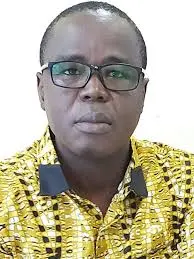
(The South African who is spewing venom against Ghanaians)
He argued that South Africans were never enslaved and never sold anyone as slaves during the Trans-Atlantic Slave trade. He then described Ghanaians as very inhuman people. ‘You sold your own people as slaves, and this is the history you never want us to talk about. We know your history, the reason why you have those dungeons is because your forefathers provided land to build the dungeons to facilitate the slave trade”, he added, “you guys went into the villages and brought your people to be sold as slaves, this is the history of Ghana.” What a time for the South African blogger to remind Ghanaians about our dark history.
In fact, I wonder why the blogger and other South African youth have taken their xenophobic attacks to such hateful levels. Are there some disputes between Ghana and South Africa that ordinary Ghanaians do not know?
The venomous and disrespectful words the guy spewed against Ghana is very disturbing and constitutes an affront to the longstanding diplomatic relations between Ghana and South Africa. The bitterness of some South Africans against Ghanaians, as depicted in the video calls for urgent response by our government. I suggest that government should consider evacuating Ghanaians who feel unsafe back home.
Investments in Ghana
On the issue of investments, he challenged Ghana’s Foreign Minister to provide evidence of black South African investments in Ghana, arguing that South African investments in Ghana are owned by white people. This is where his ignorance really got serious. Is he not aware that the so-called white South African investments in Ghana repatriate their profits to South Africa annually to boost the local economy?
It is the profit from all South African companies that are used to pay his salaries and government handouts to people. For instance, MTN Ghana, a subsidiary of MTN South Africa reported a profit after tax of GHS 7.8 billion for the in 2025. This represents a 55.9% increase in net profit compared to the previous year, driven by strong growth in data, fintech (Mobile Money), and digital services.
Most of this amount, if not all will be repatriated to South Africa. Is the South African aware that if Ghana, Nigeria and other African countries boycott goods and services from South Africa, its economy will collapse? It should not take even a child to appreciate the significance of returns of foreign investment to home country.
Evidence
He further argued that although Ghanan helped ANC during the struggle, that help did not benefit ordinary South Africans, adding that ANC does not own South Africa. This is where describing him as brainwashed man is apt.
For a reminder, ANC was the leading fighter and campaigner for the abolishing of Apartheid, so how can he argue that Ghana’s support for ANC did not benefit ordinary South Africans? “You tell us how much we owe you, so we can pay you back, but you need to produce a receipt”, he challenged Ghanaians. What kind of warped and infantile reasoning is this? Asking Ghanaians for a receipt to prove our support for ANC?
This is a clear case of toxic reasoning and lack of appreciation of the highest order among some South Africans, especially the unemployed youth. I wonder the kind of history that man and others studied in school, perhaps a distorted history that blurred his reasoning, that glorifies Apartheid and denigrates the contribution of fellow Africans to end Apartheid.
The youth of South Africa are rather blaming other Africans for lack of jobs and opportunities, when they should be holding their government accountable and fighting to correct the white dominance of their economy.
Government failure
But it must be on record that not all South Africans, support xenophobic attacks on other Africans. Perhaps, those fueling xenophobia are in the minority, however, if the majority are silent over what is becoming a festering phenomenon it might appear that they are supporting it.
The South African government led by Cyril Ramaphoza is disturbingly too quiet over South Africa increasingly becoming a dangerous place for other Africans to live. What we are witnessing is the reverse of Apartheid, where black South Africans now see themselves as superior to other Africans, and consequently beating, killing and looting their shops at the least provocation.
Black on black violence was the strategy Apartheid used to divide and rule South Africa for 46 years. It is therefore sad that after the fall of Apartheid South African blacks are using the same strategy against fellow Africans. This is not the South Africa of Nelson Mandella, Oliver Tambo, Walter Sisulu, Albert Luthuli, Winnie Madikizela-Mandela, Joe Slovo and Albertina Sisulu among others.
These patriots of blessed memory will be turning in their graves due to the failure of the current government to stem the tide of xenophobia. It appears that Cyril Ramaphosa’s government is making political gain by shifting its failure to create jobs for South African youth to other Africans.
The lone voice
Julius Malema is the lone voice calling for restraint and sanity in South Africa. In response to the recent xenophobic attacks Malema described all South Africans as foreigners because only a white South Africans have documents to prove ownership of their land. “You do not own anything, yet you are calling other Africans foreigners.
You are a foreigner yourself because you don’t own any land”, he pointed out in a speech posted on social media. He cautioned South Africans to stop the hate campaign against fellow Africans. Unlike those orchestrating the violence, Malema recalled the support Zimbabwe gave South Africa during the struggle. “They gave us safe passage, we stayed in their homes and ate their food; they never called us names, today it is our turn to say thank you, yet we have forgotten”, recounted.
Failure of ubuntu
Malema pointed out that attacking fellow Africans deviates from the spirit of ubuntu. Ubuntu is an ancient Southern African (Nguni) philosophy translating to “humanity to others” or “I am what I am because of who we all are”. It embodies a worldview of interconnectedness, sharing, and community, often summarized as “I am because we are”.
It embodies collaboration, cooperation and love rather than hatred, greed and xenophobia. Under the current circumstances, ubuntu has lost its philosophical and moral meaning. Malema further cautioned South Africans against the “culture of self-hate.” According to him, many South Africans lack confidence in other Africans because they are not confident themselves.
Emancipation
It has become scary to contemplate living in a country where I am not respected and safe. Attacks of these natures against Africans in Europe, America and Asia are normal because they do not regard us as human; but for fellow Africans to be maltreated and hated in an African country defeats our collective struggle to emancipate ourselves from mental slavery and continuous colonial domination.
Xenophobic attacks against fellow Africans is a complete reversal of the agenda to unite Africa as one borderless continent, which embodies the free movement of people and goods and services.
After the end of Apartheid South Africa was expected to lead Africa’s transition to a united continent, with a common market and a common voice at the UN Security Council.
As Africa’s biggest economy, South Africa was expected to be a haven for all Africans with the ambition to realize their full potentials. We saw a semblance of this leadership under President Nelson Mandella and Tabo Mbeki. Under Tabo Mbeki, South Africa gained a lot of respect, when he, John Kufuor of Ghana and Paul Kagame of Rwanda among others led the campaign on good governance and African peer review mechanism.
After Nelson Mandella and Tabo Mbeki South Africa recoiled into its pre-Apartheid era of violence and underdevelopment, especially attacks on other Africans. The Cyril Ramaphosa era will go down in history as a monumental failure in terms of creating jobs for the youth, correcting the historical evil of Apartheid, providing land for South Africans and the failure to protect other Africans.
Post Views: 55
Discover more from The Business & Financial Times
Subscribe to get the latest posts sent to your email.