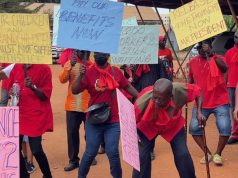

Although the country is in the midst of the rainy season, tractors remain idle across many of its major rice-producing valleys as farmers hesitate to begin cultivation.
Their reluctance stems from a persistent market crisis: more than 700,000 metric tonnes of paddy rice from the previous season remain unsold. With large stockpiles yet to find buyers, many farmers are struggling with cash-flow constraints and see little incentive to invest in a new planting season. Unless the marketing bottlenecks are addressed and demand improved, the prospect of another harvest risks deepening their financial losses rather than enhancing productivity.
A farmer and former director of the Peasant Farmers Association of Ghana (PFAG), Dr. Charles Nyaaba, who spent the past week touring the rice valleys of the North, Volta and Oti Regions, confirmed that farmers have abandoned their fields as the glut has locked up planting capital.
“They owe combined harvester operators; others bought paddy rice on credit and haven’t paid. They told me it doesn’t make sense to continue farming when what they have produced is yet to be sold,” Dr. Nyaaba explained.
Despite assurances that government would mop up the excess grain, farmers on the ground say no tangible intervention has taken place. According to the farmers in the northern belt, only about 20 percent of last year’s over 960,000-metric-tonne harvest has been sold so far.
Dr. Nyaaba himself indicated he plans to cultivate only half of his farm, confirming thousands of farmers across the country face a similar fate.
Government’s flagship “Feed Ghana” programme has been rolled out with pledges of input support and mechanisation services.
“We just call on the Ministry of Food and Agriculture: whatever support will come to the farmers should come now. If it comes late, it might not yield the expected impact,” he stated.
Reacting to news that rice farmers in the northern belt plan to cultivate only 50 percent of their production capacity in the 2026 season, the Head of the Economics Department at the University of Professional Studies, Accra (UPSA), Professor Abdullah Mumuni, warned that the impact on the economy will be severe.
“If they are going to reduce production, it will affect employment; it will also affect food production and that will have influence on our GDP,” he said. Halving local production capacity risks increasing import volumes, further straining on the local currency.
Data from the Ministry of Food and Agriculture, between 2008 and 2020, paddy rice production was in the range of 302,000 metric tonnes and 987,000 metric tonnes (181,000 to 622,000 metric tonnes of milled rice). However, rice consumption reached 1.45 million metric tonnes in 2020, due to rapid population growth, urbanisation and inadequate local production.
Post Views: 2
Discover more from The Business & Financial Times
Subscribe to get the latest posts sent to your email.