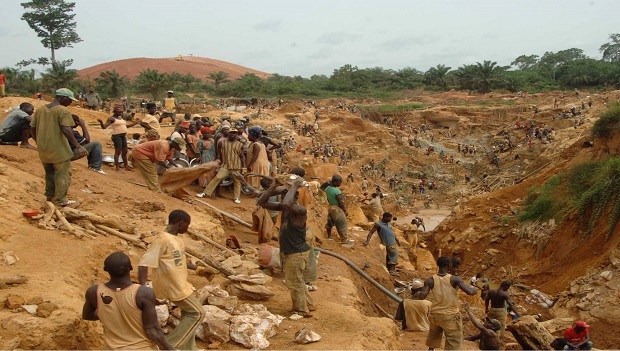
A security expert has warned that illegal mining, commonly known as galamsey, could create conditions that fuel violent extremism in Ghana if the growing insecurity and conflicts in mining communities are not urgently addressed.
Mutaru Mumuni Muqthar, Executive Director of the West Africa Centre for Counter-Extremism, says illegal mining areas are increasingly becoming vulnerable to violence due to the proliferation of firearms, disputes over mining concessions and political interests.
He described the situation as a major security concern that requires urgent attention, warning that the challenges could become more complex in the coming decade if left unresolved.
Mr Muqthar was speaking in an interview with the GBCNEWS at a three-day regional consultation in Goaso in the Ahafo Region, organised by the National Security Council Secretariat to review Ghana’s National Framework for Preventing and Countering Violent Extremism and Terrorism.
The consultation, implemented through the Ghana National Counter-Terrorism Fusion Centre, brought together representatives of civil society organisations, security agencies, traditional authorities, religious leaders, women and youth groups, political actors and local government institutions.

The engagement is intended to gather views from communities on security concerns and identify practical measures to strengthen Ghana’s preparedness against violent extremism and terrorism.
Mr Muqthar explained that although Ghana has not experienced a terrorist attack on its territory, the country is not immune to the threat, particularly with extremist activities spreading across neighbouring countries, including Burkina Faso and Mali.
He identified youth unemployment, unresolved conflicts, poverty, inequality and marginalisation as some of the conditions that could make vulnerable people susceptible to extremist recruitment.
According to him, conflicts in mining communities, chieftaincy and land disputes, as well as tensions along ethnic and religious lines, must be addressed as part of efforts to prevent violent extremism.
He stressed that terrorism does not emerge from a single cause, but often develops from a combination of social, economic and governance challenges.
Mr Muqthar said the increasing availability of firearms and violent confrontations in some illegal mining communities were particularly worrying.
He warned that the situation required stronger government intervention, improved local governance and sustained efforts to resolve disputes before they escalate.
He also called for greater investment in youth employment and the provision of essential social amenities, including roads, schools, healthcare and potable water, especially in underserved communities.
Mr Muqthar said Ghana’s history of relative peace and stability remained an important strength in preventing violent extremism, but urged citizens not to take the country’s security for granted.

He encouraged the public to remain alert, pay attention to unusual activities in their communities and report credible concerns to the appropriate security agencies.
He cautioned against individuals who use promises of quick wealth and attractive opportunities to lure young people into dangerous activities or extremist networks.
He further emphasised the need for national unity, saying extremist groups often exploit divisions among communities to advance their interests.
“Ghana is one. We are all one people,” he said, urging citizens to reject ethnic and religious divisions.
Mr Muqthar disclosed that his organisation had, over the past 12 years, trained more than 12,200 security personnel and community leaders in preventing and countering violent extremism, conflict prevention and peacebuilding.
He said the organisation had also helped prevent 23 radicalised young people from leaving Ghana to join extremist groups and trained 360 border security officers in 12 districts in northern Ghana over the past two years.
He described the National Framework as an important whole-of-government and whole-of-society strategy that requires the active involvement of state institutions, traditional authorities, civil society and ordinary citizens.
He urged the government to strengthen the implementation of the framework and intensify public education through initiatives such as the See Something, Say Something campaign.
An Academic, Professor Yunus Dumbe of the Department of Religion and Human Development at the Kwame Nkrumah University of Science and Technology (KNUST), also spoke to GBCNEWS. He said Ghana’s democratic stability has contributed significantly to its peace, but warned that internal governance challenges must not be overlooked.
He identified political corruption, youth unemployment and poverty as issues that could undermine public confidence in state institutions and create frustration among young people.
Professor Dumbe said Ghana must learn from the experiences of neighbouring countries affected by terrorism, including Burkina Faso, Côte d’Ivoire, Togo, Nigeria and Mali.
He called for stronger public education on the threat of violent extremism and encouraged citizens to report suspicious activities to the appropriate authorities rather than take matters into their own hands.
He also urged government to provide border security personnel with the necessary resources and motivation to improve their work.
Professor Dumbe said traditional authorities, security agencies, religious leaders and youth groups must work together to identify and address threats within their communities.
The regional consultations are expected to cover Western North, Ahafo, Bono East, Ashanti and Greater Accra in 2026, following engagements in the Oti and North East regions in 2025.
A national-level consultation is expected to take place in 2027 as part of efforts to strengthen the country’s response to violent extremism and terrorism.
The organisers say the consultations will help ensure that the revised framework reflects the security concerns and realities of communities across the country.