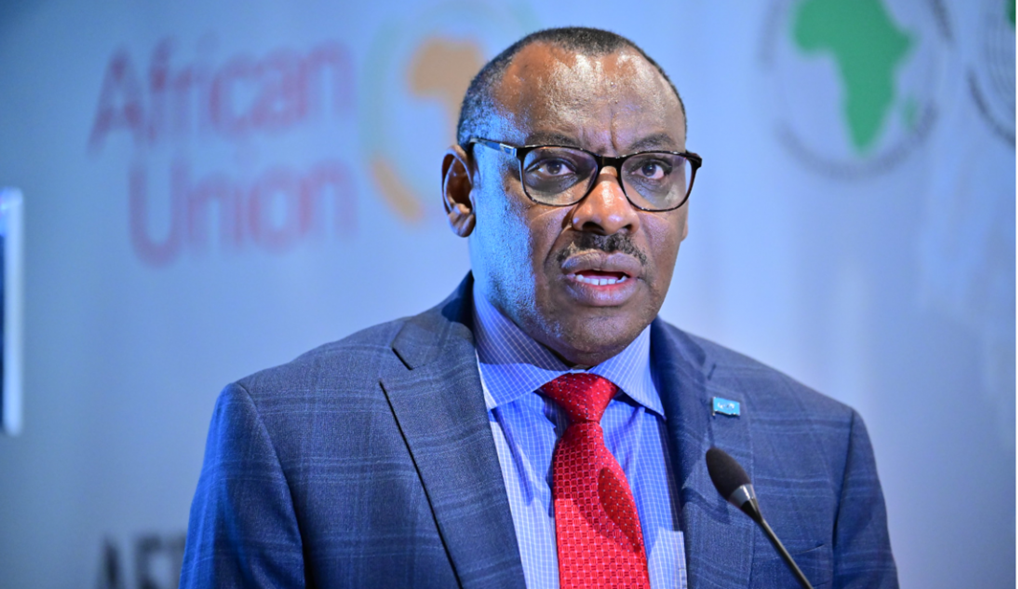
The Executive Secretary of the Economic Commission for Africa (ECA), Dr Claver Gatete has warned that any country that wants to compete in this 21st century cannot do so on analog foundations and must shift to digitize.
“No country can compete in the 21st century on analog foundations,” he said and called on African countries to accelerate their digital transformation.
He noted that they need to “power, connect, and digitize” their economies.
Dr Gatete was speaking at the Conference of African Ministers of Finance, Planning and Economic Development (CoM2026), where policymakers and experts gathered to examine how innovation, data and new technologies can drive growth and create jobs. Discussions focused on what it will take to build more competitive, higher-productivity economies, strengthen skills for a changing labour market, improve access to finance for businesses, and scale innovation, including frontier technologies such as artificial intelligence that are reshaping productivity and labour markets.
Africa has a problem of rising unemployment, and the continent’s labour market is under growing pressure, and the pace and scale of job creation are not keeping up with its fast-growing population, leaving policymakers, economists and innovators searching for solutions that can deliver at scale.
ECA’s Sustainable Africa Series, Ojoma Ochai, Managing Director of Co-Creation Hub, said in an interview that the growing focus on innovation and emerging technologies to create jobs and expand economic opportunity reflects what practitioners in the tech ecosystem have long been working toward.
She pointed to a persistent gap between ideas and implementation.
“There’s a lot of research going on, but the research hardly translates into industry or new products,” she said.
To address that gap, she said Co-Creation Hub has been working across the innovation ecosystem, supporting startups, building talent, and creating pathways that connect research to market. She gave the example of Uni:nnovators programme, which is being implemented across Namibia, Nigeria and Kenya, where students are supported through design sprints and hackathons to develop solutions and build ventures, ranging from health to agriculture. Beyond supporting startups, the work also focuses on building talent and connecting people to opportunity.
“We don’t expect the founder of a startup to have all the skills. Through our ecosystem, we’re finding ways to connect people to the talent that they need,” Ms Ochai said.
That includes job matching, skills development, and strengthening capabilities across the broader ecosystem.
For many innovators, building solutions is only the first step. Expanding them across markets and reaching enough people to make a broader economic impact often proves more difficult.
Ms Ochai said her organisation has built its work around the idea of a more connected Africa, supporting entrepreneurs to move across markets and navigate the realities of expansion.
“We believe in the potential of a connected Africa, and we’ve codified that into our programmes,” she said.
That includes helping entrepreneurs move into new markets and facilitating what she described as “soft landings”, from licensing and regulatory requirements to office space and local networks.
Across the continent, technologies such as artificial intelligence, digital platforms and mobile payments are beginning to reshape sectors from agriculture to finance, expanding access and improving productivity.
Digital payment systems and mobile money, for example, are lowering transaction costs and broadening access to financial services, while e-commerce and cross-border payment platforms are supporting more efficient trade across African markets.
Yet, the ability to scale these innovations across countries remains uneven.
Mr Gatete noted that “despite the expanding digital activity across the continent, a significant share of value continues to accrue elsewhere,” underscoring the need for stronger governance frameworks, regulatory systems and digital taxation to ensure African countries retain and capture value from their own data.
As economies evolve, education and training systems will need to keep pace, ensuring young people are equipped with the skills required for a changing world of work.
Adequate financing will also be critical to ensure that these initiatives and opportunities can scale.
At CoM2026, there was broad agreement that innovation, powered by data and new technologies, is no longer optional. It is central to how Africa creates jobs, drives productivity and builds more competitive economies.
Source: ECA