
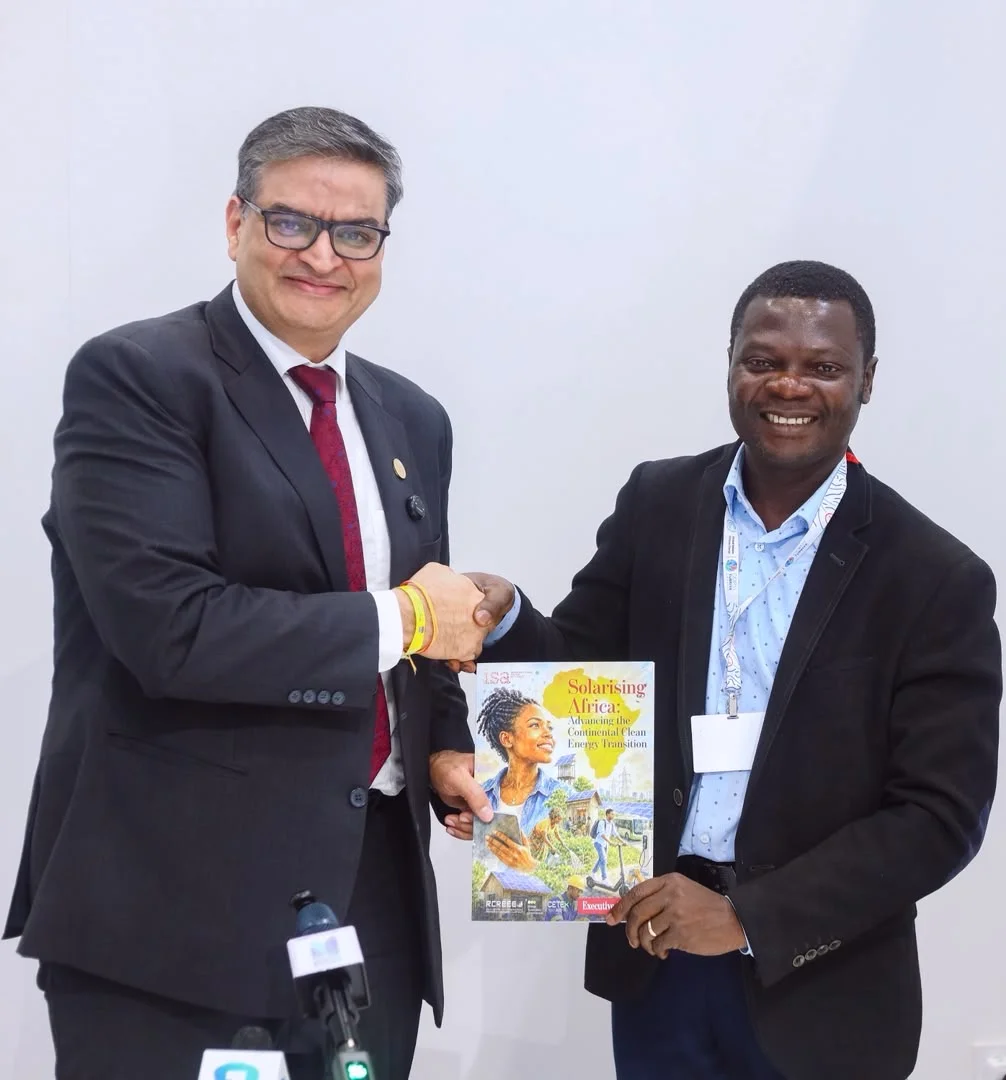
The International Solar Alliance (ISA) has presented a comprehensive solarisation roadmap to the Jospong Group of Companies (JGC) at the ongoing 31st United Nations Climate Change Conference (COP31) in Antalya, Türkiye, paving the way for a proposed strategic partnership to accelerate renewable energy deployment, promote green investments and strengthen Africa’s transition towards carbon neutrality.
The proposed collaboration seeks to leverage the technical expertise and financing opportunities of the ISA alongside Jospong Group’s extensive operational presence across Africa to develop sustainable solar energy solutions for industrial operations, agriculture and communities.
Presenting the roadmap, the Director-General of the International Solar Alliance, Mr. Ashish Khanna, emphasised the urgent need to address Africa’s energy access challenges through innovative financing, strategic partnerships, technology transfer and local capacity development.
He noted that approximately 600 million Africans still lack access to electricity, despite the continent’s enormous renewable energy potential.
Africa, he indicated, accounts for only about 1% of installed global solar photovoltaic capacity, while receiving approximately US$9 billion of the US$521 billion invested in renewable energy globally in 2024.
These disparities, he explained, demonstrate the need for stronger partnerships between governments, development institutions and private sector operators to unlock Africa’s solar energy potential.
The ISA, an intergovernmental organisation comprising 116 member and signatory countries, is pursuing an ambitious target of mobilising US$1 trillion in solar investments by 2030 under its implementation-driven agenda.
The proposed ISA-Jospong partnership focuses on four major areas designed to accelerate solar energy adoption and sustainable development across Africa.
The first component involves establishing a dedicated Solar Academy to equip young Africans with practical skills in solar technology, installation, maintenance and renewable energy systems.
The initiative is expected to promote technical expertise, create green employment opportunities and develop a skilled workforce capable of supporting Africa’s expanding renewable energy sector.
The second component seeks to unlock climate-smart agricultural financing to support the deployment of solar-powered irrigation pumps, particularly for smallholder farmers.
The initiative would help reduce dependence on conventional energy sources, improve agricultural productivity and strengthen food security.
The ISA has identified solar-powered irrigation as a major opportunity for Africa, where only about 4% of cultivated land is irrigated, compared with 37% in Asia and 14% in Latin America.
The third component focuses on facilitating the transfer of modern solar technologies, technical knowledge and international best practices to strengthen local expertise and support renewable energy innovation.
This would enable Jospong and other African institutions to adopt cost-effective solar solutions while building the technical capacity required for sustainable operations.
A major highlight of the proposed partnership is the solarisation of Jospong Group’s 36 waste treatment plants in Ghana, which would serve as a flagship project for subsequent expansion into other African markets.
The initiative forms part of Jospong’s broader green transition strategy, which includes plans to convert approximately 1,000 waste collection trucks from diesel to electric power, supported by solar mini-grids, charging stations and energy storage infrastructure.
The proposed solarisation programme is expected to reduce operational dependence on fossil fuels, improve energy security and lower the carbon footprint of the Group’s waste management operations.
Speaking during the engagement, the General Manager of the Jospong Green Transition Office, Dr. Ing. Glenn Kwabenah Gyimah, welcomed the roadmap and reaffirmed the Group’s readiness to work with the International Solar Alliance to advance renewable energy investments across Africa.
“Jospong stands ready to begin with solarising our 36 plants in Ghana and to extend this model to our Africa projects. This reflects our strong commitment to low-carbon project development and to minimising the footprint of our products and services as we drive towards our carbon neutrality agenda,” he stated.
Dr. Gyimah emphasised that the proposed partnership represents a significant opportunity to integrate renewable energy into Jospong’s operations while supporting Africa’s wider climate action and sustainable development objectives.
He noted that the Group’s growing investments in green technologies, waste recovery, recycling and sustainable infrastructure provide a strong foundation for the adoption of solar-powered industrial systems.
Jospong’s green transition efforts have also attracted international recognition through carbon financing initiatives.
At COP28, the Group secured Swiss Government authorisation for internationally transferred mitigation outcomes from its composting facilities, with an estimated value of US$20 million by 2030.
The initiative is expected to support further investments in sustainable infrastructure and community development.
The proposed collaboration is expected to support Jospong’s expanding environmental services and infrastructure operations in African countries, including Nigeria, Uganda, Kenya, Tanzania, Ethiopia, Guinea and Liberia.
It also aligns with the ISA’s Country Partnership Framework, through which the alliance works with participating countries to accelerate solar investments and strengthen institutional capacity.
Ghana signed its Country Partnership Framework with the ISA in September 2025, identifying solar rooftops, community mini-grids, agricultural applications and capacity development as priority areas.
The engagement at COP31 therefore presents an opportunity to translate these commitments into practical private sector-led projects with measurable environmental, social and economic benefits.
With Africa facing persistent electricity access challenges despite its abundant solar resources, the proposed ISA-Jospong partnership could provide a replicable model for integrating renewable energy into industrial operations, municipal services and agricultural development.
For the Jospong Group, the roadmap represents another significant step towards achieving its carbon neutrality ambitions while contributing to Africa’s clean energy transition through innovation, strategic partnerships and sustainable investments.