Gavi, the Vaccine Alliance today announced it would make up to US$ 50 million available through its First Response Fund (FRF) to support the response to the ongoing Bundibugyo ebolavirus outbreak. Of the US$50 million investment, which is the highest amount that can be approved by the Gavi Chief Executive Officer without further approvals from the Gavi Board, up to US$40 million will be dedicated to accelerating vaccine access while a further US$10 million will be directed towards supporting outbreak response needs.
“While we are some way off having a safe and effective vaccine against Bundibugyo virus, we need to act now to ensure that, once one or more vaccine candidates are ready, manufacturers are in a position to start producing doses at scale,” said Dr Sania Nishtar, CEO of Gavi, the Vaccine Alliance. “Leveraging this allocation, Gavi will work closely with CEPI and partners to design the right incentives to achieve this goal, exploring all options including potential Advance Purchase Commitments. This effort, alongside ensuring emergency funds are on hand to support outbreak response and protect routine immunisation services in the communities impacted, is exactly what our First Response Fund was designed for.”
Enabling vaccine access
The First Response Fund is the only globally approved mechanism that allows “at-risk” financing for scaled-up production of vaccines under development. This means Gavi is able to make vital early investments even when development outcomes are uncertain.
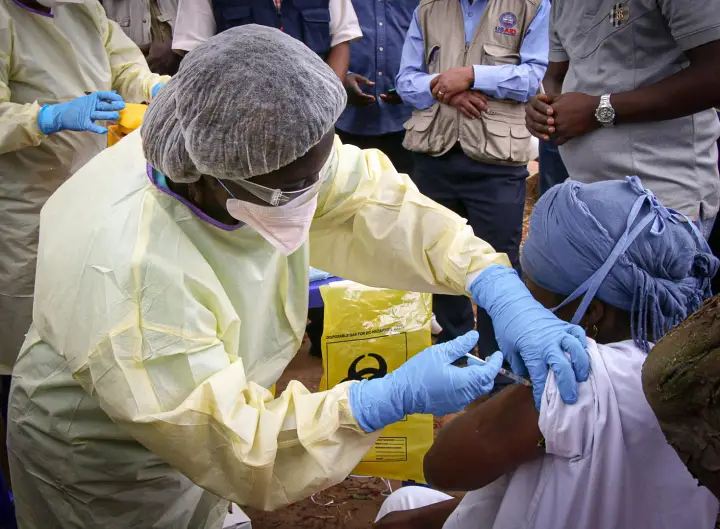
The US$40 million in immediate surge financing that has been approved today will enable manufacturers of the leading candidates of a vaccine against the Bundibugyo virus to directly commit to high-capacity manufacturing. This in turn will ensure that, as soon as clinical trials demonstrate positive outcomes, investigational vaccine doses* could be deployed rapidly to support outbreak response. Looking to the longer-term, Gavi will also provide incentives for manufacturers to adopt the fastest pathways towards WHO Emergency Use Listing (EUL) and/or WHO Prequalification (PQ), which are critical global approvals that will enable the rapid use of these vaccines in future emergencies.
In the coming weeks, Gavi will finalise the design of a financial mechanism that leverages the US$40 million FRF allocation to achieve these vaccine access goals, in close partnership with the Coalition for Epidemic Preparedness Innovations (CEPI) as well as WHO, Africa Centres for Disease Control and Prevention (Africa CDC) and UNICEF. The final design will take into account the characteristics of individual vaccine candidates and the needs of their manufacturers and may include mechanisms such as Advance Purchase Commitments. Work will also be undertaken to ensure successful candidates from African-based vaccine manufacturers can benefit from accelerated support through Gavi’s African Vaccine Manufacturing Accelerator (AVMA) initiative.
In particular, close alignment with CEPI will ensure a coordinated approach to funding across the full continuum of vaccine development, production, licensing and delivery. CEPI plays a critical role as a “push” funder, enabling rapid research and development (R&D) steps and locking in the initial production of vaccine candidates for clinical trial purposes. Gavi, meanwhile, acts in a complementary “pull” capacity to ensure manufacturers can make higher-scale production and development investments faster, i.e. offering the financial incentive to accelerate all the steps towards EUL / PQ submission, while also providing financing to secure investigational doses that can be used for outbreak response (in alignment with WHO recommendations and regional and national response plans).

Supporting outbreak response
In addition to these investments, Gavi will also immediately release US$ 10 million to support countries and partners with outbreak response.
This funding will support implementation of national outbreak response plans, including targeted investments to protect routine immunization, protect health care workers and ensure readiness for future vaccines. Gavi will work closely with countries, partners including Africa CDC, WHO, UNICEF, World Bank, and donors to ensure these investments complement other efforts.
—
NOTES TO EDITORS
*Usage of investigational vaccines doses in response to outbreaks is undertaken with strict protocols and in accordance with WHO recommendation and guidance, and with approvals from national authorities.
As the global vaccine alliance, Gavi is actively coordinating with CEPI, WHO, Africa CDC, UNICEF, World Bank, Pandemic Fund, and other partners on the response to this outbreak. For general details on vaccine development and the FRF, please refer to Gavi’s statement from last week: https://www.gavi.org/
Gavi First Response Fund
Gavi-supported Ebola vaccination
- Gavi first committed to supporting Ebola vaccination in 2014, during the deadly 2014–2016 West Africa outbreak – thereafter facilitating the use of investigational doses for outbreak response and accelerating the pathway to prequalification and the establishment of a global stockpile, which was launched in 2021.
- Gavi now funds the global Ebola vaccine stockpile, which contains Ervebo, the Ebola vaccine licensed for use against the Zaire species. It is maintained at 500,000 doses and can be used by any country in the world. Lower-income countries eligible for Gavi support receive doses for free, alongside financing for outbreak response vaccination activities.
- The global stockpile has been used to conduct four campaigns to respond to outbreaks of Ebola Zaire in the DRC – most recently in September 2025, when over 47,000 individuals were rapidly vaccinated – helping dramatically reduce cases and deaths.
- Gavi’s preventive Ebola vaccination programme: https://www.gavi.
org/news/media-room/gavi- announces-launch-preventive- ebola-routine-multivalent- meningitis-human-rabies-hep-b- vaccination-programmes - Approximately 55,000 frontline workers in Ituri and North Kivu in the DRC have received Ervebo through preventive vaccination campaigns.
- Preventive vaccination of frontline workers in Sierra Leone, a decade after the deadly 2014 West Africa Ebola outbreak: https://www.gavi.
org/news/media-room/decade- after-deadliest-ebola- outbreak-history-sierra-leone- begins-new-chapter
Impact of emergency vaccination during Zaire ebolavirus outbreaks
- A 2025 study published in BMJ Global Health analysed seven Ebola (Zaire) outbreaks between 2018 and 2022 where vaccines were available.
- The study showed that the outbreak-response vaccination reduced cases by 77% and deaths by 76% on average. Risk of large epidemics decreased from 71% to 43%.
- Overall, looking across five diseases, the study shows emergency vaccine response has cut infectious disease deaths by nearly 60% since 2000.
- Read more: https://www.gavi.org/
news/media-room/emergency- vaccine-response-has-cut- infectious-disease-deaths- nearly-60-2000
About Gavi, the Vaccine Alliance
Gavi, the Vaccine Alliance is a public-private partnership that helps vaccinate more than half the world’s children against some of the world’s deadliest diseases. The Vaccine Alliance brings together developing country and donor governments, the World Health Organization, UNICEF, the World Bank, the vaccine industry, technical agencies, civil society, the Gates Foundation and other private sector partners. View the full list of donor governments and other leading organisations that fund Gavi’s work here.
Since its inception in 2000, Gavi has helped to immunise a whole generation – over 1.2 billion children – and prevented more than 20.6 million future deaths, helping to halve child mortality in 78 lower‑income countries. Gavi also plays a key role in improving global health security by supporting health systems as well as funding global stockpiles for Ebola, cholera, meningococcal and yellow fever vaccines. After two decades of progress, Gavi is now focused on protecting the next generation, above all the zero-dose children who have not received even a single vaccine shot. The Vaccine Alliance employs innovative finance and the latest technology – from drones to biometrics – to save lives, prevent outbreaks before they can spread and help countries on the road to self-sufficiency. Learn more at www.gavi.org and connect with us on Bluesky, Facebook, Instagra