By Melissa Sackey
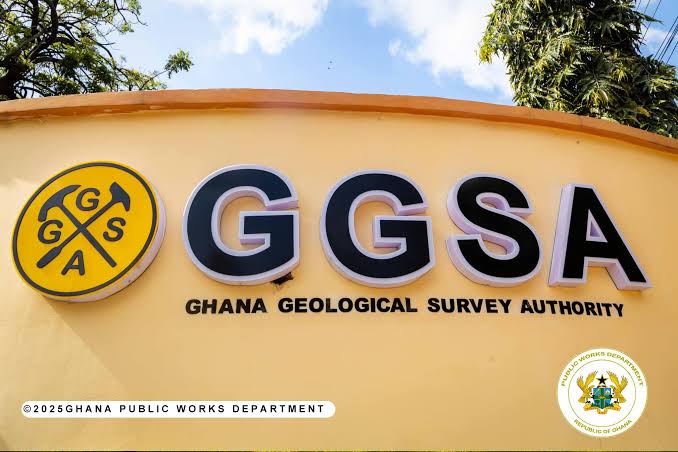
The Ghana Geological Survey Authority (GGSA) has introduced new regulatory frameworks to strengthen geological investigations, improve seismic monitoring and ensure the availability of reliable geoscientific information for national development.
At a press briefing organised by the Ministry of Lands and Natural Resources as part of its Progress Series, the Director-General of the Authority, Dr Prosper Aduah Akaba, said Ghana’s geological landscape held significant natural resources, including gold, diamonds, lithium, bauxite and manganese, making accurate geological mapping and reliable geoscientific information essential for understanding and managing the country’s resource potential.
Dr Akaba explained that reliable geological data was critical to investment decisions, noting that investors required credible information before committing capital, while district assemblies needed such data to guide development approvals and sustainable land-use planning.
He added that the government also depended on comprehensive geological information to formulate policies, attract investment and support national development.
To strengthen the sector’s regulatory framework, the Authority has developed seven draft regulations to operationalise Act 928 and establish standards for geoscientific activities.
Following stakeholder consultations, the regulations were laid before Parliament by the sector minister and came into force after the mandatory 21 parliamentary sitting days.
Among the regulations outlined by the Director-General is L.I. 2526 on Categories of Large-Scale Geological Maps, which sets requirements for the production and approval of geological maps.
L.I. 2527 on Earthquake Monitoring and Seismic Investigation establishes requirements for effective seismic monitoring and the protection of lives, property and infrastructure from earthquakes and related geological hazards.
L.I. 2529 on Ground Investigation provides for licensing procedures, standards for ground investigations and the establishment of a register of licensed practitioners.
L.I. 2530 on Geoscientific Standards and Codes of Practice establishes professional standards across geology, geochemistry, geophysics, geotechnical studies, hydrogeology, stratigraphy, exploration and small-scale mining.
Also included is L.I. 2531 on the Designation of Geoheritage and Geological Heritage Sites, which provides for the identification, protection and management of geological heritage sites, including requirements for nominating sites to the World Heritage List.
The sixth regulation, L.I. 2532 on Mineral Resources Exploration to Pre-Feasibility Study Stage, provides a regulatory framework for mineral exploration up to the pre-feasibility study stage.
The new regulatory measures are expected to improve professional standards, strengthen oversight of geological activities and enhance the availability of credible geoscientific information to support investment and sustainable national development.