By: Nana Karikari, Senior International Affairs and Political Analyst
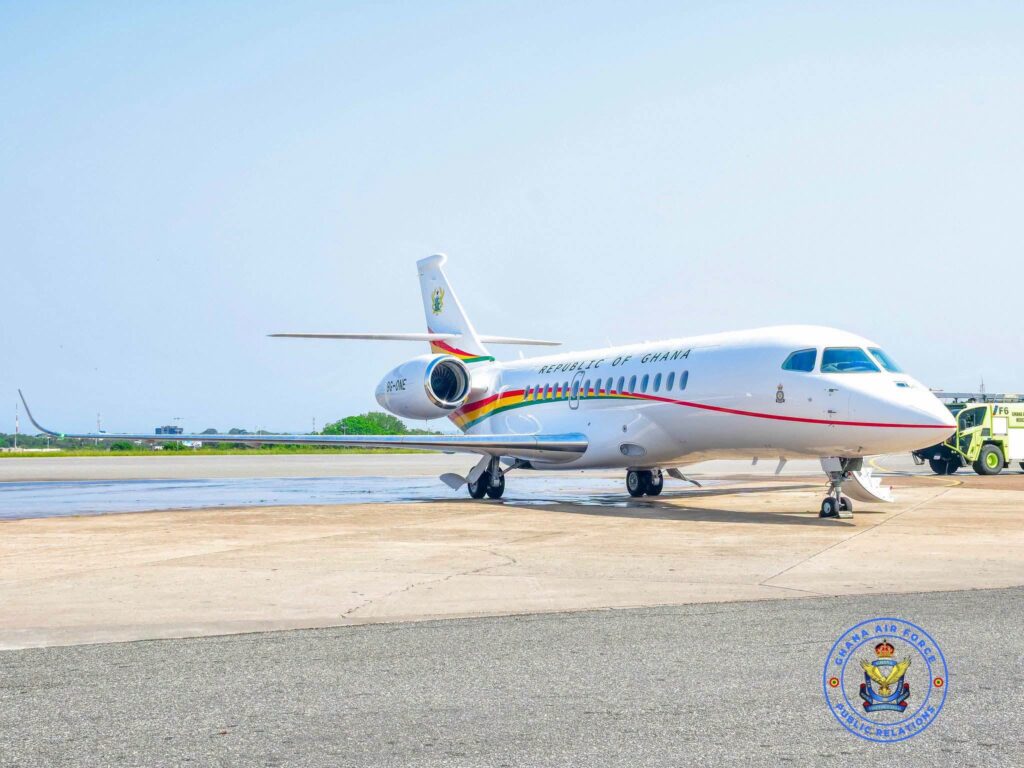
The government of Ghana is facing political and public scrutiny over its acquisition of a new presidential aircraft. The French-made Dassault Falcon 6X arrived on Monday, November 16, greeted by a ceremonial water salute from the Ghana Air Force. Priced between $60 million and $61 million—roughly GH¢720 million—the jet has drawn criticism from opposition lawmakers and citizens concerned about living costs and youth unemployment.
President John Mahama’s administration states that the purchase is a practical investment to replace an ageing, unreliable plane.
Critics, however, contend that the governing National Democratic Congress (NDC) has reversed its stance, noting that party leaders opposed similar acquisitions while in opposition.
The dispute unfolds as Accra works to demonstrate economic recovery following years of financial strain and a $3 billion—approximately GH¢36 billion—International Monetary Fund bailout.
Opposition Criticizes Spending Priorities and Past Stances
Opposition figures questioned the expenditure, arguing that public funds should address domestic economic pressures.
Samuel Abu Jinapor, Ranking Member of Parliament’s Foreign Affairs and Regional Integration Committee and former Lands and Natural Resources Minister, outlined the Minority’s objections. Speaking on JoyNews’ The Pulse on Tuesday, November 17, Jinapor pointed to financial challenges facing teachers, nurses, and judicial service workers, alongside youth unemployment.

“What was unacceptable in opposition cannot suddenly become acceptable in government merely because the occupants of power have changed,” Jinapor stated. He called for greater transparency regarding the financing and procurement process, noting that senior NDC figures had previously described the existing jet—acquired under former President John Agyekum Kufuor—as fit for purpose.
Jinapor referenced past remarks by Mahama, who had previously described buying executive aircraft as an act of “unpardonable disrespect and insensitivity.” Reading from an archived news report, Jinapor said, “Here we are, myjoyonline report, and I can hand it over to you, where President Mahama himself, then presidential candidate, states, and I quote, spending taxpayers’ money on luxurious jets, quote, is unpardonable disrespect and insensitive. And it goes on and on and on, how President Mahama was making the point that it is not prudent to spend money to purchase a presidential jet or to spend money for the President’s travels when it comes to a presidential jet.”
Jinapor also cited comments made by Foreign Affairs Minister Samuel Okudzeto Ablakwa on November 10, 2021. While serving as an opposition lawmaker, Ablakwa had argued that Ghana’s aircraft remained serviceable by pointing to Namibia’s 30-year-old presidential jet, the 31-year-old plane used by then-U.S. President Joe Biden, and France’s presidential aircraft commissioned in 2010.
“Not too long after, we have been told that somehow the Falcon is not fit for purpose, maintaining is so difficult, and so on and so forth. And you see the minority, and I quote, the minority will reject any move by the government to purchase a new presidential jet,” Jinapor said. Following his remarks, the parliamentary Minority announced plans to formally request full procurement records for the aircraft.
Jinapor further questioned the broader military aviation budget, noting that Parliament had programmed $1.2 billion—or GH¢14 billion—for two jets and four helicopters.
“The Minister is telling us that, in fact, the money that was approved by Parliament, the money that has been programmed to purchase two jets and four helicopters, is 1.2 billion United States dollars. If you convert it to Ghana cedis, it’s 14 billion Ghana cedis,” Jinapor argued. “Today, he says economic conditions are so good, and therefore, I think you should have found a different justification for this purchase of a presidential jet, and therefore, we are entitled as a country to spend 720 million Ghana cedis, and if you stretch it in terms of the plan that the government has, 14 billion Ghana cedis, ultimately, to purchase a presidential jet for the use of the president.”
Similar concerns appeared on social media platforms. “This money can employ over 100,000 nurses and 200,000 teachers,” one user posted on X, reflecting public debate over how state funds are allocated.
Government Officials Outline Economic and Operational Rationales

Members of the governing party presented differing emphases when explaining the timing of the acquisition. Peter Lanchene Toobu, chairman of parliament’s defence committee, said the NDC had never opposed acquiring a new jet in principle, but had objected to the timing during Ghana’s economic downturn.
“We agreed in principle that we needed to purchase a new presidential jet,” Toobu explained, noting that the purchase was not viable while negotiating the $3 billion—GH¢36 billion—IMF bailout. Now, he said, a stronger cedi and stabilized macroeconomic indicators allowed the state to fund the purchase without borrowing. “The strength and macroeconomic stability of this country have enhanced our status in the sense that imports have become cheaper, and this is the right time,” he said.
Minister of State in charge of Government Communications Felix Kwakye Ofosu offered a different primary justification. Ofosu noted that rising maintenance costs and the expense of chartering private flights drove the decision, rather than economic recovery alone.
“Nobody has said that we are going to buy a jet because the economy has improved…They were clear that given the frequent breakdowns of the Falcon 900, it had become economically unsustainable to maintain it as the primary aircraft of presidential travel because overall it costs more to maintain, and its absence also occasioned risks, where a president opts to charter a private jet,” Ofosu said.
Ofosu nevertheless pointed to lower inflation and resumed debt servicing as indicators of fiscal progress. He noted that while the previous administration defaulted on debt obligations and halted bondholder coupon payments, the current government pays bondholders ahead of schedule. He also cited lower commodity prices during an interview with JoyNews. “When I was campaigning in 2024, and I was donating cement, it cost GH¢115 a bag. Today, for GH¢80, you will get a bag of cement,” he said.
Fleet Modernization and Cabin Specifications
According to official statements, the procurement followed a military operational review. After an incident on August 6, the Ghana Air Force submitted a Cabinet memorandum citing frequent fleet breakdowns and spare-part shortages. The Air Force recommended acquiring four transport helicopters and two executive jets to replace the 16-year-old Falcon 900EX, which experienced fuel tank leaks and corrosion that grounded it in France for several months in 2025.
Parliament approved a reduced version of the proposal on December 4, 2025, following presentations by the Acting Minister of Defence and the Minister of Finance. “The government took the decision that we will purchase the four military helicopters and then one executive jet, which is the smaller one they recommended,” Ofosu said. The first Airbus helicopter arrived earlier this year, a second is scheduled to arrive within two weeks, and two more will follow. Officials added that the Falcon 6X provides a longer flight range, reducing refueling stops on international travel.
The acquisition also prompted online claims that the aircraft contains a private bedroom and shower. Ofosu denied those reports, explaining that the cabin is outfitted with standard reclining seats that convert into sleeping arrangements. “There certainly is no bathroom. President Mahama has no intention of bathing in the air,” he said.
Economists Weigh Operational Needs Against Fiscal Restraint
Independent analysts offered mixed assessments of the expenditure. While acknowledging the safety and reliability issues associated with operating an ageing aircraft, economists noted the political sensitivity of large capital purchases during a period of fiscal adjustment.

Professor Godfred Alufar Bokpin, an economist at the University of Ghana, stated that presidential safety is essential but questioned the timing given ongoing infrastructure needs and unemployment. “The timing makes it a bit difficult to understand,” Bokpin told the BBC.
He recommended that the government publish a cost-benefit analysis showing why purchasing the aircraft outright is more economical for Ghana than leasing.
As parliamentary oversight continues, the discussion surrounding the Falcon 6X highlights a central policy challenge for Mahama’s administration: addressing state aviation and security requirements while maintaining public confidence in fiscal discipline.