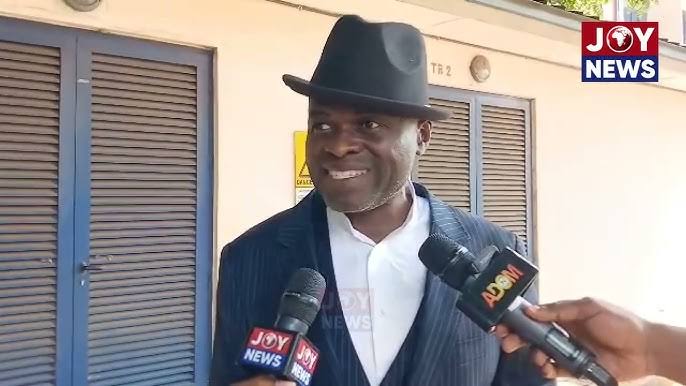
Private legal practitioner Martin Kpebu has called for a national dialogue on Ghana’s growing culture of political insults, arguing that arrests and prosecutions alone will not resolve the problem.
Speaking on Joy FM’s Top Story, Mr Kpebu said the controversy surrounding the “Ghana Jollof” TikTok account had exposed a broader problem with political discourse in the country that required collective action.
“The first thing I’m curious about is that we all want this menace of insults against politicians and other people in society to stop. That culture of vitriol, we want to control the vitriol. It’s getting out of hand,” he said.
Mr Kpebu acknowledged that the problem cuts across Ghana’s political divide, saying political actors and commentators on different sides have at various times used language that could be considered offensive.
He cited his own past comments as an example.
“Even me talking to you, for saying Akufo-Addo is ‘manpam,’ which is a song by a musician sung against him to hold him accountable — people say that my hands are also soiled,” he said.
He also referred to remarks previously made by President John Dramani Mahama, including his use of the phrase “Akyem mafia” and an occasion when he said the President jabbed him.
“So it appears we’ve all soiled our hands one way or another. That’s how come I thought that look, this thing is not about handcuffs and police cells and trials. It’s about a national conversation,” he said.
Mr Kpebu said such a conversation could provide an opportunity for political actors and citizens to agree on limits to abusive political discourse.
“So that when we have the national conversation, we’ll call a truce,” he added.
Mr Kpebu acknowledged that the content associated with the “Ghana Jollof” account had been particularly aggressive.
“Ghana Jollof’s vitriol is higher. Nobody has more vitriol than her,” he said.
“The moment I saw that her vitriol is higher, the speed at which she launches the insults, the other guys can’t match her, I said no, let’s do a national conversation.”
He said Barbara Asantewaa Kodua, who is identified by police as the alleged operator of the account, had previously indicated that she would stop if another prominent commentator, Kevin Taylor, was restrained.
“She has stated clearly that if we can rein in Kevin Taylor, she would stop. She said that several times. There was one she even addressed to me,” Mr Kpebu said.
Police have alleged that Ms Kodua is behind the “Ghana Jollof” account and that she paid Salomey Awiti Bafoh and others to help redistribute content. Those allegations are part of the ongoing investigation and have not been established by a court.
Mr Kpebu argued that taking legal action against individuals linked to the account would not necessarily stop the wider phenomenon.
“Yesterday, whilst we were having radio interviews about Salomey in custody, Ghana Jollof was blasting and blasting even the police. So she’s still out there,” he said.
His comments come after Ms Bafoh, a 40-year-old senior nursing officer, was remanded for two weeks by the Adentan Circuit Court after pleading not guilty to a charge of abetment of crime, specifically the alleged publication and circulation of false news. She is expected to reappear in court on September 30.
The prosecution alleges that Ms Bafoh acted as a liaison for Ms Kodua and helped recruit people to redistribute videos associated with the account. Police have also alleged that some of the content could cause fear, alarm or violence.
Mr Kpebu questioned whether continued detention was the appropriate response, arguing that investigators could have relied on less restrictive measures, including the seizure and examination of her phone.
He said the approach could have wider implications for public confidence and democratic freedoms.
The case has already triggered calls for Ms Bafoh’s release and a broader debate over the balance between freedom of expression, public order and accountability for online content.
NPP flagbearer Dr Mahamudu Bawumia has described the circumstances surrounding her arrest and remand as “very worrying” and called for her release, while maintaining that political insults should not be encouraged.
Government Communications Minister Felix Kwakye Ofosu, meanwhile, has said the government can tolerate criticism and insults directed at President John Mahama but would not ignore statements it considers capable of inciting violence or breaching public order.
Against that backdrop, Mr Kpebu is proposing a broader national conversation as an alternative to relying primarily on arrests, prosecutions and incarceration.
He said the objective should be to confront the culture of political vitriol collectively and establish a more sustainable way of managing disagreements in Ghana’s public discourse.
DISCLAIMER: The Views, Comments, Opinions, Contributions and Statements made by Readers and Contributors on this platform do not necessarily represent the views or policy of Multimedia Group Limited.
DISCLAIMER: The Views, Comments, Opinions, Contributions and Statements made by Readers and Contributors on this platform do not necessarily represent the views or policy of Multimedia Group Limited.
Source link