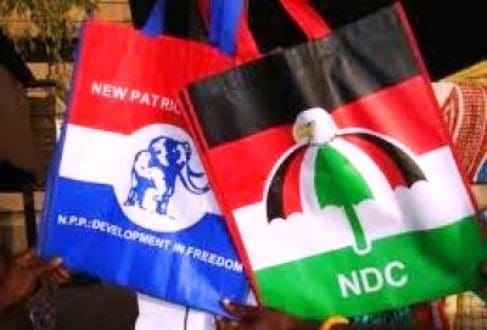
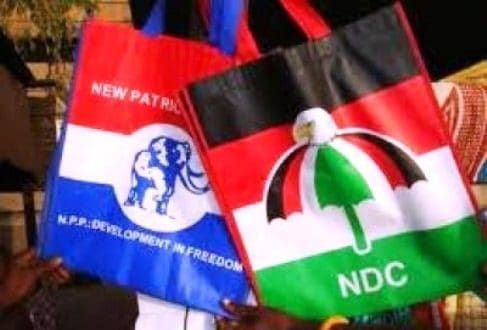

Veteran broadcaster Paul Adom-Otchere has argued that Ghana’s political duopoly remains unbreakable because the NDC and NPP have accumulated such structural and emotional capital that no splinter movement can realistically challenge their dominance.
Speaking on Channel One TV’s The Big Issue, the Good Evening Ghana host traced a long history of breakaway movements, from Goosie Tanoh’s National Reform Party to Nana Konadu Agyeman Rawlings’ Democratic Freedom Party, arguing that all lost relevance once elections concluded.
According to Adom-Otchere, most splinter movements in Ghana’s political history are driven not by ideological conviction but by what he termed “gross political impatience.” Their appeal, he contends, hinges almost entirely on the timing of their emergence relative to election cycles.
“Their relevance is always clothed in the fact that they have broken away from a big party ahead of an election,” he explained. “Once the polls end, they fade.”
The broadcaster likened the NDC-NPP dominance to historical blocs like the United Party and Convention People’s Party traditions, suggesting that Ghana’s constitution, which lacks proportional representation, has further cemented the two party stranglehold on power.
Adom-Otchere noted that while splinter parties such as Alan Kyerematen’s Movement for Change often fail to amass significant votes, their impact on public perception can prove decisive by weakening ruling parties during election years.
He referenced how Augustus ‘Goosie’ Tanoh’s breakaway from the NDC in 1999 weakened the ruling government ahead of the 2000 polls, a dynamic he believes mirrored Alan Kyerematen’s exit from the NPP in 2023 before the 2024 elections.
“It’s not about the votes they get,” Adom-Otchere stated. “It’s really about the impact they make, which then throws a huge advantage to the opposition party for that election.”
According to his analysis, the pattern remains clear. Breakaways that occur while the mother party governs tend to hurt it electorally, while those emerging during opposition periods have minimal or even reverse effects, sometimes consolidating the parent party’s strength.
“As soon as the election is over, their relevance evaporates,” he added. “They are unable to sustain momentum because their appeal hinges 80 percent on breaking away before an election.”
The broadcaster also challenged conventional thinking about how Ghanaians vote, insisting that citizens don’t truly vote for opposition parties but rather vote to punish incumbent governments regardless of opposition internal problems.
“Ghanaians don’t really vote for opposition parties,” he said, citing the 2016 general election when the NPP appeared disorganized yet secured its largest victory in the Fourth Republic. “Every headline then was about turmoil, chairmen being removed, party divisions, yet they won big. That tells you what Ghanaians were really voting against.”
This voting pattern, according to Adom-Otchere, reinforces why Ghana’s duopoly remains strong despite growing calls for a third political force. The two major parties benefit from entrenched structural advantages, historical loyalties and constitutional frameworks favoring winner-takes-all electoral systems.
However, the broadcaster suggested that electoral reforms might be necessary to encourage smaller political voices and create space for alternative ideologies to gain traction beyond mere protest voting.
“Perhaps it’s time to look at a system that gives room for smaller ideas,” he said. “South Africa’s proportional representation model, for example, allowed Julius Malema’s party to thrive. Ghana can learn from that.”
Proportional representation allocates parliamentary seats based on vote percentages rather than constituency victories, enabling smaller parties to gain legislative representation even without winning individual districts. This system operates successfully in countries like South Africa, Israel, Netherlands and New Zealand.
Ghana’s current first-past-the-post system requires winning constituency battles, making it extremely difficult for third parties to break through even with significant national support. A party could theoretically win 20 percent of votes nationwide but secure zero parliamentary seats if that support spreads thinly across constituencies.
Adom-Otchere also observed that media coverage patterns reinforce the duopoly, with journalists naturally gravitating toward NDC and NPP stories because they generate responses and counter-responses that sustain news cycles.
“Over the last 15 years, journalists have found NDC and NPP stories more relevant,” he noted. “Once you report one side, the other responds, and that’s how the duopoly feeds itself.”
This media dynamic creates a self-reinforcing cycle where third parties struggle for coverage, limiting their ability to build name recognition and credibility with voters who primarily consume mainstream political news dominated by the two major parties.
The analysis comes as some political observers predict that NPP-NDC dominance could eventually weaken within the next two decades, particularly if younger generations increasingly reject traditional party loyalties in favor of issue-based politics and new movements.
Constitutional lawyer Martin Kpebu recently predicted the duopoly will end within 20 years, though he acknowledged the current structure makes immediate change unlikely. He suggested demographic shifts and evolving voter priorities could gradually erode the two parties’ stranglehold.
Whether Ghana eventually adopts electoral reforms enabling multi-party representation remains uncertain. Constitutional amendments require significant political will and broad consensus, which the two beneficiary parties may resist absent overwhelming public pressure for change.
For now, Adom-Otchere’s assessment reflects the prevailing reality. Despite periodic excitement around breakaway movements and third party candidates, Ghana’s political landscape remains firmly controlled by the NDC and NPP, with no credible challenger emerging to disrupt their alternating grip on power.
The question is whether this duopoly serves Ghana’s democratic interests or whether genuine multi-party competition would improve governance, policy innovation and accountability. Those debates will likely intensify as frustrated citizens increasingly question whether two parties alone can adequately represent the nation’s diverse interests and aspirations.