

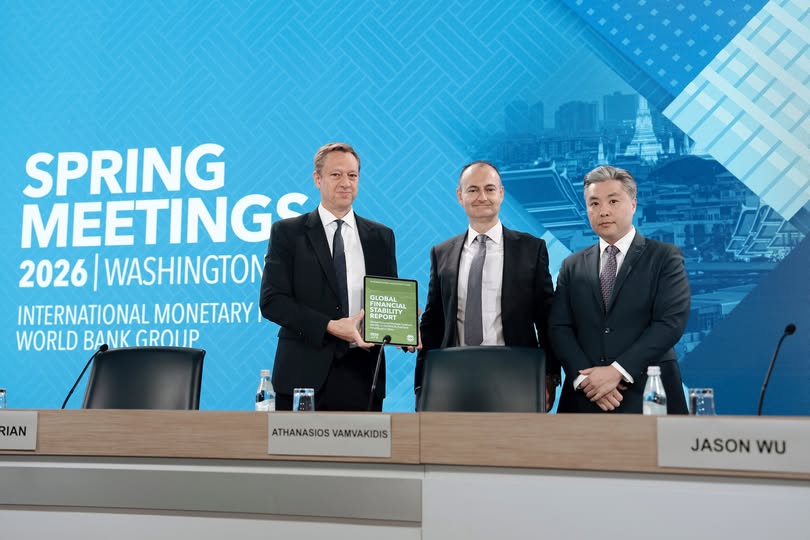
The International Monetary Fund’s latest Global Financial Stability Report says despite the turbulence caused by the war in the Middle East, the global financial system remains resilient.
It noted that while volatility had been evident, financial markets had avoided sustained stress seen in past crises with liquidity facilities from central banks and structural improvements such as central clearing helping to maintain orderly functioning.
Speaking during the briefing at the ongoing IMF/World Bank Group Spring Meetings in Washington, Tobias Adrian, IMF Financial Counsellor, noted that the banking sector remained well‑capitalised and liquid, providing a buffer against shocks.
“Financial markets are being challenged by the war in the Middle East. The financial system has been resilient so far… the banking system is not a worry at this point in this particular juncture,” he said.
The IMF Financial Counsellor was quick to add that resilience was not assured in all states of the world, especially in emerging markets, where non-bank flows could be subject to shifts in global risk appetite.
Mr Adrian also cited elevated public debt and private debt, a rollover risk, bank sovereign nexus, which continued to make bond markets fragile, private credit, as well as technology-related investments as vulnerabilities to financial sector resilience.
Providing the regional context, he stated that capital flows to sub‑Saharan Africa had reacted strongly to the conflict, but price movements remain contained, reflecting healthy global risk appetite and a stabilising factor.
In Asia, the most vulnerable economies were those heavily dependent on oil and food imports, he said, advocating targeted support for low‑income households alongside macroeconomic stability measures.
For the Middle East, decisive liquidity injections by policymakers had helped to sustain financial system functioning despite inflationary pressures and infrastructure damage while Dollar bond issuance remained possible, Mr Adrian noted.
However, he said: “Over the past five or six years, oftentimes governments have come in to support financial stability within the policy space. But the policy space has been drawn down in many countries.”
“Against this backdrop, it is very important for countries to safeguard financial stability by monitoring closely how vulnerabilities are evolving, taking market with intellectual actions where necessary, having strong oversight of the banks and the non-banks and being operationally ready to inject liquidity.”
In respect of the vulnerabilities in emerging markets, Mr Adrian called for exchange rate flexibility and credible monetary policies as shock absorbers, citing Egypt’s adjustment as a positive example.
“Going forward, maintaining financial system stability remains pretty paramount, and in particular, focussing on banking sector and how it could support the real economy after the war as we head towards the next stage of this conflict,” he stated.
Source: GNA