
- Board Chairlady turns crisis into catalyst and mobilises around acting CEO
- As transmission utility charts course beyond its worst operational crisis in years
- Only woman board chair in the energy utility entities signals infrastructure reset at historic staff Durbar
Ghana Grid Company Limited (GRIDCo) has indicated that the fire that destroyed its Akosombo switchyard control room last month will serve as the catalyst for a long-overdue infrastructure overhaul at the country’s most critical power transmission node; a commitment that has drawn alignment from the highest levels of government and the company’s own board.
Speaking at a Durbar convened to interact with staff following the restoration of the Akosombo Generating Station, Board Chairlady, Kuukua Maurice Ankrah said the company intended to build a state-of-the-art replacement for the destroyed facility.
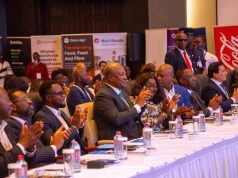
The occasion was itself historic, being the first time in GRIDCo’s 18-year history that the board has met staff in a collective forum of this nature. It brought together employees from across the company’s operational areas for direct engagement with the full board and senior management.
Noting that the board had toured the Akosombo switchyard just two weeks before the April 23 fire, the Chairlady said the visit would provide a meaningful baseline for what the rebuilt infrastructure should surpass.
“What has happened here is unfortunate, but it also gives us a clear responsibility, not just to replace what we have lost, but to build something better. What we put up must be modern, stronger, and fit for the critical role this station plays in our national grid,” she said.

Kuukua Maurice Ankrah brings considerable institutional and professional depth to the commitment. A lawyer of 24 years’ standing, she served on GRIDCo’s inaugural board from 2009 to 2013 before returning as chair, making her the first woman to hold the position and the only female board chair among the 17 entities under the Ministry of Energy and Green Transition.
Her appointment places a figure of rare institutional continuity at the helm of GRIDCo at precisely the moment its most consequential investment decisions in a generation are being made.
The board she leads reflects a deliberate breadth of composition. Odeneho Kwafo Akoto III, Paramount Chief and President of the Akwamu Traditional Council – whose traditional jurisdiction encompasses the Akosombo area itself, sits alongside Nana Amoasi VII, Chief of Ekumfi Abor in the Central Region.
Legislative representation comes from Solomon Kuyon, MP for the Krachi Nchumuru Constituency in the Oti Region, and Hon. Joseph Kwame Kumah, MP for the Kintampo North Constituency in the Bono East Region. Engineer Daniel Atchulo and Alhaji Muhammed Bashiru Nii Narh Alema complete a board whose span of traditional authority, parliamentary reach, technical expertise, and commercial experience.
The Chairlady noted that the board was not a passive observer during the crisis. She and Odeneho Kwafo Akoto III were at the Akosombo facility the morning after the fire, alongside the Energy Minister, as engineers began executing the bypass solution. An emergency board meeting followed on April 28, at which acting Chief Executive Engineer Frank Otchere briefed members on the incident and restoration progress.

The Deborah of our time
The acting chief executive, in his address to staff at the Durbar, drew on the biblical account of Deborah — a woman who arose to guide her people through a national crisis, to characterise the Chairlady’s conduct through the emergency, a characterisation she received with the measured confidence of someone who had already decided how she intended to lead. This gives credence to the President’s affirmative action plan.
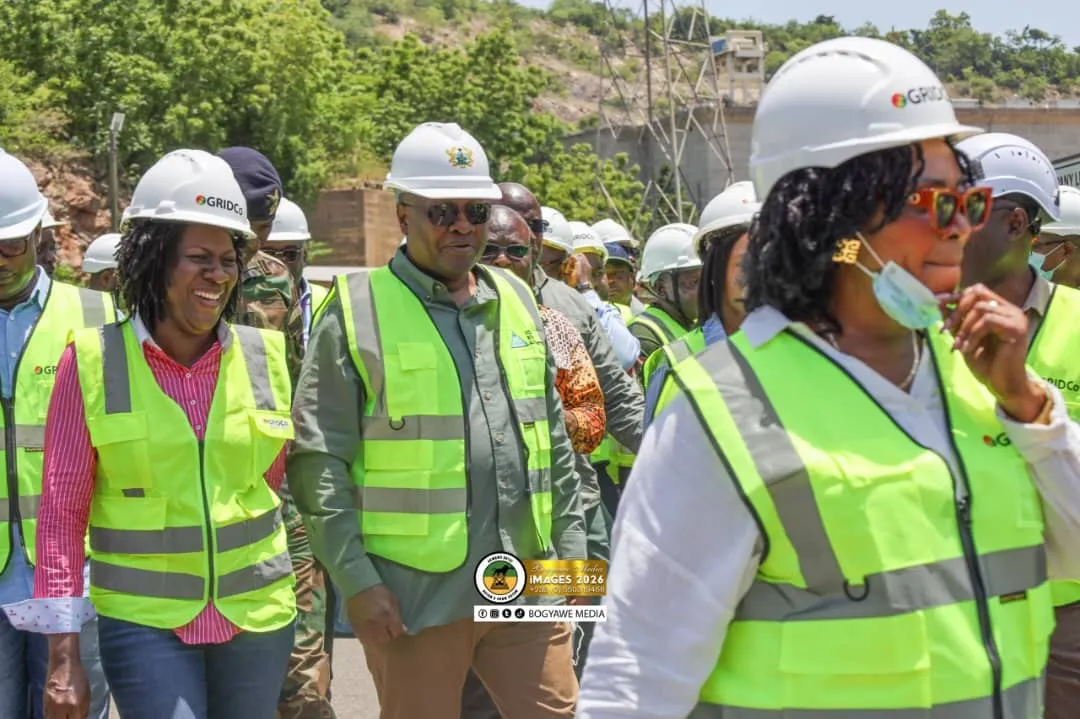
The commitment to rebuild echoes a position staked out by President Mahama during his visit to the Akosombo facility on April 30, the day full generation was confirmed restored; a visit the President used to praise the engineering teams and call for modern replacement infrastructure that would serve future generations.
On her part, the Chairlady commended the President’s personal engagement, in setting the tone for the restoration. She acknowledged the role President himself played when he personally visited the site a week after the fire outbreak and expressed her profound appreciation to the first gentleman of the land.
The convergence of signals from the presidency and the GRIDCo board gives the rebuild commitment a degree of institutional weight that previous infrastructure upgrade pronouncements in Ghana’s power sector have sometimes lacked.

The April 23 fire, which broke out at 2:01pm at the GRIDCo switchyard, destroyed the control room together with all switches, control, protection, monitoring and communication systems, cutting off the entire 1,020-megawatt installed capacity of the Akosombo Generating Station from the national grid and removing roughly 25 percent of Ghana’s average national electricity demand in a single event. The physical generating units remained intact, but without the destroyed control infrastructure, they were stranded.
A joint VRA-GRIDCo engineering team executed an emergency bypass, routing new power and control cables directly through cable trenches, re-engineering the switchyard’s transmission configuration, and remapping the entire protection and control scheme, restoring all six units within seven days. The Public Utilities Regulatory Commission confirmed full restoration on May 4.
The bypass, however, is an interim solution. Reconstruction of a permanent switchyard control centre is expected to take a minimum of six months. That six-month window is the operative planning horizon. During it, the national grid will operate with a critical node, one carrying a quarter of average national demand, dependent on improvised infrastructure.
Acting Chief Executive, Ing. Otchere was direct on the point when addressing staff at the Durbar. “We have made good progress in restoring power, but we are not out of the woods yet. What we have in place now is temporary, and there is still a lot of detailed work ahead to secure the system fully,” he said.
The cross-institutional collaboration that characterised the restoration effort was itself a source of institutional pride. The Chairlady noted that the seamless coordination between GRIDCo and VRA staff during the recovery had demonstrated what the sector was capable of when aligned around a common purpose.
“It was beautiful to see the collaboration between the VRA staff and the GRIDCo staff, you couldn’t tell who was VRA, you couldn’t tell who was GRIDCo. That is the kind of unity that we want to see,” she said.
The incident has reinvigorated a wider debate about Ghana’s transmission infrastructure. Analysts have noted that the country’s grid remains heavily dependent on a small number of high-capacity nodes, with the consequence that a single point of failure can produce national disruption.
Ghana’s installed generation capacity now exceeds 5,000 megawatts according to the Energy Commission, yet that capacity advantage offers limited protection when the transmission architecture connecting generation to distribution is concentrated and fragile.
Post Views: 1
Discover more from The Business & Financial Times
Subscribe to get the latest posts sent to your email.