A High Court ruling delivered on Wednesday, April 15, 2026, stripping the Office of the Special Prosecutor (OSP) of its independent prosecutorial authority has revived a debate that played out on the floor of Ghana’s Parliament nearly a decade ago.
Presiding judge Justice John Eugene Nyadu Nyante held that the OSP, though empowered to investigate corruption-related offences, lacks the constitutional mandate to independently initiate prosecutions. The court directed that all cases handled by the OSP be referred to the Attorney-General’s Department.
The ruling has cast legal uncertainty over several ongoing prosecutions, among them the 78-count corruption case against former Finance Minister Ken Ofori-Atta and seven others. Ofori-Atta is currently in US custody at the Caroline Detention Facility in Virginia pending extradition proceedings initiated by the Ghanaian government.
The1957News has reviewed the Official Hansard Report of Ghana’s Parliament dated Thursday, 26th October, 2017 (Fourth Series, Vol. 99, No. 15), which records the Second Reading debate of the Office of the Special Prosecutor Bill, 2017. The constitutional objections raised by members of both sides of the House during that sitting bear directly on the legal question the High Court has now ruled upon.
The OSP Bill before Parliament
Office of the Special Prosecutor Bill, 2017 was laid before Parliament on Monday, 31st July, 2017 by the then Attorney-General and Minister for Justice, Gloria Akuffo, under the Akufo-Addo administration. It was a commitment drawn from the NPP’s 2016 election manifesto and was intended to establish an independent office to investigate and prosecute corruption cases involving public officers, politically exposed persons, and private sector actors implicated in public sector corruption.
Moving the motion for the Second Reading, Gloria Akuffo told Parliament that the concentration of prosecutorial authority in the Attorney-General’s office had been identified as a key obstacle to effective anti-corruption prosecution. As recorded in the Hansard, she stated that:
“The monopoly of prosecutorial authority by an Attorney-General, who is hired and fired by the President, has been singled out by governance experts as one of the key factors that stand in the way of using law enforcement and prosecution as a credible tool in the fight against corruption,” she said.
She further told Parliament that the Bill was intended to give the Special Prosecutor operational independence and financial insulation from political interference, and that its passage would, in her assessment, have what she described as a monumental impact on the prosecution of corruption cases.
Committed raises early constitutional concerns
Before the floor debate commenced, the Parliamentary Committee on Constitutional, Legal and Parliamentary Affairs, which had conducted public consultations, a two-day stakeholder conference, and a clause-by-clause review of the Bill, had already identified constitutional concerns. Committee Chairman Ben Banda presented the findings to the House.
The Report noted that Clause 4(2) of the Bill as drafted was inconsistent with Article 88(4) of the 1992 Constitution, which vests prosecutorial authority in the Attorney-General, and recommended amendments. The Committee additionally raised concerns about provisions that could compel accused persons to disclose assets, the proposal to allow administrative asset freezing for up to 60 days without prior court authorisation, and the extent of powers assigned to the Bill’s governing Board, which members felt could undermine the independence the Bill was designed to create.
NDC Minority indicates support in principle but constitutional objections
Inusah Fuseini, who was at the time serving his third full term as Member of Parliament for Tamale Central, was among the most vocal on the constitutional question. Fuseini, who would voluntarily retire from Parliament ahead of the 2020 general elections by opting not to contest the NDC primary, told the House that the prosecutorial monopoly of the Attorney-General as set out in Article 88(3) of the Constitution could not be diluted through ordinary legislation.
“To dilute that monopoly of power would not require a law in Parliament; it would require a constitutional amendment,” the former Lands Minister said.
Fuseini went further, telling Parliament that what the Bill could legitimately achieve was limited to establishing a Special Prosecutor who would exercise powers conferred by the Attorney-General, not independent of the office.
He also questioned the appointment structure, noting what he described as an inherent contradiction in having the same President appoint both the Attorney-General and the Special Prosecutor.
“We are not talking about the establishment of an independent prosecutor. We are talking about the establishment of a Special Prosecutor. We admit that such a person would be under the directions and control of the Attorney-General. He or she would prosecute pursuant to article 88(4) by fiat of the Attorney-General,” he stated.
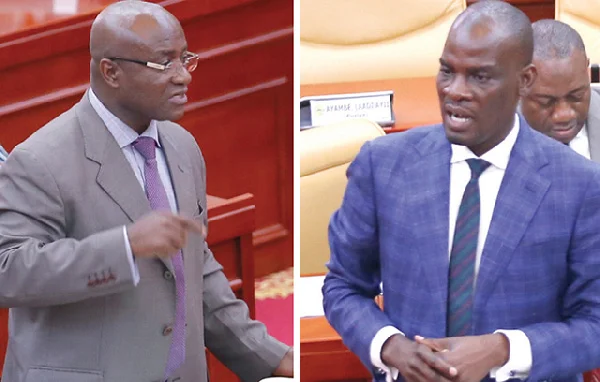
Dr Dominic Ayine, then Member of Parliament for Bolgatanga East, who had served as Deputy Attorney-General and Minister for Justice between 2013 and 2016 and who was appointed Attorney-General and Minister for Justice by President John Mahama in January 2025, told Parliament that the Bill as originally drafted carried significant constitutional deficiencies.
“With due deference to the Attorney-General and Minister for Justice, one could actually drive a truck load of constitutional issues through the Bill,” Dr Ayine said.
Dr Ayine noted that the Committee had admitted Clause 4(2) of the Bill was inconsistent with the Constitution. He also flagged the provision that would penalise an accused person’s right to remain silent as a violation of Article 19, and questioned the constitutional standing of the phrase ‘corruption related offences’ as a legal category. He told the House that when the Bill came to the Consideration Stage, the legal and technical issues would require thorough examination.
Mahama Ayariga, Member of Parliament for Bawku Central, questioned whether the OSP represented any genuinely new institutional architecture. He argued that the office as designed functioned no differently from any ordinary state attorney prosecuting a criminal case, and that the more effective path was to resource and strengthen existing institutions. Ayariga who is now the Majority leader, cautioned the House against legislation that could erode the constitutional protections of individuals.
“As a very senior lawyer, at the end of the day, it is the quality of the judgement, the conviction, reasoning of the judge, analysis of the facts and law, and application of the law to the facts, which would determine independence or otherwise of any prosecution,” he said.
Rockson-Nelson Dafeamekpor, Member of Parliament for South Dayi, noted that the scale of proposed amendments to the Bill was itself an indication of its deficiencies. Defeamekpor who is now Majority Chief Whip, told Parliament he had personally submitted 45 amendments to the Table Office on a 77-clause Bill that had attracted over 100 proposed amendments from the Committee. He warned that provisions allowing asset freezing before conviction risked eroding the constitutional presumption of innocence.
“We are beginning to be oblivious of the constitutional presumption of innocence until proven guilty by a court of law,” he said.
Bernard Ahiafor, Member of Parliament for Akatsi South, sought to correct what he described as a mistaken impression that the NDC was opposed to the Bill. The now First Deputy Speaker, stated the party supported the principle of fighting corruption but argued Parliament had a constitutional obligation to ensure the laws it passed were consistent with the 1992 Constitution.
“What is the need for Parliament to make a law when it knows that it has an infraction on the Constitution, only for that law to be shot down by the Supreme Court?” he questioned.
Then-Minority Leader Haruna Iddrisu delivered the most extensive legal address on the NDC side. He told Parliament the Bill amounted to a backdoor amendment of Article 88(3) of the Constitution, which states that the Attorney-General shall be responsible for the initiation and conduct of all prosecutions of criminal offences.
“That is where I dare say that this Bill is pregnant with constitutional flaws, and therefore can only give birth to an illegal child called a Special Prosecutor,” he said.
Iddrisu argued that since the Bill required the Special Prosecutor to operate on the authority of the Attorney-General, and since both the Attorney-General and the Special Prosecutor were to be appointed by the same President, the principle of prosecutorial independence had been defeated from within the Bill’s own framework. He further flagged potential violations of Article 18(2) on the right to privacy through the Bill’s interception provisions, and described the absence of bribery from the list of offences covered as conspicuous, given that bribery and corruption were twin evils.
He also raised incompatibility concerns between the functions of the proposed OSP and those of the Commission on Human Rights and Administrative Justice (CHRAJ) and the Economic and Organised Crime Office (EOCO).
Iddrisu recommended that appointment of the Special Prosecutor be subject to approval by a two-thirds majority of Parliament, and issued a specific caution to the House about the future of the law.
“The first person brought to court may have an opportunity to get the Supreme Court to make a pronouncement on this matter,” he said.
NPP Majority leans on constitutional grounding and policy necessity as defence
Yaw Boaben Asamoa, then-Member of Parliament for Adentan and Ranking Member on the Committee, rejected the NDC’s constitutional objections. He argued that Article 88(4) of the Constitution provided sufficient grounding for the Bill because it explicitly permits the Attorney-General to authorise other persons to prosecute.
“All offences prosecuted in the name of the Republic of Ghana shall be at the suit of the Attorney-General or any other person authorised by him in accordance with any law. I believe the Office of the Special Prosecutor is not just any law. It is one of those laws under which the Attorney-General and Minister of Justice could exercise his or her power to delegate to any other person to prosecute in his or her name,” he argued.
Asamoa told Parliament that concerns about the constitutionality of the Bill had a proper forum in the Supreme Court, and that this was not a reason for Parliament to withhold legislation.
Kwame Anyimadu-Antwi, Member of Parliament for Asante Akim Central, focused his contribution on the Bill’s institutional structure. He highlighted the four divisions of the OSP, namely the administrative, investigative, prosecutorial, and assets recovery divisions, and argued that the asset recovery mandate would serve as a meaningful deterrent to corruption.
Andrew Egyapa Mercer, then-Member of Parliament for Sekondi, acknowledged the Bill was not perfect and described that imperfection as precisely the reason Parliament existed. He described the OSP as a necessary institution given the scale of corruption in the country.
“This Bill is not perfect, and that is the reason the Constitution mandates the promoters of the Bill to submit it to this august House to perfect it. That is the duty of Parliament,” he said.
Joseph Kpemka, then Deputy Attorney-General and Deputy Minister for Justice and Member of Parliament for Tempane, told Parliament that comparable special prosecutorial arrangements had been adopted in advanced democracies and that Ghana’s establishment of such an office had attracted international commendation.
“The establishment of the Office of the Special Prosecutor is necessary now than ever before, to give practical meaning and demonstration to the President’s avowed aim of taking the fight against corruption to another level,” he stated,
Alexander Abban, Member of Parliament for Gomoa West, dismissed constitutional objections as speculative, arguing that if the law was found to be unconstitutional, the right forum was the Supreme Court once the law was in operation. He also defended the Bill’s asset freezing and recovery provisions.
Majority Leader’s address
Majority Leader Osei Kyei-Mensah-Bonsu anchored his defence of the Bill in the preamble to the 1992 Constitution and in Article 35(8), which enjoins the State to take steps to eradicate corrupt practices and the abuse of power. He told Parliament that probity and accountability were not the property of any political party but a collective national resolve expressed through a national referendum.
On the constitutional objections, he told the House that the Bill did not amend the Constitution but gave legislative expression to the opportunity already created by Article 88(4).
“What the Bill seeks to do, is to lift the opportunity afforded by article 88(4) to place this on a higher pedestal, and to give the officer who the Attorney-General may designate a greater focus. That is the remit of the Bill,” the then-Majority Leader said
He responded to the argument that existing institutions should simply be better resourced by saying that in corruption cases, financial incentives could never be a sufficient safeguard.
“In corruption cases, one could never provide sufficient motivation or incentives. For instance, today, if we pay an investigator an equivalent of US$10,000 per month and the person is to investigate a corruption case involving about US$200 million, would we be thinking that the person is not a human being?” he questioned.
Bill passed, OSP established
At the conclusion of the Second Reading debate, the motion was put and agreed to. The Office of the Special Prosecutor Bill, 2017 was subsequently enacted as the Office of the Special Prosecutor Act, 2017 (Act 959). Martin Amidu was appointed as the first Special Prosecutor under the Act.
Following Amidu’s resignation in November 2020, Kissi Agyebeng was sworn in as the second Special Prosecutor on 5th August 2021, for a statutory non-renewable term of seven years.
High Court ruling and OSP’s response
The High Court ruling of April 15, 2026 has given judicial weight to the constitutional arguments pressed by the NDC Minority during the 2017 debate. Dominic Ayine, who stood in Parliament in October 2017 and warned of constitutional deficiencies in the Bill, is now Ghana’s Attorney-General and Minister for Justice, the office to which the High Court has directed that OSP cases be transferred.
The OSP has rejected the High Court ruling, issuing a statement insisting the Office of the Special Prosecutor Act, 2017 (Act 959) remains valid and in force and that the matter has not been finally determined by the Supreme Court.
“The OSP firmly assures the public that all the criminal prosecutions it has commenced before the courts and all the criminal prosecutions it is about to commence before the courts remain valid and would proceed based on its mandate under the Office of the Special Prosecutor Act, 2017 (Act 959), which remains valid and in force as the matter has not been decided by the Supreme Court,” the Office said.
The 78-count corruption case against former Finance Minister Ken Ofori-Atta and seven others, widely regarded as one of the most significant corruption prosecutions in Ghana’s recent history, is among the cases affected by the ruling. Ofori-Atta is in US custody pending extradition proceedings.
The matter is expected to proceed to the Supreme Court for a definitive ruling on the constitutional question that both sides of Parliament debated in October 2017 but ultimately did not resolve.