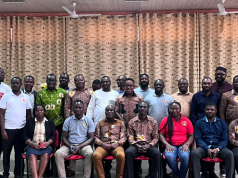



The Minister of Health, Kwabena Mintah Akandoh, says increased government spending on healthcare is beginning to improve access to services, as the government rolls out measures to strengthen primary healthcare and expand health infrastructure.
Speaking at a Health Sector Update Engagement in Accra, he said systems had been established to track expenditure and ensure that the resources allocated to the sector delivered measurable results.
Mr Akandoh said the government had earmarked GH¢32 billion for health sector expenditure in 2026, emphasising that investment in healthcare should be seen as a priority rather than a cost.
Mr Akandoh also highlighted the expansion of the government’s Free Primary Healthcare programme, which is currently being implemented in 135 districts and about 4,500 health facilities.
The Minister said the programme was expected to extend to 150 districts by the end of the year, urging the public to use the services for early screening, disease prevention and treatment.
Efforts are also being made to reach communities where access to healthcare remains a challenge. Mr Akandoh said 7,000 motorbikes and tricycles had been distributed to frontline health workers in hard-to-reach areas.
He added that about 8,000 additional health professionals had been posted and cleared to support healthcare delivery, particularly at the primary and rural levels.
On funding for healthcare services, the Minister disclosed that the government had so far paid GH¢2.1 billion in National Health Insurance Scheme (NHIS) claims to public, private and mission healthcare providers.
“Government has so far paid GH¢2.1 billion in NHIS claims to public, private and mission healthcare providers. The uncapping of the NHIL will allow more funds to go directly into patient care,” he said.
Beyond funding and service delivery, Mr Akandoh said the President had committed to constructing six 160-bed regional hospitals, with work already underway in the Oti, Western North and Savannah regions.
According to the Minister, a digital bed management system is being introduced to improve the allocation and management of beds in emergency units.
The rollout, he said, was intended to help tackle the persistent “no bed syndrome” in emergency departments.
Additional projects planned by the government include a 400-bed mother and child facility at the Korle Bu Teaching Hospital in 2027 and two new cardiology centres, one of which is expected to be located in the Western Region.
The engagement was attended by development partners, principal officers, nursing trainees, health sector unions and traditional leaders.
DISCLAIMER: The Views, Comments, Opinions, Contributions and Statements made by Readers and Contributors on this platform do not necessarily represent the views or policy of Multimedia Group Limited.
DISCLAIMER: The Views, Comments, Opinions, Contributions and Statements made by Readers and Contributors on this platform do not necessarily represent the views or policy of Multimedia Group Limited.
Source link