
By Kizito CUDJOE
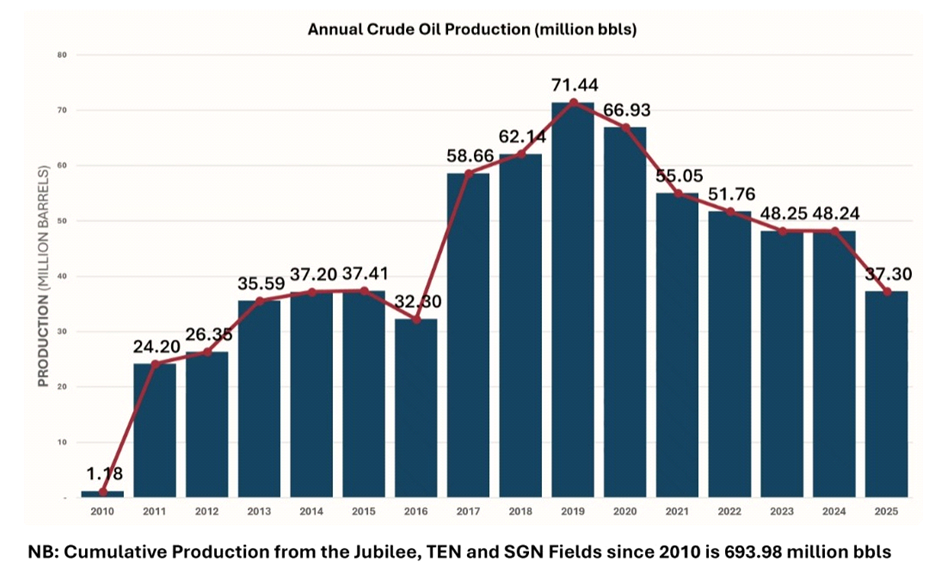
The country’s steady decline in oil production is emerging as a long-term threat to fiscal stability, eroding a once-reliable revenue stream and exposing the budget to heightened volatility at a time of tightening economic conditions, a resource governance expert has cautioned.
With crude output falling consistently after peaking in 2019 and petroleum receipts dropping sharply in recent years, the expert, who requested anonymity, warned that Ghana is entering a structurally weaker phase of its oil cycle – one defined not only by declining volumes but also limited new investment and weak financial buffers.
He said the trend raises serious concerns about sustainability of petroleum-funded spending and the state’s capacity to absorb future shocks in an inherently volatile sector.
According to the Public Interest and Accountability Committee’s (PIAC) 2025 annual report, crude oil production declined to 37.3 million barrels – down from 48.24 million barrels in 2024. This translated into a 43 percent drop in petroleum revenue from US$1.36billion to US$770million.
The figures point to a compounded annual average decline of about nine percent. The downturn has been worsened by delayed liftings and absence of inflows from the Tweneboa-Enyenra-Ntomme (TEN) field, further tightening revenue flows.
The expert noted that the trajectory has long been evident. “This trend has been clear for years. The issue is not whether production would decline, but whether we prepared for it,” he said, cautioning against an over-reliance on incentives as a quick fix to attract upstream investment.
While successive efforts have been made to revive activity through fiscal incentives and renewed investor engagement, he maintained that policy consistency remains the decisive factor.
“It is not one-off interventions that make the difference. What investors want is a stable policy environment – one that gives them confidence that their investments will not be undermined by changes in leadership or direction,” he said.
“Our fiscal regime, legal structures and investment policies must work together. Where there are uncertainties, particularly in resolving contractual and tax disputes, investor confidence is weakened,” he added, referencing disputes involving ENI, Springfield and other sector players.
Beyond attracting foreign capital, he pointed to a need for strengthening domestic participation.
“Entities such as the Ghana National Petroleum Corporation (GNPC) and its related companies have a role to play. But assets must be developed. Holding blocks for extended periods without progress does not support the broader objective of revitalising the sector,” he said.
On the fiscal side, the implications of sustained revenue decline are becoming more pronounced, particularly for projects funded through petroleum receipts.
The expert identified two main risks: falling production and price volatility. While current geopolitical tensions, particularly in the Middle East, may offer temporary support to crude prices, he cautioned that such gains are unlikely to last.
“Once these tensions ease, prices are likely to return to a more stable range of about US$60 to US$70 per barrel. That means the underlying structural challenges will remain,” he said.
“We have had mechanisms to absorb shocks, but we have not used them effectively. That is where the real problem lies,” he said.
Central to this concern is the Ghana Stabilisation Fund (GSF), established to cushion the budget against petroleum revenue volatility. The GSF has however been consistently drawn down and maintained at relatively low levels, limiting its effectiveness.
“If the GSF had been built up during periods of strong inflows, we would not be facing the same level of fiscal pressure today,” he said, pointing to concerns about non-compliance with the formula used to determine the fund’s cap.
Over the years, the Fund has hovered between US$100million and US$150million – far below what is required to serve as a meaningful buffer.
“The purpose of the Fund is clear. It is meant to protect the economy when revenues fall. But that objective is undermined when it is not adequately capitalised,” he added.
He contrasted this with the Ghana Heritage Fund (GHF), which has seen more consistent contributions and now generates over US$40million annually in interest income.
“That shows what disciplined savings can achieve. The question is why that same discipline was not applied to the GSF, particularly during periods of high revenue,” he said.
He cited 2024 as a missed opportunity, noting that despite petroleum revenues exceeding US$1billion, funds were still drawn from the GSF instead of being preserved to strengthen fiscal resilience.
Such decisions, he argued, point to deeper issues around fiscal discipline and adherence to established frameworks.
“There are clear legal provisions governing how these funds should be managed. When those rules are not followed, it weakens the entire system,” he said.
At a broader level, he said the debate over declining oil revenues should be framed within the context of managing volatility rather than trying to eliminate it.
“Production will decline over time and prices will fluctuate. These are inherent characteristics of the sector. The objective is to manage their impact effectively,” he explained.
That, he noted, is precisely why mechanisms such as the GSF were created – to provide a buffer against predictable shocks.
“The framework exists. The challenge has been in its implementation,” he said.
With petroleum revenues expected to remain uncertain in the coming years, he called for a reset – one that prioritises strict adherence to fiscal rules, rebuilds buffers during periods of strong inflows and strengthens the petroleum revenue management system’s credibility.
Reacting to PIAC’s latest report, a Technical Advisor at the Ministry of Finance, Theo Acheampong, said the increase in petroleum revenues recorded in previous years was largely driven by higher oil prices rather than increased production.
“Production volumes contributed less significantly, meaning the gains were mainly due to price effects. This underscores the inherent volatility of oil revenue, as global prices are determined by external demand and supply factors beyond the country’s control,” he said.
He added that mechanisms under the Petroleum Revenue Management framework are designed to manage such volatility. After allocations to GNPC, remaining funds are distributed to the national budget, GSF and GHF.
“These systems are meant to cushion the economy against shocks while promoting long-term stability. Recent adjustments do not change the framework but refine how funds are utilised,” he said, noting that the focus has shifted toward fewer, high-impact projects such as the Accra–Kumasi Expressway.
He maintained that in periods of economic shocks, the GSF can be used to support the budget while the Heritage Fund remains dedicated to intergenerational savings.
Even so, the expert insists that without rebuilding buffers and enforcing the rules governing petroleum revenue management, Ghana will remain exposed – repeating a cycle in which predictable shocks continue to translate into avoidable fiscal strain.
Post Views: 1
Discover more from The Business & Financial Times
Subscribe to get the latest posts sent to your email.