
By Joshua Worlasi AMLANU & Ebenezer Chike Adjei NJOKU
The government has secured International Monetary Fund (IMF) staff-level backing for a new three-year Policy Coordination Instrument (PCI), marking the country’s transition from crisis-era financing under the Extended Credit Facility (ECF) toward a reform-focused framework aimed at preserving macroeconomic stability and restoring long-term investor confidence.
The IMF said its staff had completed the 2026 Article IV consultation and reached agreement with Ghana on the sixth and final review of the ECF arrangement alongside a request for a 36-month non-financing PCI. The IMF Executive Board is expected to consider both requests by the end of July.
The development effectively signals the end of Ghana’s reliance on IMF bailout financing after the country entered a US$3 billion ECF programme in 2023 following a severe debt and currency crisis that forced a domestic debt restructuring and external creditor negotiations.
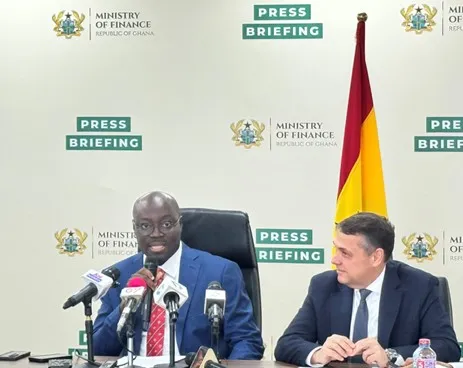
Finance Minister, Dr. Cassiel Ato Baah Forson, said the government was now focused on maintaining fiscal discipline and avoiding a return to the conditions that pushed Ghana into repeated IMF programmes. “We believe that we do not have a need to go for a bailout currently. But it does not mean we should lower our guard. It means that we don’t have to be complacent,” he said at a joint press briefing with IMF officials in Accra.
Dr. Forson said the new PCI framework would be reform-based, with semi-annual reviews and IMF board assessments designed to signal policy credibility to international investors and development partners. The minister credited the recovery to what he described as front-loaded fiscal consolidation, expenditure rationalisation and structural reforms implemented after the IMF programme was derailed at the end of 2024.
According to the Finance Ministry, this is evident as inflation has eased significantly, the cedi has strengthened, public debt ratios have declined and sovereign credit ratings have improved from restricted default status to ‘B’ with a positive outlook. Ghana’s gross international reserves also climbed to about US$14.5 billion by February 2026, equivalent to nearly six months of import cover.
The IMF said Ghana’s ECF-supported programme had delivered “substantial stabilisation gains” driven by fiscal reforms and debt restructuring progress. It cited sharply lower inflation, improved external buffers, stronger fiscal performance and renewed confidence in the cedi. The Fund also said growth exceeded expectations in 2025, supported by broad-based economic activity and historically high gold export earnings.
Still, IMF officials cautioned that the next phase of engagement would shift from stabilisation toward resilience-building and institutional reforms. “Stabilisation and resilience are two different things. The focus needs to be on building resilience going forward,” IMF Africa Department Division Chief, Ruben Atoyan, said during the briefing. Mr. Atoyan noted that the PCI would prioritise reforms aimed at strengthening fiscal institutions, improving governance in state-owned enterprises and limiting quasi-fiscal activities that could recreate fiscal vulnerabilities.
Pressing matters
The IMF statement identified contingent liabilities from state-owned enterprises and quasi-fiscal operations as key risks to Ghana’s fiscal outlook, particularly in the energy sector and at the central bank. The Fund specifically highlighted losses linked to the Bank of Ghana’s Domestic Gold Purchase Programme, saying greater transparency and safeguards were needed to protect the central bank’s balance sheet. “Efforts to protect the Bank of Ghana’s balance sheet from DGPP-related quasi-fiscal risks and budget recognition of future costs would help enhance accountability and oversight,” the IMF said.
The Fund also urged authorities to sustain reforms in the banking sector, noting progress in bank recapitalisation and the unwinding of regulatory forbearance introduced during the domestic debt exchange programme. However, it warned that vulnerabilities remained, particularly elevated non-performing loans and weaknesses in some state-owned financial institutions.
Reforms in energy and cocoa sectors
The PCI framework will also focus on reforms in Ghana’s energy and cocoa sectors, both of which have historically generated large fiscal pressures. In the energy sector, the IMF called for measures to reduce distribution and collection losses at the Electricity Company of Ghana, finalize private sector participation in electricity distribution and clear legacy arrears. For the cocoa sector, the Fund said deeper structural reforms were needed to ensure the long-term sustainability of Cocobod, including more frequent farmgate price adjustments and measures to streamline operational costs.
No rushing to international capital markets
Despite improving investor sentiment, Ghana said it was not rushing back to international capital markets. “We are not in a hurry to go back to the capital market,” Dr. Forson said, adding that the 2026 budget had not assumed any international market borrowing.
The IMF also indicated that Ghana’s financing outlook remained manageable through domestic markets under the agreed fiscal trajectory. “We believe that the resources are available,” Atoyan said, pointing to renewed confidence following the government’s successful return to the domestic Treasury bond market earlier this year.
At the same time, the IMF acknowledged growing interest from international investors seeking exposure to Ghana as macroeconomic conditions continue to improve. “In our discussions with international investors, we do see a lot of interest in exposure to Ghana. The good story of Ghana has been noticed,” Mr. Atoyan said
The PCI is expected to run through mid-2029 and will not involve IMF financing. Instead, it is designed to provide technical policy support, regular programme assessments and external validation of Ghana’s reform agenda. Government officials said the arrangement would support Ghana’s efforts to regain investment-grade credit ratings over the medium term, lower borrowing costs and attract long-term private capital flows.
The IMF nevertheless warned that maintaining the gains achieved under the ECF programme would depend on sustained policy discipline and stronger domestic institutions. “Avoiding past policy slippages, including recurring cycles of fiscal imbalances, rising debt, weak buffers and reform reversals, will be critical to safeguarding the hard-earned success,” the Fund said.
Post Views: 1
Discover more from The Business & Financial Times
Subscribe to get the latest posts sent to your email.