
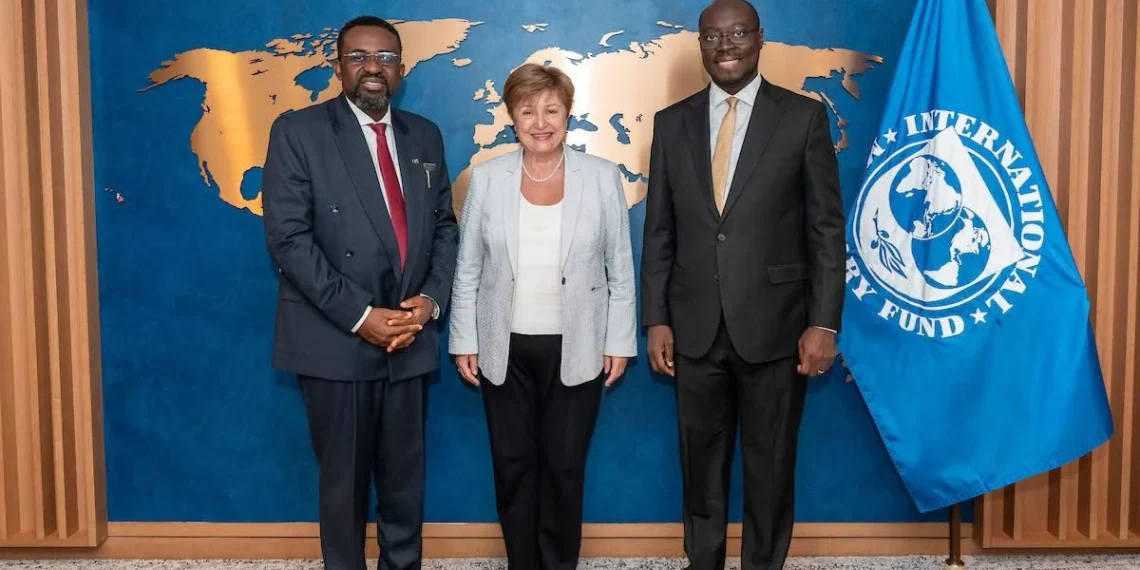
An International Monetary Fund (IMF) staff mission is expected in Accra from April 29, 2026, for Ghana’s sixth and final review under its Extended Credit Facility programme.
The mission is expected to stay in the country for about two weeks, with the first official engagements likely to begin on Thursday, April 30, 2026.
JOYBUSINESS understands this will be the final programme review as Ghana prepares to exit the IMF-supported programme in August 2026, after signing up to a three-year Extended Credit Facility arrangement.
Focus of the review
The mission will assess Ghana’s overall performance since the fifth review earlier this year and determine whether delayed targets and structural reforms have been met or are nearing completion.
On the fiscal front, attention is expected to focus on developments in the energy sector, particularly on structural reforms and debt management.
The team is also expected to examine government spending priorities, including whether adequate allocations have been made to critical areas, especially social protection.
A key part of the discussions will be the setting of prior actions required under the sixth review. These conditions will be necessary for Ghana to qualify for the final tranche of IMF support and complete the review successfully.
In the monetary and banking sector, the mission is expected to seek updates on progress in addressing legacy challenges within the financial system.
After engagements in Accra, the IMF team will return to Washington, D.C. with data for analysis. The report will then be circulated internally to IMF management and the Executive Board.
This process is expected to take about two to three weeks before a Board date is set, potentially paving the way for programme completion and exit in August 2026.
Technical extension to August 2026
Ghana’s programme was initially expected to end in May 2026, but the government and the IMF agreed on a technical extension to August 2026.
The IMF Resident Representative in Ghana, Dr Adrian Alter, recently told JOYBUSINESS that the extension was purely technical.
He explained that it was needed to allow sufficient time to complete the final review, including assessments of end-2025 and first-quarter 2026 data.
Dr Alter rejected suggestions that the extension was due to Ghana missing critical targets and requiring corrective measures.
Programme performance and outlook
Ghana’s 36-month Extended Credit Facility arrangement was approved in May 2023, with access of 303.8 per cent of quota, equivalent to SDR 2.2419 billion (about US$3 billion).
At the fifth review, the IMF said Ghana’s performance had been broadly satisfactory, despite delays in some structural reforms.
It noted that reforms were beginning to yield results following earlier policy slippages.
“Growth through September 2025 exceeded expectations, driven by strong services and agriculture,” the Fund said.
It also highlighted progress in financial sector stability, including ongoing bank recapitalisation efforts and steps involving key state-owned banks.
Analysts say Ghana’s macroeconomic position has improved, supported by reforms under the programme.
The Bank of Ghana’s reserves have also reached record levels, strengthening the country’s buffer against external shocks.
IMF growth and inflation outlook
In its latest Economic Outlook, the IMF maintained Ghana’s 2026 growth projection at 4.8 per cent, slightly above the 4.6 per cent forecast for Sub-Saharan Africa.
This comes against a revised global growth forecast of 3.1 per cent, reflecting rising energy costs and geopolitical tensions.
The Fund also projects Ghana’s inflation to decline to 7.9 per cent in 2026, slightly below government expectations, assuming current disinflation trends continue.
Inflation is expected to remain in single digits through 2026 and 2027.
IMF outlook on programme exit
Speaking to JOYBUSINESS in Washington, D.C., Abebe Aemro Selassie, Director of the IMF Africa Department, said the Fund remains optimistic about Ghana’s outlook as it prepares to exit the programme.
He said recent reforms have been encouraging but stressed the importance of maintaining fiscal discipline.
“It is critical to ensure a continued balance between addressing development needs and avoiding a return to the sustainability challenges that necessitated the programme,” he said.
He added that sustaining gains will depend largely on domestic policy choices after the programme ends.
Macroprudential reforms
An IMF technical assistance mission to the Bank of Ghana recently reviewed the country’s macroprudential policy framework to strengthen financial stability.
The mission assessed oversight structures, evaluated existing tools, and provided guidance on implementing buffers for systemic risks and major banks.
It recommended a dedicated macroprudential decision-making process, a formal strategy, improved communication, and more forward-looking risk monitoring tools to enhance financial system resilience.
DISCLAIMER: The Views, Comments, Opinions, Contributions and Statements made by Readers and Contributors on this platform do not necessarily represent the views or policy of Multimedia Group Limited.
DISCLAIMER: The Views, Comments, Opinions, Contributions and Statements made by Readers and Contributors on this platform do not necessarily represent the views or policy of Multimedia Group Limited.
Source link