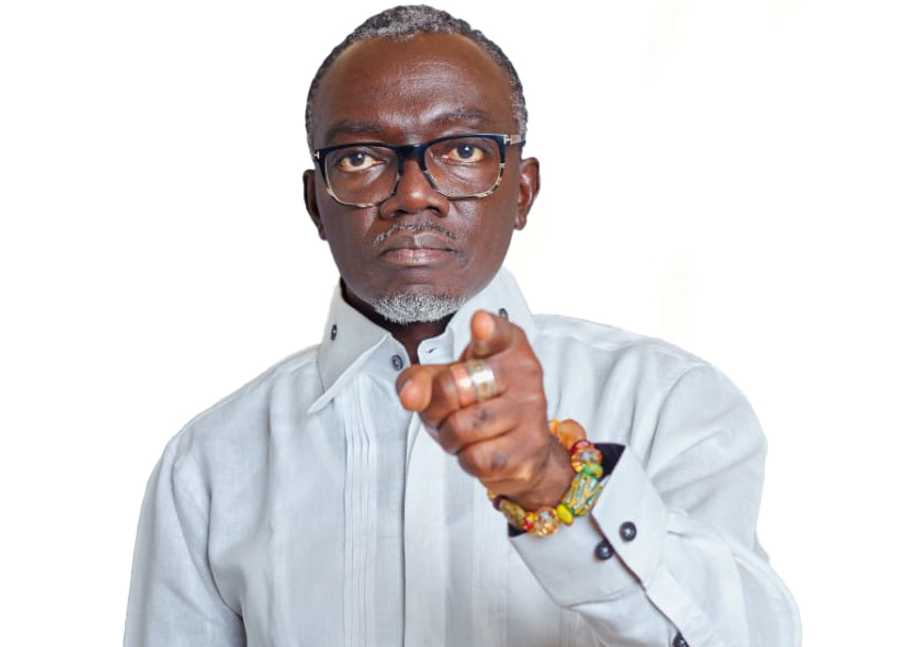
Ing. Prof. Douglas Boateng
Africa is not being held back by politics. It is being held back by politicking: the moment ambition for the nation is quietly replaced by ambition for the party.
It Begins the Moment We Stop Asking What Is Best for the Nation.
There is a distinction that Africa can no longer afford to blur. Politics, at its finest, is among humanity’s noblest pursuits: the art of organising society, balancing competing interests and improving citizens’ lives. Without it, democracies cannot function, and institutions lose their direction. Politics, properly practised, is indispensable to civilisation itself.
Politicking is something else entirely. It begins the moment political survival becomes more important than national survival, when defeating an opponent feels more urgent than solving a problem, when every policy is judged not by whether it improves lives but by who proposed it. Politics asks: what is best for the nation? Politicking asks: what is best for my side? That single substitution has cost Africa incalculable decades of development.
“Politics builds nations when it becomes a tool for solving problems. Politicking destroys nations when it becomes an end in itself.”
NyansaKasa — Words of Wisdom
Read that slowly. The same institution, the same parliament, the same election, the same political energy, can either build or destroy depending entirely on whether the people inside it have placed the nation above themselves. The instrument is neutral. The intention is everything.
The Elephants and The Grass
There is an old African proverb: when two elephants fight, it is the grass that suffers. Today, however, the elephants are no longer fighting over the grass. They are fighting while standing on the very future they claim to protect. That future belongs not to politicians. It belongs to the children quietly watching how adults conduct public life.
Roads do not distinguish between governing and opposition parties. Hospitals do not ask patients how they voted before providing treatment. Floodwaters do not pause to determine political affiliation before entering homes. Unemployment shows remarkable impartiality when denying young people opportunity. Yet public discourse increasingly encourages citizens to evaluate every national issue through a partisan lens before considering national interest. The result is a kind of collective sleepwalking, in which the nation quietly falls behind while everyone argues about who is to blame for the falling.
Germany rebuilt after the Second World War not because political differences vanished but because successive generations agreed that certain things lay above them. South Korea pursued industrialisation and education as national objectives, not temporary slogans. Singapore built institutions designed to outlive political personalities. Africa possesses the intelligence, the resources and the vision to achieve the same. What it too often lacks is the agreement that some national priorities are simply too consequential to become permanent political trophies.
“A nation builds its future not by agreeing on everything, but by agreeing on the things that matter most.”
NyansaKasa — Words of Wisdom
Education. Industrialisation. Agricultural transformation. Infrastructure. The fight against corruption. None of these should carry a party colour. They belong to the nation and to the generation that comes after it. The politician who makes them partisan has not won an argument. They have stolen from a future they will not live to answer for.
The Cathedral Nobody Finishes
One administration begins a major infrastructure project. The next delays it, reviews it or abandons it, not always because it lacks merit but because it carries the fingerprints of a predecessor. Years later, another government recommences the same project under a different name. Public resources are spent repeatedly while citizens continue waiting for services that should have been delivered years earlier.
National development should resemble the construction of a cathedral. Those who lay the foundations may never see the completed structure. Those who install the windows may never meet those who eventually worship there. Yet every generation contributes its part because the vision is larger than individual recognition. African politics too often produces the opposite: leaders who prefer ribbon-cutting to foundation-laying, announcements over completions, credit over continuity.
‘Too many leaders wish to cut ribbons. Too few are willing simply to lay foundations.’
“The tree does not refuse to provide shade because someone else planted it.”
NyansaKasa — Words of Wisdom
That is perhaps the most quietly devastating line in the politics of developing nations. The shade belongs to the citizen, not the party. The project belongs to the nation, not the administration that began it. Maturity in governance is not measured by how many things a government starts. It is measured by how many things a nation completes regardless of who receives the credit.
The Hidden Cost Of Permanent Politicking
Perhaps the most expensive consequence of excessive politicking cannot be measured in national budgets. It is measured in lost confidence. Investors rarely commit where national direction changes dramatically every electoral cycle. Young professionals lose hope when merit appears secondary to political affiliation. Businesses hesitate where long-term policies become temporary experiments. Nations rarely decline because of one catastrophic decision. They decline because countless ordinary decisions gradually place short-term political advantage above long-term national interest.
Trust, once eroded, is extraordinarily expensive to rebuild. We spend years attending investment conferences encouraging the world to believe in our economies while simultaneously giving our own citizens reasons to doubt the continuity of our national commitments. It resembles repainting the exterior of a house whose foundations are quietly cracking beneath the surface.
“Institutional failure does not usually arrive loudly. It accumulates quietly, one unasked question at a time, one uncomfortable truth left unspoken, one promise abandoned because politics became more important than posterity.”
NyansaKasa — Words of Wisdom
There is no single moment when a nation loses its way. There are only thousands of ordinary moments in which someone chose the politically convenient answer over the nationally necessary one. Compounded across years, those moments become a trajectory. And trajectories, unlike promises, are very difficult to reverse.
The Politics Worth Practicing
If Africa is to liberate itself from irrelevant politicking, it must first recognise that political culture rarely rises above civic culture. If citizens reward division, politics will be divisive. If citizens reward integrity, politics will become more principled. Long before politicians enter parliament, they pass through homes, schools and communities. The quality of tomorrow’s politics is being shaped today by parents, teachers and the examples that surround every young person deciding what public life is for.
The evidence that transformation is possible sits within Africa itself. Mauritius built strong institutions through policy continuity and disciplined governance. Ghana’s peaceful democratic transitions have earned international admiration. Botswana has illustrated, decade after decade, the compounding returns of prudent stewardship. Rwanda has demonstrated what determined institutional reform can accomplish within a generation. Africa is not short of success stories. It is short of replicating them consistently and building on them beyond individual political personalities.
Asia is investing in artificial intelligence. Europe is advancing green technologies. The Gulf states are diversifying beyond oil. Africa risks exhausting its intellectual energy debating personalities while others quietly build industries. History has little sympathy for continents that mistake endless political argument for measurable national progress.
“The difference between a nation that grows and one that stagnates is rarely the quality of its resources. It is almost always the quality of its decisions. And decisions are governance.”
NyansaKasa — Words of Wisdom
History will never ask how passionately we defended our political parties. It will ask what became of our nations. It will not remember how many rallies we attended. It will remember whether our children inherited stronger schools, more competitive industries and greater opportunities than those we ourselves received. Africa does not need less democracy. It needs more mature democracy. Not fewer disagreements. Greater agreement on the things that matter most. For the greatest victory in politics is not defeating an opponent. It is leaving behind a nation that future generations are proud to inherit.
About Ing. Professor Douglas Boateng
Ing. Professor Douglas Boateng is a pioneering international industrial, manufacturing, and production systems engineer, governance strategist, and Pan-African thought leader whose work continues to shape boardroom thinking, supply chain transformation, and industrialisation across both the continent and globally. As Africa’s first appointed Professor Extraordinaire in Supply Chain Management, he has consistently championed the integration of procurement, value chain, industrialisation strategy, and governance into national and continental development agendas, aligning practice with purpose and long-term impact. An International Chartered Director and Chartered Engineer, he has received numerous lifetime achievement awards and authored several authoritative books. He is also the scribe of the globally acclaimed and widely followed daily NyansaKasa (Words of Wisdom), which continues to inspire reflection, accountability, and purposeful living among audiences worldwide. His work is driven by a simple yet powerful belief: Africa’s transformation will not come from rhetoric but from deliberate action, strong institutions, and leaders willing to build for future generations.
DISCLAIMER: The Views, Comments, Opinions, Contributions and Statements made by Readers and Contributors on this platform do not necessarily represent the views or policy of Multimedia Group Limited.
DISCLAIMER: The Views, Comments, Opinions, Contributions and Statements made by Readers and Contributors on this platform do not necessarily represent the views or policy of Multimedia Group Limited.
Source link