
By Elizabeth PUNSU, Kumasi
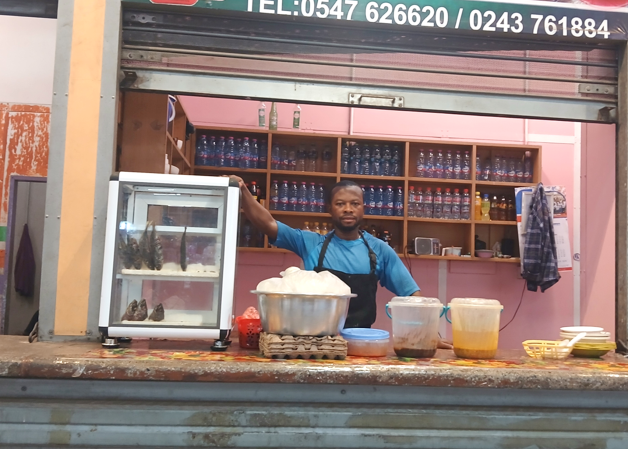
Food vendors operating at the Kejetia Market in Kumasi are calling on the Ghana Revenue Authority (GRA) to significantly reduce what they describe as an “excessive” income tax regime that is threatening their livelihoods.
Speaking in an interview with Business & Financial Times (B&FT), Chairman of the Ghana Traditional Caterers Association – Kejetia Branch, Emmanuel Kwarteng, said members are struggling to cope with annual income tax demands ranging between GH₵1,500 and GH₵3,000.
In addition to income taxes, the vendors say they are burdened with multiple levies, including business operating permits, sanitation fees, fumigation charges, waste collection and electricity bills. The cumulative effect, they argue, leaves little room for profit or reinvestment.
The association is, therefore, proposing a reduction in the income tax rate to between 0.5 percent and 1 percent of annual income, instead of the current 3 percent they claim is being enforced.
“We believe tax payments should reflect the capacity of the individual. If the system assumes figures traders cannot afford, it becomes punitive,” Mr. Kwarteng added.
According to him, although food operators are not opposed to paying taxes, the current rates imposed by the GRA are too high given the economic realities and operational costs within the market.
“We are willing to pay, but the amount being charged is too much. It is collapsing our businesses instead of helping them grow,” he said.
Mr. Kwarteng further highlighted what he described as unfair competition within the market. He explained that itinerant food vendors—who operate without permanent stalls—are not being taxed, yet compete directly with registered operators.
“These individuals sell in corners of the market or hawk their meals to traders. Because they do not have shops; they are not taxed, but they take away our customers,” he said.
He revealed that leaders of the association recently engaged officials at the GRA office to negotiate a reduction, but the discussions yielded no significant outcome.
Mr. Kwarteng is now urging government to intervene and work with the GRA to develop a more flexible tax model; one that could include reinvestment incentives for compliant taxpayers.
“We want a system where, after paying taxes, a portion is reinvested into our businesses. That will encourage compliance and growth,” he said.
Mr. Kwarteng warned that if the concerns of registered traders are not addressed – particularly regarding the taxation of informal competitors, the association may consider legal action.
“We cannot continue to operate under such conditions while others go untaxed. If nothing changes, we may be forced to go to court,” he cautioned.
Post Views: 1
Discover more from The Business & Financial Times
Subscribe to get the latest posts sent to your email.