Rugby Africa’s 40th Anniversary highlights the lasting impact of the Rugby Africa Charter through the legacy of Nelson Mandela.
As Rugby Africa marks its 40 years of existence, we celebrate the iconic late President of South Africa, Nelson Mandela, a great supporter of development and equality in sport on the continent.
Rugby is today one of the fastest-growing team sports in Africa, having witnessed a surge in participation over the past two decades.
It is fitting that it has been two decades since the Rugby Africa Charter was signed in the presence of the great Mandela on 23 July 2005 in Johannesburg, South Africa.
The words of the Charter, written nearly 21 years ago, aptly describe the good health of African rugby today.
It reads:
We, the undersigned, hereby confirm our commitment to realising the potential of African rugby…
THAT, on this day, the creation of the African Leopards Rugby Union in Africa will develop its own heroes and heroines;
THAT developing rugby nations throughout Africa will be assisted with adequate human and physical resources to develop their playing potential at all levels;
THAT every African boy and girl may soon have the opportunity to play the sport of rugby football.
Also fitting is that two of the men who signed the Charter are prominent figures in rugby, as well as in nationalism and the fight for equality and justice.
The late Makhenkesi Stofile, then South Africa’s Minister of Sport, was not only a renowned anti-apartheid activist. He played scrum-half and wing for the Fort Hare First XV in the 1970s, captaining the famed South African black university team as well as provincial side Border in senior rugby.
As for Mandela, he was of course an eminent figure in rugby, using the previously racially divided sport as a unifying factor for his previously divided country.
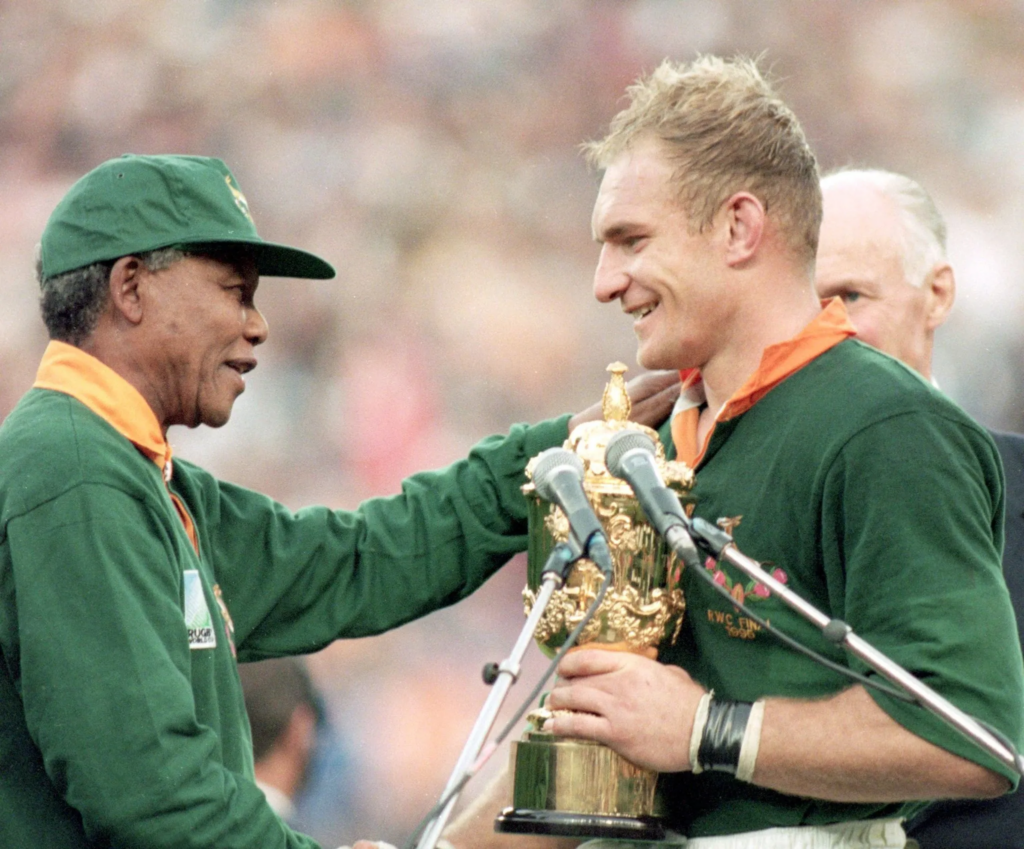
Ten years before witnessing the signing of the Rugby Africa Charter – and in the same city of Johannesburg – Mandela famously handed over the Rugby World Cup trophy to the triumphant Springboks captain François Pienaar at Ellis Park on 24 June 1995, after South Africa defeated New Zealand in the final.
Since that first World Cup glory for South Africa in 1995, the Boks added another trophy in Mandela’s lifetime, winning the Webb Ellis Cup in France in 2007.
The Springboks have since sealed two more titles after Mandela’s passing in 2013, being crowned champions twice in a row in 2019 and 2023. With four titles under their belts, the Boks have now eclipsed New Zealand (three titles) as the most successful team in the history of the Rugby World Cup.
By being inscribed in the World Rugby Hall of Fame in 2015, Mandela became the first black South African to be honoured in this way by the global governing body of the sport, and only the third black African to be inducted after the trailblazing Zimbabwean brothers Richard and Kennedy Tsimba, who were listed in 2012.
Zimbabwe talismanic centre Richard Tsimba, who died in a car crash in Harare in 2000 at the age of 34, was the first black player to represent Zimbabwe in rugby.
The “Black Diamond”, as he was affectionately nicknamed, marked his international debut with two scintillating tries in a narrow 21–20 defeat to Romania during the Sables’ opening game of the inaugural Rugby World Cup in New Zealand in 1987.
He also played in the following World Cup in Europe in 1991, the last time Zimbabwe appeared in the tournament.
Richard’s younger brother, Kennedy – a record-breaking legend of first-class rugby in South Africa – went on to become the first black captain of Zimbabwe’s rugby team when he was appointed in 1998.
In welcoming President Mandela to the World Rugby Hall of Fame, the younger Tsimba said in an interview in 2015:
“I was doing TV work for SABC during the (2015) World Cup a few months ago when the news came through that Nelson Mandela had been inducted. I was asked how it felt to be in such company, alongside an icon like Nelson Mandela, and him becoming only the third black person on the list. I said, ‘At least a brother has come; we were feeling lonely.’ Given two options, I would choose to be inducted into the Hall of Fame over winning the World Cup. It’s only for the greats. To have Nelson Mandela there epitomises the height of the achievement.”
Rugby Africa honours you, Ntate Mandela. Forever in our hearts.
DISCLAIMER: The Views, Comments, Opinions, Contributions and Statements made by Readers and Contributors on this platform do not necessarily represent the views or policy of Multimedia Group Limited.
DISCLAIMER: The Views, Comments, Opinions, Contributions and Statements made by Readers and Contributors on this platform do not necessarily represent the views or policy of Multimedia Group Limited.
Source link