


By Juliet ETEFE
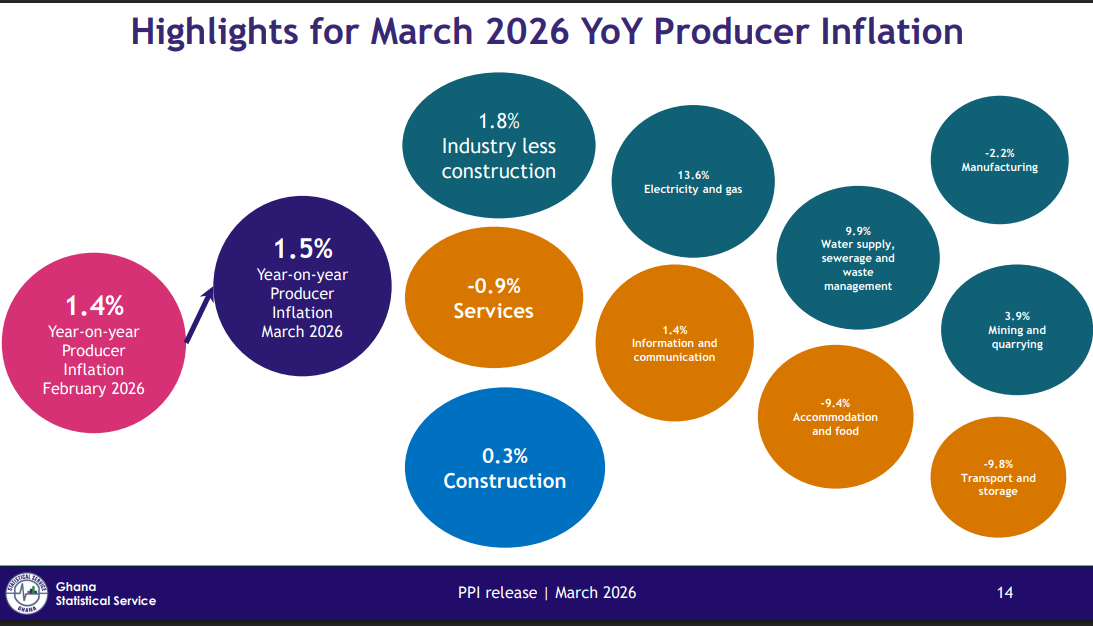
Producer price inflation (PPI) edged up marginally to 1.5 percent year-on-year in March 2026 from 1.4 percent for February, reflecting subdued price pressures at the factory gate despite varied sectoral trends, data from the Ghana Statistical Service (GSS) have shown.
On a month-on-month basis, inflation slowed to 0.7 percent from 1.3 percent in February, indicating a deceleration in the pace of short-term price increases.
The Producer Price Index (PPI) – which measures the average change over time in prices received by domestic producers – rose to 280.3 in March 2026, up from 278.4 in February and 276.1 for March 2025.
This translates into a 1.5 percent increase in ex-factory prices over the 12-month period, 0.1 percentage point higher than the February rate but 22.9 percentage points lower than the level recorded in March 2025 – underscoring a sharp easing in producer inflation over the past year.
Mixed sector performance
At the sector level, performance remained mixed across industry, construction and services.
The Industrial Producer Price Inflation (I-PPI), which excludes construction and carries the largest weight in the index, recorded 1.8 percent year-on-year… unchanged from February. On a monthly basis, the sector’s inflation rose by 0.6 percent.
Within the industrial sector, mining and quarrying – the largest component with a weight of 43.7 percent – recorded inflation of 3.9 percent, down slightly from 4.1 percent in February. Manufacturing remained in deflation at -2.2 percent, though this marked an improvement from -2.9 percent previously.
Electricity and gas continued to record the highest inflation rate at 13.6 percent, albeit down from 14.3 percent, while water supply, sewerage and waste management remained unchanged at 9.9 percent.

In the construction sector, producer inflation eased to 0.3 percent year-on-year from 0.4 percent in February. Month-on-month, prices in the sector increased marginally by 0.1 percent.
A breakdown of the construction subsector shows civil engineering recording inflation of 3.8 percent while specialised construction activities stood at 4.7 percent. However, construction of buildings remained in deflation at -7.5 percent.
The services sector remained in deflation at -0.9 percent year-on-year, though prices inched up by 0.1 percent on a monthly basis.
Within services, transport and storage recorded a deeper decline to -9.8 percent from -8.6 percent while accommodation and food services fell further to -9.4 percent from -8.4 percent. Information and communication however posted positive inflation of 1.4 percent.
Recommendation
The GSS noted that businesses – particularly those reliant on manufactured inputs – may take advantage of favourable pricing conditions to secure medium-term supply agreements, while remaining cautious on adjusting prices in the face of emerging short-term pressures.
It further indicated that sustained fuel supply stability and improved logistics efficiency will be critical to maintaining declining transport costs and enhancing competitiveness, while households may reorient consumption toward goods and services with more stable prices to preserve real incomes.
Post Views: 1
Discover more from The Business & Financial Times
Subscribe to get the latest posts sent to your email.