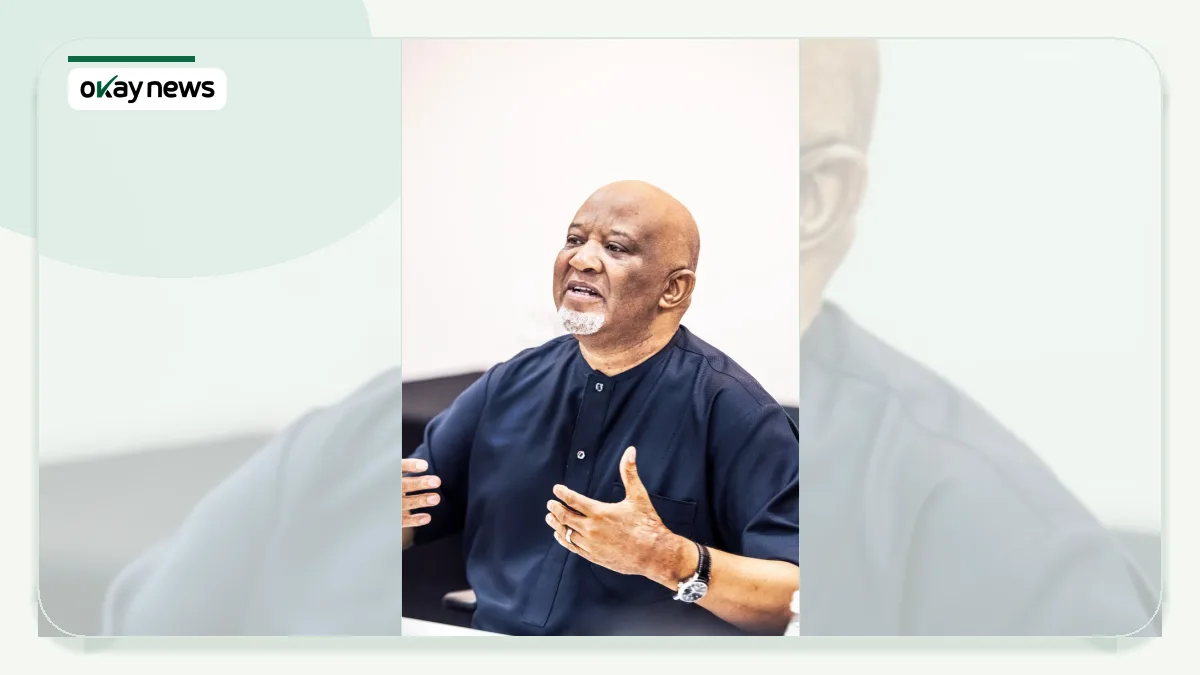
Chairman of MTN Group, Mcebisi Jonas, has delivered a strong criticism of South Africa’s growing anti-foreigner sentiment, arguing that xenophobic rhetoric masks deeper failures of governance and diverts attention from the country’s unresolved economic and social challenges.
Speaking during the funeral service of Zimbabwean-born activist and public servant Thokozani Damasane, Jonas said foreign nationals had become convenient scapegoats for problems rooted in state failure, warning that such narratives threaten South Africa’s future and its relationship with the rest of the African continent.
Okay News reports that the speech has attracted widespread attention across South African civil society, with many describing it as one of the clearest interventions by a leading business executive on recurring xenophobic tensions that have periodically strained diplomatic and commercial ties across Africa.
Reflecting on Damasane’s life, Jonas challenged the notion that national identity should define belonging.
“I was thinking, what is home to Damasane?” he told mourners.
“Because I understand, and I understood very early in life, that home is where humanity is. Home is about humanness. It is about the good of humanity and striving for the good of humanity.”
Damasane, who was born and educated in Zimbabwe before relocating to South Africa after apartheid, dedicated much of his career to public service and civic engagement in his adopted country.
Jonas praised his commitment to South Africa despite arriving as an outsider.
“He immersed himself deeply into the struggles, into the pains of South Africans, and he became one of us,” Jonas said.
“In Damasane’s strength, our strength as South Africa and South Africans is reflected. And in his weaknesses, our own weaknesses are reflected.”
Turning to the country’s worsening anti-immigrant rhetoric, Jonas rejected claims that expelling foreign nationals would resolve South Africa’s socioeconomic problems.
“Foreigners can leave tomorrow, inequality will be with us,” he said.
“Foreigners will leave tomorrow, unemployment will be with us. Foreigners will leave tomorrow, our police will remain corrupt. Foreigners will leave tomorrow, our politicians will still be concerned with one thing: being elected and re-elected.”
According to Jonas, the real crisis lies in weak institutions rather than migration.
“The problem is the failure of the state. The state doesn’t manage immigration. It doesn’t manage its borders. It doesn’t enforce law enforcement. It doesn’t manage education. What are you expecting?”
He warned that these governance failures create opportunities for politicians to exploit public frustration.
“When people feel the burn, they become vulnerable to politicians whose sole purpose is to be elected and re-elected. Some of them have no credibility whatsoever. But they lead marches and tell our people that the problem is not us, it is foreigners.”
Jonas also challenged ethnic nationalism, describing tribal divisions as a colonial construct that continues to influence politics across Africa.
“The tribe is a product of colonial powers,” he said.
“You would notice that it is so dominant in areas where the English conquered, because they used something called the principle of indirect rule.”
He argued that the same mindset now fuels discrimination and violence.
“You would see in the streets, it’s no longer about whether you are from South Africa or not from South Africa. It’s about the tribe, it’s about who you are, you are not like us, and you are different, and therefore, we have to persecute you. Something fundamental has been lost in our country. Something fundamental has been lost in our nation.”
The MTN chairman further criticised liberation movements for sustaining ethnic divisions for political advantage.
“Liberation movements still sustain this thing of tribes, Zulu and Xhosa, and we sustain this thing as if it is real,” he said.
“It is in our heads. We’re creating it because it makes us feel big. Identity politics, we must banish them in our country. Ethno-nationalism is something that in this country we must banish.”
Jonas recounted a conversation Damasane once had with a young South African who questioned the presence of foreign nationals in the country.
“Damasane said to this guy: Just wait fifteen or twenty years. You will also want to leave your country.”
Jonas said those words have become increasingly relevant as many South Africans grapple with unemployment, corruption and inequality.
“As I stand up today, I look at South Africa. The level of oppression and inequality, the level of exclusion of our people, the level of corruption, the betrayal of the dream of liberation, those words of Damasane ring very loud in my ears.”
In his closing remarks, Jonas called for renewed African solidarity, saying South Africa’s prosperity is inseparable from that of the continent.
“We are a nation embedded in Africa. And without Africa, our growth as a country, economically, our fortune is intertwined with the growth of Africa. South Africa is nothing without Africa. And Africa is nothing without South Africa.”
He also urged Africans to reject prejudice based on nationality or ethnicity.
“We cannot judge people by their origin,” he said.
“We cannot determine the legal status of people by their origin.”
Jonas concluded by invoking anti-colonial thinker Frantz Fanon, comparing Damasane’s commitment to South Africa with Fanon’s dedication to Algeria despite being born elsewhere.
Quoting Fanon, he said: “Each generation must, out of relative obscurity, discover its mission, fulfil it, or betray it.”
“Damasane understood the mission. And he did not betray it.”
DISCLAIMER: The Views, Comments, Opinions, Contributions and Statements made by Readers and Contributors on this platform do not necessarily represent the views or policy of Multimedia Group Limited.
DISCLAIMER: The Views, Comments, Opinions, Contributions and Statements made by Readers and Contributors on this platform do not necessarily represent the views or policy of Multimedia Group Limited.