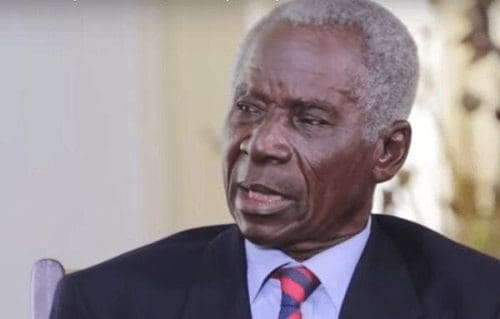

Brigadier General (Rtd) Joseph Nunoo Mensah believes Ghana’s biggest problem today is the loss of discipline and strong upbringing, arguing that society in the past played a major role in shaping children into responsible adults.
Speaking on The KSM Show monitored by MyNewsGh, the former Chief of Defence Staff and National Security Advisor reflected on how communal responsibility for child development has eroded over time, with consequences for national character.
“In those days, society managed us,” he said. “Everybody believed it was their duty to correct you.”
The 86 year old retired general recalled how teachers and elders were strict, sometimes harsh, but committed to leading by example. He described an era when authority figures shared the hardships they imposed on those under their supervision rather than exempting themselves.
“Our headmaster would stand in the rain with us,” he said. “He was not in an air conditioned car. So why would you complain?”
Nunoo Mensah admitted that discipline in the past was sometimes crude but maintained it helped build strong character. He argued that children lack the maturity to discern right from wrong without firm guidance.
“As a child, you don’t know your right from your left,” he said. “You need to be guided.”
The former military officer placed responsibility squarely on his generation for making life too easy for their children. He suggested that in trying to spare their offspring from hardship, parents inadvertently weakened their resilience and moral foundation.
“We went through hell,” he said. “We didn’t want our children to suffer like us, so we made things soft. That was wrong.”
According to Nunoo Mensah, contemporary society has inverted priorities, punishing those who attempt to enforce discipline rather than supporting corrective measures. He cited the example of teachers facing legal consequences for disciplining students.
“Today, if a teacher disciplines a child, the parent will take him to court,” he said. “Things are getting worse, not better.”
The retired general also criticized modern leadership for focusing on luxury instead of service during the same interview. He said leaders today care too much about material things and too little about society.
“This house you are sitting in, I built it with less than 50 pounds,” he said. “People won’t believe it, but it’s true.”
Nunoo Mensah said during his time in public service, he avoided luxury even when it was available. He questioned the necessity of extravagant expenditures when more modest options could serve the same purpose.
“Why should I buy a Land Cruiser when my old car could still work?” he asked, contrasting his approach with contemporary officials who he suggested prioritize personal comfort over fiscal responsibility.
The former military leader said honesty was deeply rooted in his upbringing, and that foundation shaped how he handled public funds throughout his career. He described rejecting payments that exceeded what he considered appropriate compensation.
“If money was more than I deserved, I rejected it,” he said. “Today, people will even ask for more.”
Nunoo Mensah also spoke about personally funding schools, boreholes and facilities without seeking praise or political gain. He framed these contributions as natural expressions of concern for community welfare rather than acts deserving special recognition.
“I never stole from anyone,” he said. “I did it because I wanted a better society.”
According to the retired general, leadership should be about caring for people rather than chasing wealth. He suggested that indifference to poverty indicates a fundamental moral deficiency in those occupying positions of authority.
“If you see poverty and it doesn’t disturb you, then something is wrong,” he added.
Nunoo Mensah’s comments reflect longstanding concerns he has voiced about Ghana’s trajectory. Born in Winneba in 1939, he enlisted with the Ghana Military Academy in 1961 and served as Chief of Defence Staff under the Armed Forces Revolutionary Council government in 1979.
He was retired in November 1979 by the People’s National Party government of Dr Hilla Limann but later became a member of the Provisional National Defence Council government that overthrew Limann’s administration in 1981. He subsequently served as National Security Advisor to the late President John Evans Atta Mills.
Throughout his post military career, Nunoo Mensah has remained an outspoken commentator on national affairs. In February 2024, he expressed deep concern about economic hardships facing Ghanaians, stating he had never been depressed in his life until witnessing the current situation.
“I have never been depressed in my life. I took care of myself in school. People are suffering, others are hungry, and I ask what the hell is going on in this country that we can’t feed ourselves in Ghana,” he lamented during an interview on Neat FM.
His recent comments about discipline and leadership arrive at a moment when debates about parenting methods, educational standards and governance ethics dominate public discourse in Ghana. The tension between traditional strict discipline and contemporary child development approaches remains contentious.
Child development experts generally acknowledge that while structure and boundaries are essential for healthy development, research increasingly shows that positive reinforcement, emotional support and age appropriate communication produce better long term outcomes than harsh punitive measures. Studies indicate that children raised with warmth alongside clear expectations tend to develop stronger self regulation and moral reasoning.
However, many Ghanaians, particularly older generations, share Nunoo Mensah’s view that excessive permissiveness has contributed to declining respect for authority and weakening social cohesion. They point to increased youth delinquency, disrespect for elders and erosion of communal values as evidence that softer parenting approaches have failed.
The debate about leadership ethics similarly divides opinion. While few would dispute that integrity should guide public service, disagreement persists about what constitutes reasonable compensation for officials and whether Ghana’s political culture has fundamentally deteriorated or simply reflects longstanding patterns now receiving greater scrutiny.
Nunoo Mensah’s assertion that he built his house with less than 50 pounds, while literally true given inflation and currency devaluation over decades, underscores his broader point about living modestly regardless of access to greater resources. His example challenges contemporary officials who justify lavish lifestyles as appropriate to their positions.
The retired general’s call for leaders to be disturbed by poverty resonates with citizens frustrated by displays of wealth from officials while many Ghanaians struggle with basic needs. His suggestion that indifference to suffering indicates moral failure directly challenges those who view leadership primarily as personal advancement rather than public service.
Whether Nunoo Mensah’s prescriptions for restoring discipline and ethical leadership are practical in contemporary Ghana remains debated. Critics might argue that nostalgia for harsher times overlooks the genuine suffering that strict discipline often inflicted, particularly on vulnerable children.
Others might question whether returning to older authoritarian models represents genuine progress or merely exchange of one set of problems for another. They might suggest that developing positive discipline approaches requires patience and skill building rather than simply reverting to punitive methods.
Regarding leadership, implementing the selflessness Nunoo Mensah advocates would require systemic changes to how political office is viewed, compensated and regulated. It would demand cultural shifts in how Ghanaians define success and what they expect from those who govern them.
For now, the veteran statesman’s reflections serve as a challenge to both parents and leaders to examine whether current practices truly serve Ghana’s long term interests or merely satisfy short term comfort at the expense of building strong character and effective institutions.