
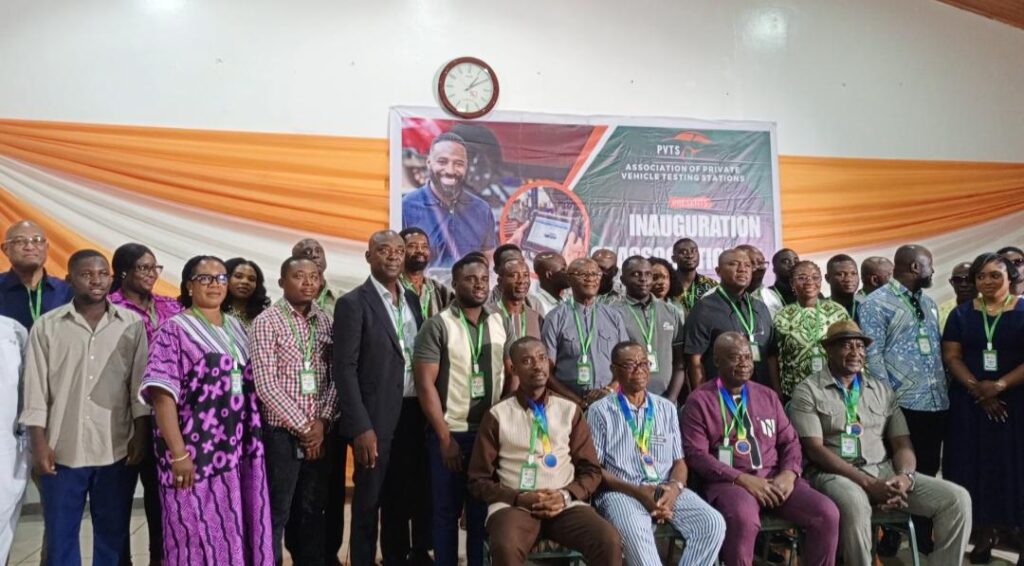
The Association of Ghana Private Vehicle Testing Stations (AGPVTS) is calling on the government to adopt machine-based vehicle testing nationwide and review what it describes as an unfair revenue-sharing model that is threatening the survival of private testing centres.
Chairman of the Association, Robert Adomako, says the Driver and Vehicle Licensing Authority (DVLA) must urgently phase out manual inspections in favour of automated systems to improve road safety and reduce road crashes.
He appealed the inauguration of the association in Kumasi, describing machine-based testing as the most reliable method for assessing vehicle roadworthiness.
“Our primary goal is to curb road accidents by ensuring only roadworthy vehicles operate on our roads. We therefore call on the government to transition from manual inspections to machine-based testing and inspection,” Mr Adomako said.
He argued that human-led inspections are increasingly unreliable and open to inconsistencies and compromise.
“We cannot continue to rely on human judgment alone when technology gives us precision. Manual inspections are prone to inconsistency, fatigue, and in some cases, compromise. These gaps put lives at risk,” he added.
The AGPVTS says it is also tightening internal discipline among members, warning against the issuance of roadworthy certificates to unfit vehicles, which it says undermines road safety efforts.
However, beyond safety concerns, members of the association say many Private Vehicle Testing Stations (PVTS) are struggling financially due to what they describe as an imbalanced revenue-sharing arrangement.
One member, Sampson Asiamah, explained that the bulk of fees collected from roadworthy certificates does not remain with the stations that conduct the actual inspections.
“The current arrangement leaves testing stations with very little to cover operational costs. At present, the roadworthy fee for a two-wheeled motorcycle is ¢104.25. From this amount, PVTS receives a share of ¢11, out of which we must pay 10% to the DVLA and also cover VAT. Many stations are struggling to stay afloat,” he said.
He further argued that recent increases in roadworthy charges by the Driver and Vehicle Licensing Authority have not been matched with adjustments to the portion retained by private stations.
“That is unfair. If charges are reviewed upward, the stations doing the actual testing should also see a corresponding adjustment in their service fees,” he added.
The association is therefore calling for a comprehensive review of the revenue-sharing structure to ensure financial sustainability for private operators while maintaining safety standards.
The DVLA introduced private participation in vehicle testing under the Driver and Vehicle Licensing Authority (Private Vehicle Testing Station) Regulation, 2012 (L.I. 2192), as part of efforts to decongest public testing centres and improve efficiency in vehicle inspections nationwide.
DISCLAIMER: The Views, Comments, Opinions, Contributions and Statements made by Readers and Contributors on this platform do not necessarily represent the views or policy of Multimedia Group Limited.
DISCLAIMER: The Views, Comments, Opinions, Contributions and Statements made by Readers and Contributors on this platform do not necessarily represent the views or policy of Multimedia Group Limited.
Source link