
Felix Xedra Agbenyo, Ho
Kete from any part of Ghana remains a cornerstone of the nation’s legacy and its primary diplomatic gift over the decades. The trailblazer for this tradition was Ghana’s first president, Dr. Kwame Nkrumah. The fire he lit continues to burn brightly today. His wife, Fathia, received her own distinction with a pattern named in her honor. Kete remained the ceremonial attire of choice for Dr. Nkrumah during African and Ghanaian summits; he frequently wore kete during his parliamentary appearances. In fact, kete was the fabric of choice during the declaration of Ghana’s independence in 1957 at the Old Polo Grounds in Accra.
Former President, Jerry John Rawlings, beyond his frequent ceremonial use of the fabric, famously met former U.S. President Bill Clinton wearing a kete product—a smock over long sleeves—during Clinton’s official working visit to Accra on Monday, March 23, 1998.
Former President John Agyekum Kufuor, the late Professor John Evans Atta Mills, and Former President Nana Addo Dankwa Akufo-Addo were all sworn into office wearing this heritage cloth. Similarly, the current president, John Dramani Mahama, was sworn into office a year ago in an attire featuring kete strips.
Regional distinctions in weaving
The art of kete weaving in Ghana is concentrated in three broad zones: the North, Ashanti (Bonwire), and the Volta Region. There are three distinct qualities that differentiate these regions. Ashanti Bonwire kente is typically lighter and more brightly colored than both Northern and Volta kete (popularly called E3e kete). While kete from the Volta Region is heavier than Bonwire kente, fabric from the North is the heaviest of the three. Both Northern and E3e kete share the common qualities of significant weight and “cold” (subdued) colors.

Although kete is woven across the Volta Region, Agortime-Kpetoe has become particularly prominent. The people of Agortime consolidated their ownership of the craft by instituting a festival four decades ago to celebrate the fabric. The Agbamevor-
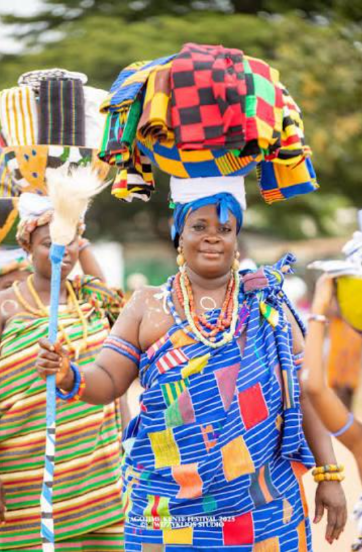
za is now the largest gathering and exhibition of kete fabric in Ghana. It is a showcase of all colors and shades, not just from the Volta Region, but from across the country. The Agbamevor festival celebrates the “treasure fabric,” where the cloth serves as a symbol of wealth and social standing. Among the Ewes, the specific type of kete one wears in public announces their status in society.
Patterns and nomenclature
Ewe kete names are derived from their patterns, textures, and yarn types. Many are named after significant figures, such as “Fathia Nkrumah”. Patterns are categorized by the creativity demanded of the artist. Examples from “Agbozume” include: Afevorwo (Social cloths): “Ehianega” (It demands cash/the lover craves it); “Atsushidomado” (My rival takes the lead and I follow); “Fiawoyome” (Walking behind kings); “Achimota”; “Agamagbale” (Chameleon skin); “Damlobedzi” (Snake resting on grass); “Easter Sunday; and “Glass”. “Kavorwo (Pure cotton fabrics requiring high creativity): “Fiazikpi (Kings’ or ancestral throne); “Oath Sword” (now also called “Obama” after former U.S. President Barack Obama); “Takpekpeleanloga” (There is a meeting at Anloga); “Hlormade Kotoku” (The hedgehog in a sack); and “Bullet”.
In total, there are approximately 300 named Ewe kete patterns.
Global outreach and local challenges
Many have promoted kete through trade, research, and education. Some merchants trade internationally, while others host researchers or teach the art in schools across America and Europe. However, despite this global relevance, local investment lags. While governments have supported the industry in Bonwire and the North, the same cannot be said for Agortime-Kpetoe, Agbozume, and surrounding areas. For years, authorities have offered little more than empty promises. Today, weavers struggle to buy yarn and pigments.
In Kpetoe and Agbokorfe, the structures used for weaving are often unsuitable for such a prestigious craft. One notable exception is the private center owned by Mr. Thompson Yao Avornyotse in Agbokorfe, which is perhaps the largest of its kind. Mr. Avornyotse has been a titan in the industry since 1992 and was recognized by UNESCO in 1999 for his contributions.
The first significant government attention toward E3e kete occurred in 1994, under Hon. Dan Abodakpi, then Minister for Trade and Industry. This preceded the official launch of the Agbamevor festival in 1995. Despite these milestones and a past attempt by the European Union to build a gallery, the industry lacks sustained state support.
The human element: Masters and apprentices
Agbozume and Agortime remain the hubs of the craft, followed by Tafi, Ando, Tornu, Denu, Anlo–Afiadenyigba, Dzodze, Klikor, and Aflao. Despite its fame, Agbozume lacks a public weaving center. Providing a modest, modern administrative and weaving facility would be a small investment compared to the cultural and economic revenue it would generate.
Consider the story of Moses Ahiavorri from Agbozume. Born into a family of weavers, he began learning at age 6 and was weaving independently by age 12. His craft paid for his education and even took him to Nigeria at age 18 to teach the Agbozume standard. Now 27, kete remains his primary occupation. Many others have similarly funded their secondary and tertiary educations through this art, or through trading in yarns and pigments.

Economic impact and international recognition
In 2025, kete exports to the USA and Europe reached a staggering $41 million, driven largely by the African Diaspora and the CEANA conventions. Internally, the trade is even more robust. In the West African market, Ewe Agbozume kete is highly prized in Côte d’Ivoire and Nigeria, despite competition from lower-grade fabrics like “kpero” and “nuvi”.
The cultural impact is undeniable. At international gatherings, the sight of men with kete thrown over the left shoulder and women in kete “slit and kaba” rivals the finest art in the world. In a landmark achievement, UNESCO Ghana secured international protection for the fabric. In December 2024, Ewe Kete was listed as an Intangible Cultural Heritage of Humanity. Furthermore, in September 2025, it received Geographic Indication (GI) status. This means that legally, only hand-loomed production from identified hubs like Agortime, Bonwire, and Sanko Wanoo can be marketed as authentic kente or kete.
The way forward
Despite these gains, the youth are drifting away from the looms toward commercial motor riding (okada) for quicker cash, citing high yarn costs and unstable markets. While UNESCO provides the framework, the responsibility for marketing and infrastructure falls on the Ghana Tourism Development Company, the Ghana Tourism Authority, and the Ministry of Tourism, Arts, and Culture.
To prevent the decline of this legacy, The Business & Financial Times proposes that the Ministry of Trade and Industry, the Ministry of Tourism, and the Ministry of Youth collaborate to provide modern, fully furnished Kete Art Centers in weaving hubs, establish a formal off-taker system to buy fabrics directly from weavers, regulate pricing and provide a credit system for artisans, and offer motivational packages to encourage the youth to sustain this $15 million-a-year industry.
Where 24H+ policy provides a tourism leverage & the away forward
The 24H+ policy has provided the direct leverage for Ewe kete (handwoven textiles) as a tourism business is the SHOW24 sub-programme to collaborate in promoting and fine tuning the kete/kente art and business. The policy focused on culture and tourism is SHOW24, which positions culture as an economic value chain, not just heritage, targets tourism, creative arts and identity-based exports but where explicitly E3e kete and its fashions that comes with it as one of its key cultural value chains.
The key leverage areas are where Ewe kete/’kente is classified as a cultural identity, as a weaving business of some communities in Ghana and fashioning it into forms, live weaving demonstrations for tourists, cultural performances where kete is worn (especially Ewe festivals) and onboard cruise exhibitions and sales at the international level.
The 24H+ system promotes round-the-clock activity, kete businesses can be supported to operate both daytime and night to offer the convenience for production & tourist visits, evening/night and cultural shows, fashion showcases and craft markets.
The community arts hub under this policy is obviously an undeniable leverage, where local weavers in the Bonwire, Agortime, Agbozume, Tafi, Anlo–Afiadenyigba, Aflao, the north as one etc become part of tourism circuits.
Post Views: 1
Discover more from The Business & Financial Times
Subscribe to get the latest posts sent to your email.